












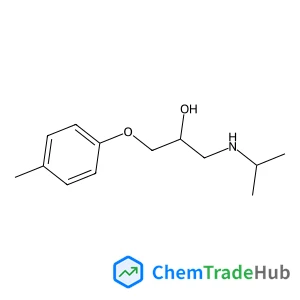
1-(4-Methylphenoxy)-3-(propan-2-ylamino)propan-2-ol
CAS Number:
5790-46-5
Molecular Formula:
C13H21NO2
Lorraine M. Caldwell, Anthony F. Hill, Anthony C. Willis
The reaction of mesityl isoselenocyanate with molybdenum alkylidynes provides the first structurally characterised examples of mononuclear selenoaroyl complexes, which may also be obtained directly from elemental selenium in the presence of a catalytic amount of mesityl isocyanide.
Zhen-Kai Lin, Jing-Syu Lin, Zih-Huei Chen, Hung-Wei Cheng, Wei-Chen Huang
DOI: 10.1039/D3TB02715E
Varvara Lagunova, Evgeny Filatov, Pavel Plyusnin, Natalia Kuratieva, Sergey Korenev
DOI: 10.1039/D3NJ05311C
Lei Li, Tianshu Wang, Yuting Zhong, Ruyi Li, Wei Deng, Xuanyu Xiao, Yuanyuan Xu, Jieyu Zhang, Xuefeng Hu, Yunbing Wang
DOI: 10.1039/D3TB02648E
Xuewei Zhang, Jing Ye, Zhigang Ni, Xuerui Yang, Yuefei Ji, Jean-Marc Chovelon
DOI: 10.1039/D3NJ05471C
DOI: 10.1039/D3TB02491A
Hongmei Liu, Jianxin Ye, Hui Hu, Yuheng Song, Huijun Qiang, Junjun Wang, Lei Zhou, Xuefen Wang, Meifang Zhu
DOI: 10.1039/D3TB02453A
Chunhua Quan, Lei Wang
DOI: 10.1039/D3TB02620E
Xi-Rui Wang, Ke-Lan Xu, Pan Hu, You-Ping Tian, Hui-Juan Wang, Ying Zhou
DOI: 10.1039/D3NJ05076A
Sonia Iranpour, Mahdieh Dayyani
DOI: 10.1039/D3TB02571C
4-(4-tert-Butylphenyl)-1H-pyrazol-3-amine finds applications in various industri...
H3TATAB is used in the pharmaceutical industry for the synthesis of certain orga...
1-Ethyl-3-fluorobenzene (CAS: 696-39-9) is primarily used as a precursor in the ...
1-(tert-Butoxycarbonyl)-4-(4-methoxyphenyl)pyrrolidine-3-carboxylic acid is prim...
1-Cyclobutyl-4-piperidinone (CAS: 359880-05-0) is a colorless or white crystalli...
Pyridine-2,6-dicarboxylic acid mono-tert-butyl ester (CAS: 575433-76-0) is a che...
The market for 2,3-Difluorophenylalanine (CAS: 236754-62-4) is growing with incr...
(2-Hydroxy-1-naphthyl)boronic acid can be synthesized through the reduction of 2...
This compound is a crystalline solid with a molecular weight of approximately 52...
While 5,7-Dihydroxy-4-oxo-2-(3,4,5-trihydroxyphenyl)-4H-chromen-3-yl beta-D-gluc...

ChemComm publishes urgent research which is of outstanding significance and interest to experts in the field, while also appealing to the journal’s broad chemistry readership. Our communication format is ideally suited to short, urgent studies that are of such importance that they require accelerated publication. Our scope covers all topics in chemistry, and research at the interface of chemistry and other disciplines (such as materials science, nanoscience, physics, engineering and biology) where there is a significant novelty in the chemistry aspects. Major topic areas covered include: Analytical Chemistry Catalysis Chemical Biology and medicinal chemistry Computational Chemistry and Machine Learning Energy and sustainable chemistry Environmental Chemistry Green Chemistry Inorganic Chemistry Materials Chemistry Nanoscience Organic Chemistry Physical Chemistry Polymer Chemistry Supramolecular Chemistry
![2-Methyl-2-propanyl [1-(3-nitro-2-pyridinyl)-4-piperidinyl]carbamate structure](https://static.chemtradehub.com/structs/833/833452-36-1-7af5.webp "2-Methyl-2-propanyl [1-(3-nitro-2-pyridinyl)-4-piperidinyl]carbamate structure")


