












Inversion of enantioselectivity of asymmetric biocatalytic decarboxylation by site-directed mutagenesis based on the reaction mechanism
Literature Information
Publication Date
2005-01-10
DOI
10.1039/B416398B
Impact Factor
6.222
Authors
Yoichiro Ijima, Kaori Matoishi, Yosuke Terao, Nobuhide Doi, Hiroshi Yanagawa, Hiromichi Ohta
View Original
Abstract
The introduction of two mutations (G74C/C188S) based on the estimated reaction mechanism resulted in the inversion of enantioselectivity of arylmalonate decarboxylase, which catalyses the asymmetric decarboxylation of arylmethylmalonate to give optically active arylpropionate.
Related Literature
High-level QM/MM modelling predicts an arginine as the acid in the condensation reaction catalysed by citrate synthase
Marc W. van der Kamp, Adrian J. Mulholland
2008-03-11
Communication
DOI: 10.1039/B800496J
A practical demonstration of electronic promotion in the reduction of ceria coated PGM catalysts
Shik Chi Tsang, Stan Golunski, Paul Collier
2008-02-18
Communication
DOI: 10.1039/B718956G
Phase-transfer catalytic aza-Michael addition of tert-butyl benzyloxycarbamate to electron-deficient olefins
Jihoon Lee, Mi-hyun Kim, Sang-sup Jew, Hyeung-geun Park, Byeong-Seon Jeong
2008-03-03
Communication
DOI: 10.1039/B800130H
Autonomous propulsion of carbon nanotubes powered by a multienzyme ensemble
Davide Pantarotto, Wesley R. Browne, Ben L. Feringa
2007-11-16
Communication
DOI: 10.1039/B715310D
A dinuclear ruthenium(ii) complex that functions as a label-free colorimetric sensor for DNA
Veronica Gonzalez, Tom Wilson, Izumi Kurihara, Arata Imai, Jim A. Thomas, Joe Otsuki
2008-03-20
Communication
DOI: 10.1039/B802073F
A DNAzyme cascade for the amplified detection of Pb2+ ions or l-histidine
Johann Elbaz, Bella Shlyahovsky, Itamar Willner
2008-01-31
Communication
DOI: 10.1039/B716774A
Rigid cyanine dyenucleic acid labels‡
Adrian Fegan, Pravin S. Shirude, Shankar Balasubramanian
2008-03-26
Communication
DOI: 10.1039/B801629A
A mechanistic study on the oxidation of hydrazides: application to the tuberculosis drug isoniazid‡
Ruth I. J. Amos, Brendon S. Gourlay, Brian F. Yates
2008-02-08
Communication
DOI: 10.1039/B719570B
You might also like
Compound Q&A
What precautions should be taken when handling 4-(2-Furylmethyl)thiomorpholine 1,1-dioxide (CAS: 79206-94-3)?
When handling 4-(2-Furylmethyl)thiomorpholine 1,1-dioxide (CAS: 79206-94-3), it ...
79206-94-34-(2-Furylmethyl)thi...
Compound Q&A
What precautions should be taken when handling 4-Chloro-N-[2-(4-morpholinyl)ethyl]benzamide (CAS: 71320-77-9)?
When handling 4-Chloro-N-[2-(4-morpholinyl)ethyl]benzamide (CAS: 71320-77-9), it...
71320-77-94-Chloro-N-[2-(4-mor...
Compound Q&A
How should waste containing 2-[2-(2-Methoxyethoxy)ethoxy]ethyl 4-methylbenzenesulfonate (CAS: 62921-74-8) be handled?
Waste containing this compound (CAS: 62921-74-8) should be handled according to ...
62921-74-82-[2-(2-Methoxyethox...
Compound Q&A
How should waste containing (S)-Methyl 2-amino-3-cyclohexylpropanoate be handled?
Waste containing (S)-Methyl 2-amino-3-cyclohexylpropanoate should be collected i...
40056-18-6(S)-Methyl 2-amino-3...
Compound Q&A
How is 5-({4-[(2S,4R)-4-Hydroxy-2-methyltetrahydro-2H-pyran-4-yl]-2-thienyl}sulfanyl)-1-methyl-1,3-dihydro-2H-indol-2-one (CAS: 166882-70-8) typically synthesized?
This compound can be synthesized using a multi-step process involving the conjug...
166882-70-85-({4-[(2S,4R)-4-Hyd...
Compound Q&A
Are there alternatives to (2E)-3-(3,4-Dichlorophenyl)acrylic acid (CAS: 7312-27-8) in synthesis?
There are several alternatives to (2E)-3-(3,4-Dichlorophenyl)acrylic acid in syn...
7312-27-8(2E)-3-(3,4-Dichloro...
Compound Q&A
How should Ethyl 6-(2-nitrophenyl)imidazo[2,1-b][1,3]thiazole-3-carboxylate (CAS: 925437-84-9) be stored?
Ethyl 6-(2-nitrophenyl)imidazo[2,1-b][1,3]thiazole-3-carboxylate (CAS: 925437-84...
925437-84-9Ethyl 6-(2-nitrophen...
Compound Q&A
How should waste containing 2-(1,3-Thiazol-2-yl)ethanamine (CAS: 18453-07-1) be handled?
Waste containing 2-(1,3-Thiazol-2-yl)ethanamine (CAS: 18453-07-1) should be coll...
18453-07-12-(1,3-Thiazol-2-yl)...
Compound Q&A
How is Methyl 5-iodo-2-methylbenzoate (CAS: 103440-54-6) typically synthesized?
Methyl 5-iodo-2-methylbenzoate can be synthesized through the iodination of meth...
103440-54-6Methyl 5-iodo-2-meth...
Compound Q&A
How is 5-Chloro[1,2,4]triazolo[1,5-a]pyridine (CAS: 1427399-34-5) typically synthesized?
5-Chloro[1,2,4]triazolo[1,5-a]pyridine is commonly synthesized via the condensat...
1427399-34-55-Chloro[1,2,4]triaz...
Source Journal
Chemical Communications

CiteScore:
8.6
Self-citation Rate:
4.7%
Articles per Year:
2458
ChemComm publishes urgent research which is of outstanding significance and interest to experts in the field, while also appealing to the journal’s broad chemistry readership. Our communication format is ideally suited to short, urgent studies that are of such importance that they require accelerated publication. Our scope covers all topics in chemistry, and research at the interface of chemistry and other disciplines (such as materials science, nanoscience, physics, engineering and biology) where there is a significant novelty in the chemistry aspects. Major topic areas covered include: Analytical Chemistry Catalysis Chemical Biology and medicinal chemistry Computational Chemistry and Machine Learning Energy and sustainable chemistry Environmental Chemistry Green Chemistry Inorganic Chemistry Materials Chemistry Nanoscience Organic Chemistry Physical Chemistry Polymer Chemistry Supramolecular Chemistry
Recommended Compounds
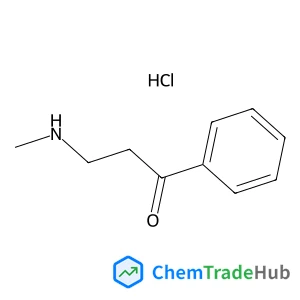
3-(Methylamino)-1-phenyl-1-propanone hydrochloride (1:1)
CAS Number:
2538-50-3
Molecular Formula:
C10H14ClNO
![N-[(Benzyloxy)carbonyl]serine structure](https://static.chemtradehub.com/structs/276/2768-56-1-77f7.webp "N-[(Benzyloxy)carbonyl]serine structure")

Recommended Suppliers





Disclaimer
This page provides academic journal information for reference and research purposes only. We are not affiliated with any journal publishers and do not handle publication submissions. For publication-related inquiries, please contact the respective journal publishers directly.
If you notice any inaccuracies in the information displayed, please contact us at support@chemtradehub.com. We will promptly review and address your concerns.