












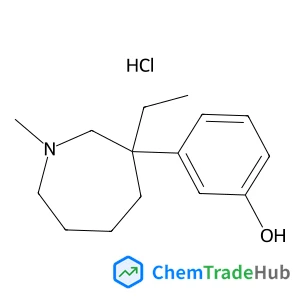
3-(3-Ethyl-1-methyl-3-azepanyl)phenol hydrochloride (1:1)
CAS Number:
59263-76-2
Molecular Formula:
C15H24ClNO
Hiroshi Yano, Chisato Ono, Hidenobu Shiroishi, Tatsuhiro Okada
Novel types of CO tolerant electro-catalysts from Pt and organic metal complexes that are far superior to Pt–Ru and practically usable as anode catalysts in reformate gas fuel cells with 100 ppm CO tolerance have been developed.
Yuanqing Wang, Makoto Hatakeyama, Koji Ogata, Masamitsu Wakabayashi, Fangming Jin, Shinichiro Nakamura
DOI: 10.1039/C5CP02008E
Cherumuttathu H. Suresh
DOI: 10.1039/C5CP03371C
Mingjie Wu, Qiaowei Tang, Fang Dong, Yongzhen Wang, Donghui Li, Qinping Guo, Yuyu Liu
DOI: 10.1039/C6CP02785G
DOI: 10.1039/C6CP00380J
DOI: 10.1039/C5CP01436K
M. H. Yang, Y. Li, J. H. Li, B. X. Liu
DOI: 10.1039/C6CP90176J
Ana Rita R. Teles, Teresa B. V. Dinis, Emanuel V. Capela, Luís M. N. B. F. Santos, Simão P. Pinho, Mara G. Freire, João A. P. Coutinho
DOI: 10.1039/C6CP03495K
Meng Zhang, Yuxue Liu, Hancheng Zhu, Duanting Yan, Jian Yang, Xinyang Zhang, Chunguang Liu, Changshan Xu
DOI: 10.1039/C6CP02026G
M. Smerieri, L. Savio
DOI: 10.1039/C6CP02999J
Tongtao Yue, Yan Xu, Shixin Li, Xianren Zhang, Fang Huang
DOI: 10.1039/C6CP01957A
When handling 4-(2-Furylmethyl)thiomorpholine 1,1-dioxide (CAS: 79206-94-3), it ...
When handling 4-Chloro-N-[2-(4-morpholinyl)ethyl]benzamide (CAS: 71320-77-9), it...
Waste containing this compound (CAS: 62921-74-8) should be handled according to ...
Waste containing (S)-Methyl 2-amino-3-cyclohexylpropanoate should be collected i...
This compound can be synthesized using a multi-step process involving the conjug...
There are several alternatives to (2E)-3-(3,4-Dichlorophenyl)acrylic acid in syn...
Ethyl 6-(2-nitrophenyl)imidazo[2,1-b][1,3]thiazole-3-carboxylate (CAS: 925437-84...
Waste containing 2-(1,3-Thiazol-2-yl)ethanamine (CAS: 18453-07-1) should be coll...
Methyl 5-iodo-2-methylbenzoate can be synthesized through the iodination of meth...
5-Chloro[1,2,4]triazolo[1,5-a]pyridine is commonly synthesized via the condensat...

ChemComm publishes urgent research which is of outstanding significance and interest to experts in the field, while also appealing to the journal’s broad chemistry readership. Our communication format is ideally suited to short, urgent studies that are of such importance that they require accelerated publication. Our scope covers all topics in chemistry, and research at the interface of chemistry and other disciplines (such as materials science, nanoscience, physics, engineering and biology) where there is a significant novelty in the chemistry aspects. Major topic areas covered include: Analytical Chemistry Catalysis Chemical Biology and medicinal chemistry Computational Chemistry and Machine Learning Energy and sustainable chemistry Environmental Chemistry Green Chemistry Inorganic Chemistry Materials Chemistry Nanoscience Organic Chemistry Physical Chemistry Polymer Chemistry Supramolecular Chemistry
![[4-Amino-2-(methylsulfanyl)-5-pyrimidinyl]methanol structure](https://static.chemtradehub.com/structs/588/588-36-3-fc73.webp "[4-Amino-2-(methylsulfanyl)-5-pyrimidinyl]methanol structure")
![1,2-Diphenyl-4-[2-(phenylsulfinyl)ethyl]-3,5-pyrazolidinedione structure](https://static.chemtradehub.com/structs/57-/57-96-5-efcc.webp "1,2-Diphenyl-4-[2-(phenylsulfinyl)ethyl]-3,5-pyrazolidinedione structure")




