












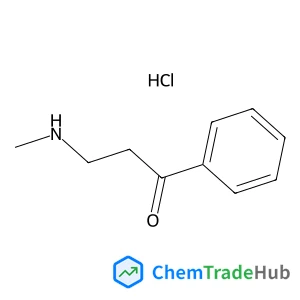
3-(Methylamino)-1-phenyl-1-propanone hydrochloride (1:1)
CAS Number:
2538-50-3
Molecular Formula:
C10H14ClNO
Ana Rita R. Teles, Teresa B. V. Dinis, Emanuel V. Capela, Luís M. N. B. F. Santos, Simão P. Pinho, Mara G. Freire, João A. P. Coutinho
Herein, solubility experimental data for six monosaccharides, viz.D-(+)-glucose, D-(+)-mannose, D-(−)-fructose, D-(+)-galactose, D-(+)-xylose and L-(+)-arabinose, in four ionic liquids (ILs), at temperatures ranging from 288.2 to 348.2 K, were obtained aimed at gathering a better understanding of their solvation ability and molecular-level mechanisms which rule the dissolution process. To ascertain the chemical features that enhance the solubility of monosaccharides, ILs composed of dialkylimidazolium or tetraalkylphosphonium cations combined with the dicyanamide, dimethylphosphate or chloride anions were investigated. It was found that the ranking of the solubility of monosaccharides depends on the IL; yet, D-(+)-xylose is always the most soluble while D-(−)-fructose is the least soluble monosaccharide. The results obtained show that both the IL cation and the anion play a major role in the solubility of monosaccharides. Finally, from the determination of the respective thermodynamic properties of solution, it was found that enthalpic contributions are dominant in the solubilization process. However, the observed differences in the solubilities of monosaccharides in 1-butyl-3-methylimidazolium dicyanamide are ruled by a change in the entropy of solution.
Bo Pang, Rui Liu, Guang Han, Wei Wang
DOI: 10.1039/D1PY00087J
Tianwen Zhu, Qiaoxi Yu, Weiwen Zheng, Runxin Bei, Wenhui Wang, Minming Wu, Siwei Liu, Zhenguo Chi, Yi Zhang, Jiarui Xu
DOI: 10.1039/D1PY00084E
Mariya Edeleva, Yoshi W. Marien, Paul H. M. Van Steenberge
DOI: 10.1039/D1PY00151E
Xue-Yi Sun, Ya-Xuan Liang, Cheng-Yan Wu, Quan Tang, Rui Liu, Zhong-Lin Lu, Lan He
DOI: 10.1039/D1PY00232E
Haoxiang Wang, Lei Shen
DOI: 10.1039/D1PY00637A
Marc Guerre, Cédric Totée, Gilles Silly, Olinda Gimello, Bruno Améduri, Jean-François Tahon, Rinaldo Poli, Sophie Barrau, Vincent Ladmiral
DOI: 10.1039/D0PY01754J
Josina L. Bohlen, Bragavie Kulendran, Hannah Rothfuss, Peter W. Roesky
DOI: 10.1039/D1PY00552A
When handling 4-(2-Furylmethyl)thiomorpholine 1,1-dioxide (CAS: 79206-94-3), it ...
When handling 4-Chloro-N-[2-(4-morpholinyl)ethyl]benzamide (CAS: 71320-77-9), it...
Waste containing this compound (CAS: 62921-74-8) should be handled according to ...
Waste containing (S)-Methyl 2-amino-3-cyclohexylpropanoate should be collected i...
This compound can be synthesized using a multi-step process involving the conjug...
There are several alternatives to (2E)-3-(3,4-Dichlorophenyl)acrylic acid in syn...
Ethyl 6-(2-nitrophenyl)imidazo[2,1-b][1,3]thiazole-3-carboxylate (CAS: 925437-84...
Waste containing 2-(1,3-Thiazol-2-yl)ethanamine (CAS: 18453-07-1) should be coll...
Methyl 5-iodo-2-methylbenzoate can be synthesized through the iodination of meth...
5-Chloro[1,2,4]triazolo[1,5-a]pyridine is commonly synthesized via the condensat...

Physical Chemistry Chemical Physics (PCCP) is an international journal co-owned by 19 physical chemistry and physics societies from around the world. This journal publishes original, cutting-edge research in physical chemistry, chemical physics and biophysical chemistry. To be suitable for publication in PCCP, articles must include significant innovation and/or insight into physical chemistry; this is the most important criterion that reviewers and Editors will judge against when evaluating submissions. The journal has a broad scope and welcomes contributions spanning experiment, theory, computation and data science. Topical coverage includes spectroscopy, dynamics, kinetics, statistical mechanics, thermodynamics, electrochemistry, catalysis, surface science, quantum mechanics, quantum computing and machine learning. Interdisciplinary research areas such as polymers and soft matter, materials, nanoscience, energy, surfaces/interfaces, and biophysical chemistry are welcomed if they demonstrate significant innovation and/or insight into physical chemistry. Joined experimental/theoretical studies are particularly appreciated when complementary and based on up-to-date approaches.
![5-Acetyl-2,3-dihydrobenzo[b]furan structure](https://static.chemtradehub.com/structs/908/90843-31-5-eea4.webp "5-Acetyl-2,3-dihydrobenzo[b]furan structure")
![[4-(Heptyloxy)phenyl]boronic acid structure](https://static.chemtradehub.com/structs/136/136370-19-9-ad33.webp "[4-(Heptyloxy)phenyl]boronic acid structure")



