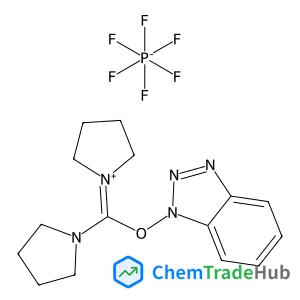
(1H-Benzotriazol-1-yloxy)(di-1-pyrrolidinyl)methylium hexafluorophosphate
CAS Number:
105379-24-6
Molecular Formula:
C15H21F6N5OP
Angelo Alberti, Maurizio Guerra, Philippe Hapiot, Thierry Lequeux, Dante Macciantelli, Serge Masson
The redox properties of ethyl diethoxyphosphoryldithioacetate (1), methyl diethoxyphosphorylfluorodithioacetate (2) and methyl diethoxyphosphoryldifluorodithioacetate (3) were measured by cyclic voltammetry. Addition of free radicals to the three dithioesters led to the detection of the ESR spectra of the spin adducts only with the last two compounds. Based on the reduction potentials of the three dithioacetates, this may be explained by capto-dative stabilization of the adducts. On the basis of DFT calculations, the temperature dependent variations of the spectral patterns exhibited by the radicals were attributed to restricted rotation about the Cα–SMe bond.

Heteroatom Chemistry

Bioorganic & Medicinal Chemistry Letters

Chinese Journal of Chemistry

Bioorganic & Medicinal Chemistry

NDT & E International

Polycyclic Aromatic Compounds

Colloid Journal

Journal of the Indian Institute of Science

Topics in Catalysis

Critical Reviews in Solid State and Materials Sciences
Lijia Liu, Tsun-Kong Sham, Weiqiang Han
DOI: 10.1039/C3CP50498K
Xiaowei Li, Shunhong Zhang, Qian Wang
DOI: 10.1039/C3CP44660C
Sven Ernst, Kristopher R. Ward, Sarah E. Norman, Christopher Hardacre, Richard G. Compton
DOI: 10.1039/C3CP51004B
Giuseppe Graziano
DOI: 10.1039/C3CP50616A
Qian Gou, Gang Feng, Luca Evangelisti, Alberto Lesarri, Emilio J. Cocinero, Walther Caminati
DOI: 10.1039/C3CP50306B
Yimin Cui, Wei Liu, Rongming Wang
DOI: 10.1039/C3CP00132F
Eric S. Shamay, Nicholas A. Valley, Frederick G. Moore, Geraldine L. Richmond
DOI: 10.1039/C3CP50609F
V. Epp, Ö. Gün, H.-J. Deiseroth, M. Wilkening
DOI: 10.1039/C3CP44379E
Marco Micciarelli, Carlo Altucci, Bartolomeo Della Ventura, Raffaele Velotta, Valer Toşa, Adán B. Gónzalez Pérez, Martin Pérez Rodríguez, Ángel R. de Lera, Attila Bende
DOI: 10.1039/C3CP50343G
Ye Zhang, Bai Cui, Chunsong Zhao, Hong Lin
DOI: 10.1039/C3CP50202C
When handling 4-(2-Furylmethyl)thiomorpholine 1,1-dioxide (CAS: 79206-94-3), it ...
When handling 4-Chloro-N-[2-(4-morpholinyl)ethyl]benzamide (CAS: 71320-77-9), it...
Waste containing this compound (CAS: 62921-74-8) should be handled according to ...
Waste containing (S)-Methyl 2-amino-3-cyclohexylpropanoate should be collected i...
This compound can be synthesized using a multi-step process involving the conjug...
There are several alternatives to (2E)-3-(3,4-Dichlorophenyl)acrylic acid in syn...
Ethyl 6-(2-nitrophenyl)imidazo[2,1-b][1,3]thiazole-3-carboxylate (CAS: 925437-84...
Waste containing 2-(1,3-Thiazol-2-yl)ethanamine (CAS: 18453-07-1) should be coll...
Methyl 5-iodo-2-methylbenzoate can be synthesized through the iodination of meth...
5-Chloro[1,2,4]triazolo[1,5-a]pyridine is commonly synthesized via the condensat...

Physical Chemistry Chemical Physics (PCCP) is an international journal co-owned by 19 physical chemistry and physics societies from around the world. This journal publishes original, cutting-edge research in physical chemistry, chemical physics and biophysical chemistry. To be suitable for publication in PCCP, articles must include significant innovation and/or insight into physical chemistry; this is the most important criterion that reviewers and Editors will judge against when evaluating submissions. The journal has a broad scope and welcomes contributions spanning experiment, theory, computation and data science. Topical coverage includes spectroscopy, dynamics, kinetics, statistical mechanics, thermodynamics, electrochemistry, catalysis, surface science, quantum mechanics, quantum computing and machine learning. Interdisciplinary research areas such as polymers and soft matter, materials, nanoscience, energy, surfaces/interfaces, and biophysical chemistry are welcomed if they demonstrate significant innovation and/or insight into physical chemistry. Joined experimental/theoretical studies are particularly appreciated when complementary and based on up-to-date approaches.
![1-Naphthalenesulfonic acid, 2-[(2-hydroxy-1-naphthalenyl)azo]-, bariumsalt (2:1) structure](https://static.chemtradehub.com/structs/110/1103-38-4-0b33.webp "1-Naphthalenesulfonic acid, 2-[(2-hydroxy-1-naphthalenyl)azo]-, bariumsalt (2:1) structure")

![[4-(Heptyloxy)phenyl]boronic acid structure](https://static.chemtradehub.com/structs/136/136370-19-9-ad33.webp "[4-(Heptyloxy)phenyl]boronic acid structure")