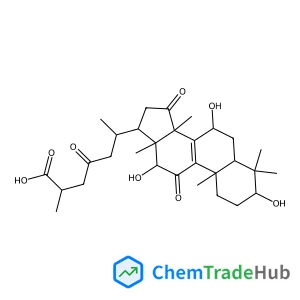
(3beta,7beta,12beta)-3,7,12-Trihydroxy-11,15,23-trioxolanost-8-en-26-oic acid
CAS Number:
98665-22-6
Molecular Formula:
C30H44O8
Steven M. Mennen, Jarred T. Blank, Michelle B. Tran-Dubé, Jason E. Imbriglio, Scott J. Miller
Thiazolylalanine, in appropriately functionalized form, has been found to function as an enantioselective catalyst for an intramolecular Stetter reaction. Incorporation of the residue in a number of environments has resulted in a family of catalysts that promote the cyclization of a test substrate with up to 81% enantiomeric excess.
Iris Haas, Aharon Gedanken
DOI: 10.1039/B717670H
Sivakolundu Bhuvaneswari, Masilamani Jeganmohan, Ming-Che Yang, Chien-Hong Cheng
DOI: 10.1039/B800118A
M. Baidya, Herbert Mayr
DOI: 10.1039/B801811A
Ali Abou Hassan, Olivier Sandre, Valérie Cabuil, Patrick Tabeling
DOI: 10.1039/B719550H
Matthew J. Fuchter, Catherine J. Smith, Alistair Boyer, Simon Saubern, John H. Ryan, Andrew B. Holmes
DOI: 10.1039/B801537F
Shik Chi Tsang, Stan Golunski, Paul Collier
DOI: 10.1039/B718956G
Pravin S. Shirude, Liming Ying, Shankar Balasubramanian
DOI: 10.1039/B801465E
Masanori Adachi, Tatsuo Shimomura, Makoto Komatsu, Hiroshi Yakuwa, Akiko Miya
DOI: 10.1039/B717773A
Yue-Ling Bai, Jun Tao, Rong-Bin Huang, Lan-Sun Zheng, Shao-Liang Zheng, Kazuyoshi Oshida, Yasuaki Einaga
DOI: 10.1039/B718456E
When handling 4-(2-Furylmethyl)thiomorpholine 1,1-dioxide (CAS: 79206-94-3), it ...
When handling 4-Chloro-N-[2-(4-morpholinyl)ethyl]benzamide (CAS: 71320-77-9), it...
Waste containing this compound (CAS: 62921-74-8) should be handled according to ...
Waste containing (S)-Methyl 2-amino-3-cyclohexylpropanoate should be collected i...
This compound can be synthesized using a multi-step process involving the conjug...
There are several alternatives to (2E)-3-(3,4-Dichlorophenyl)acrylic acid in syn...
Ethyl 6-(2-nitrophenyl)imidazo[2,1-b][1,3]thiazole-3-carboxylate (CAS: 925437-84...
Waste containing 2-(1,3-Thiazol-2-yl)ethanamine (CAS: 18453-07-1) should be coll...
Methyl 5-iodo-2-methylbenzoate can be synthesized through the iodination of meth...
5-Chloro[1,2,4]triazolo[1,5-a]pyridine is commonly synthesized via the condensat...

ChemComm publishes urgent research which is of outstanding significance and interest to experts in the field, while also appealing to the journal’s broad chemistry readership. Our communication format is ideally suited to short, urgent studies that are of such importance that they require accelerated publication. Our scope covers all topics in chemistry, and research at the interface of chemistry and other disciplines (such as materials science, nanoscience, physics, engineering and biology) where there is a significant novelty in the chemistry aspects. Major topic areas covered include: Analytical Chemistry Catalysis Chemical Biology and medicinal chemistry Computational Chemistry and Machine Learning Energy and sustainable chemistry Environmental Chemistry Green Chemistry Inorganic Chemistry Materials Chemistry Nanoscience Organic Chemistry Physical Chemistry Polymer Chemistry Supramolecular Chemistry