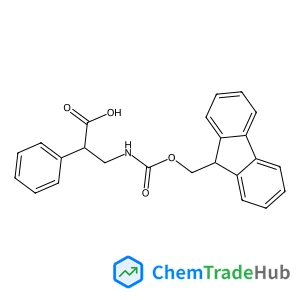
(S)-3-((((9H-Fluoren-9-yl)methoxy)carbonyl)amino)-2-phenylpropanoic acid
CAS Number:
1217663-60-9
Molecular Formula:
C24H21NO4
Ulrich Flörke
Bicyclometalation of aromatic substrates containing imine anchoring groups is achieved with a dimethyliron complex at −70 °C; azadiene systems undergo a regiospecific activation of 1,4-CH/N interchanged C–H bonds which may be aromatic or vinylic.
Yuya Oaki, Shinichiro Hayashi, Hiroaki Imai
DOI: 10.1039/B704129B
Roxanne Clément, Christiane M. Grisé, Louis Barriault
DOI: 10.1039/B803898H
Shigeo Kajii, Toshio Nishikawa, Minoru Isobe
DOI: 10.1039/B803797C
Claude Villiers, Pierre Thuéry, Michel Ephritikhine
DOI: 10.1039/B705224C
Masilamani Jeganmohan, Chien-Hong Cheng
DOI: 10.1039/B800440D
Lidia Armelao, Gregorio Bottaro, Silvio Quici, Marco Cavazzini, Maria Concetta Raffo, Francesco Barigelletti, Gianluca Accorsi
DOI: 10.1039/B702238G
Shelli R. Waetzig, Jon A. Tunge
DOI: 10.1039/B806949B
Søren Bertelsen, Rasmus L. Johansen, Karl Anker Jørgensen
DOI: 10.1039/B806418K
Lixia Sun, Qianwang Chen, Yan Tang, Ying Xiong
DOI: 10.1039/B704689H
When considering alternatives to 1-(4-Chlorophenyl)-N-hydroxymethanimine (CAS: 3...
This compound should be stored in a cool, dry place away from direct sunlight. I...
3-(4-Bromophenyl)-5-(2-fluorophenyl)-1,2,4-oxadiazole is synthesized through a m...
5-Chloro-2-(4-chlorophenyl)-4-methyl-6-[3-(1-piperidinyl)propoxy]pyrimidine (CAS...
2-Chloro-4-(difluoromethoxy)pyridine is used in the pharmaceutical industry for ...
3-Chloro-6-methylpyridazine (CAS: 1121-79-5) is classified under the Globally Ha...
Several alternatives can be used in the synthesis of Methyl 4,5-dimethyl-2-nitro...
Alternatives to (2E,2'E)-3,3'-(1,4-Phenylene)bisacrylaldehyde include other acry...
3-Amino-5-chloropyridin-2-ol hydrochloride is an organic compound with the CAS n...
When handling 6,7-Difluoro-2,3-dihydro-4H-chromen-4-one, it is essential to wear...

ChemComm publishes urgent research which is of outstanding significance and interest to experts in the field, while also appealing to the journal’s broad chemistry readership. Our communication format is ideally suited to short, urgent studies that are of such importance that they require accelerated publication. Our scope covers all topics in chemistry, and research at the interface of chemistry and other disciplines (such as materials science, nanoscience, physics, engineering and biology) where there is a significant novelty in the chemistry aspects. Major topic areas covered include: Analytical Chemistry Catalysis Chemical Biology and medicinal chemistry Computational Chemistry and Machine Learning Energy and sustainable chemistry Environmental Chemistry Green Chemistry Inorganic Chemistry Materials Chemistry Nanoscience Organic Chemistry Physical Chemistry Polymer Chemistry Supramolecular Chemistry