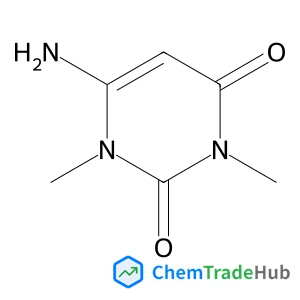
6-amino-1,3-dimethyl-1,2,3,4-tetrahydropyrimidine-2,4-dione
CAS Number:
6642-31-5
Molecular Formula:
C6H9N3O2
Contemporary design strategies aimed at developing highly functional anion conducting membranes (ACMs) for solid state alkaline fuel cell (SAFC) applications are often hampered by intrinsic limitations such as less efficiency in controlling swelling, declined alkaline durability, high fuel cross-over and/or poor stability against OH radicals especially for polyelectrolytes composed of aliphatic chains. Hence, it is a challenging task to develop an ACM that satisfies all pre-requisites: high conductivity, alkaline durability, chemical stability and very low fuel cross-over for successful SAFC applications. Here we present the systematic design of a simple molecular architecture based on the benzyl ammonium group and benzene without a hetero atom segment as a promising alkaline durable ACM with high anion conductivity. We have designed a new monomer 1,3,5-tri[p-(N′,N′′-dimethylaminomethyl)phenyl]benzene (TDAMPB) with three tertiary amino groups that generates poly-TDAMPB (PTDAMPB) with three anion-exchange sites per molecule upon in situ cross-linking. This highly cross-linked aromatic polyelectrolyte could generate highly packed anion-exchange sites by polymerization in the pores of a porous substrate and thereby presents an imperative solution for the existing challenges associated with current SAFC membranes. The PTDAMPB membrane performances were compared with an aliphatic poly(vinylbenzyltrimethyl ammonium chloride) (PVBTAC) membrane. The results demonstrate that the PTDAMPB membrane exhibited high OH− ion conductivity similar to PVBTAC membranes, but exceptionally low methanol permeability and low swelling while maintaining good durability against hot alkali, boiling water and oxidative decomposition in contrast to PVBTAC. The functionalities of the PTDAMPB membrane satisfy the anticipated requirements for a viable SAFC, which is difficult to attain simultaneously for a conventional anion-conducting membrane and hence the results of this work address a major unresolved challenge representing an advancement toward successful SAFC applications.
Joseph E. Subotnik, Alex Sodt, Martin Head-Gordon
DOI: 10.1039/B709171K
Jonas Baltrusaitis, Vicki H. Grassian
DOI: 10.1039/B709167B
DOI: 10.1039/B712647F
Nathanael Guigo, Alice Mija, Luc Vincent, Nicolas Sbirrazzuoli
DOI: 10.1039/B707950H
Ji-Woong Kim, Jae-Au Ha, Hun Jung, Byung-II Ahn, Sung-Han Lee, Joong-Gill Choi
DOI: 10.1039/B709102H
Michael J. Pilling, Steven S. Brown
DOI: 10.1039/B709193A
Lauro Oliver Paz-Borbón, Thomas V. Mortimer-Jones, Roy L. Johnston, Alvaro Posada-Amarillas, Giovanni Barcaro, Alessandro Fortunelli
DOI: 10.1039/B707136A
1-(2,4,6-Trifluorophenyl)ethanol is an organic compound with the CAS number 1250...
1-(2,4-Dimethoxybenzyl)-4-(hydroxymethyl)-2-pyrrolidinone (CAS: 919111-34-5) is ...
(7S,15R)-6β,15-Diacetoxy-7α,20-epoxy-7-hydroxykaura-2,16-dien-1-one is a crystal...
The compound rac-ethyl (1r,4r)-4-hydroxycyclohexane-1-carboxylate, trans (CAS: 3...
The market for 2-(2,4-Difluorophenoxy)-3-nitropyridine (CAS: 175135-62-3) is cur...
The main uses of 6-Diazo-5-oxo-L-norleucine (CAS: 157-03-9) include research in ...
When handling 2-Aminoethyl-mono-amide-DOTA-tris(tBu ester) (CAS: 173308-19-5), i...
5-Methylimidazo[1,2-a]pyridine-3-carbaldehyde (CAS: 178488-37-4) can be synthesi...
There are alternative reagents that can be used in the synthesis of 2,4,6-Trihyd...
(2Z)-3-(5-Fluoro-1H-indol-3-yl)-2-sulfanylacrylic acid is a chemical compound wi...

Polymer Chemistry welcomes submissions in all areas of polymer science that have a strong focus on macromolecular chemistry. Manuscripts may cover a broad range of fields, yet no direct application focus is required.