












Click reactive microgels as a strategy towards chemically injectable hydrogels
Literature Information
Publication Date
2016-10-12
DOI
10.1039/C6PY01663D
Impact Factor
5.582
Authors
Seda Çakir, Sylvain Gabriele, Philippe Dubois, Filip Du Prez, Laetitia Mespouille
View Original
Abstract
Doubly crosslinked microgels (DX microgels) are hydrogels constructed by covalently interlinked microgel particles, offering two levels of hierarchy within the network, the first one being the microgel and the second being the interlinked microgel network. Herein we describe an efficient approach for DX microgel synthesis via the ultrafast triazolinedione (TAD)-based click reaction. Cyclopentadienyl functional microgels were prepared by a conventional water in oil (W/O) suspension, free-radical copolymerization of poly(ethylene glycol)methyl ether methacrylate (Mn = 500 g mol−1) with glycidyl methacrylate and ethylene glycol dimethacrylate as crosslinkers. Microgel post-modification was subsequently achieved by reacting glycidyl functions with sodium cyclopentadienide (NaCp), resulting in Cp-functionalized microgels. Finally, the microgels were mixed with a bis-TAD functional crosslinker, resulting in crosslinking with adequate kinetics (minutes to seconds) to form a doubly crosslinked microgel network. Size distributions of swollen microgels before creation of the second network were followed by optical microscopy and particle size measurements. The efficient functionalization of the microgels with Cp units was demonstrated by a fluorescence labelling study. Dynamic rheology data showed the increase of mechanical properties from the microgels to the doubly crosslinked microgel network formed after addition of the TAD crosslinker. The current study thus highlights the efficiency of catalyst free modular ligation chemistry to synthesize DX microgels with a very fast gelation process from 5 minutes to 15 seconds depending on the crosslinker to Cp ratio, from 0.7 to 1 respectively.
Recommended Journals
Related Literature
Interrogation of living cells using alternating current scanning electrochemical microscopy (AC-SECM)
Piotr M. Diakowski, Zhifeng Ding
2007-10-09
Paper
DOI: 10.1039/B711448F
Second-harmonic generation for studying structural motion of biological molecules in real time and space
2007-09-07
Paper
DOI: 10.1039/B710505C
Solute–solvent interactions in imidazolium camphorsulfonate ionic liquids
Kaoru Nobuoka, Satoshi Kitaoka, Masashi Iio, Thomas Harran, Yuichi Ishikawa
2007-08-28
Paper
DOI: 10.1039/B709407H
Structures and energetics of 98 atom Pd–Pt nanoalloys: potential stability of the Leary tetrahedron for bimetallic nanoparticles
Lauro Oliver Paz-Borbón, Thomas V. Mortimer-Jones, Roy L. Johnston, Alvaro Posada-Amarillas, Giovanni Barcaro, Alessandro Fortunelli
2007-07-17
Paper
DOI: 10.1039/B707136A
Multiphoton dissociation dynamics of BrCl and the BrCl+cation
Olivier P. J. Vieuxmaire, N. Hendrik Nahler, Richard N. Dixon, Michael N. R. Ashfold
2007-08-30
Paper
DOI: 10.1039/B709222A
Low-volatility poly-oxygenates in the OH-initiated atmospheric oxidation of α-pinene: impact of non-traditional peroxyl radical chemistry
L. Vereecken, J.-F. Müller, J. Peeters
2007-08-02
Paper
DOI: 10.1039/B708023A
Selected ion flow tube cation–molecule reaction studies and threshold photoelectron photoion coincidence spectroscopy of cyclic-C5F8
Michael A. Parkes, Sahangir Ali, Richard P. Tuckett, Victor A. Mikhailov, Chris A. Mayhew
2007-08-02
Paper
DOI: 10.1039/B704862A
Theory and computation of nuclear magnetic resonance parameters
Juha Vaara
2007-07-06
Perspective
DOI: 10.1039/B706135H
You might also like
Compound Q&A
What is 1-(2,4,6-Trifluorophenyl)ethanol (CAS: 1250113-83-7)?
1-(2,4,6-Trifluorophenyl)ethanol is an organic compound with the CAS number 1250...
1250113-83-71-(2,4,6-Trifluoroph...
Compound Q&A
Is 1-(2,4-Dimethoxybenzyl)-4-(hydroxymethyl)-2-pyrrolidinone (CAS: 919111-34-5) safe?
1-(2,4-Dimethoxybenzyl)-4-(hydroxymethyl)-2-pyrrolidinone (CAS: 919111-34-5) is ...
919111-34-51-(2,4-Dimethoxybenz...
Compound Q&A
What are the physical and chemical properties of (7S,15R)-6β,15-Diacetoxy-7α,20-epoxy-7-hydroxykaura-2,16-dien-1-one (CAS: 51419-51-3)?
(7S,15R)-6β,15-Diacetoxy-7α,20-epoxy-7-hydroxykaura-2,16-dien-1-one is a crystal...
51419-51-3(7S,15R)-6β,15-Diace...
Compound Q&A
What regulatory guidelines apply to rac-ethyl (1r,4r)-4-hydroxycyclohexane-1-carboxylate, trans (CAS: 3618-04-0)?
The compound rac-ethyl (1r,4r)-4-hydroxycyclohexane-1-carboxylate, trans (CAS: 3...
3618-04-0rac-ethyl (1r,4r)-4-...
Compound Q&A
What is the market or research trend for 2-(2,4-Difluorophenoxy)-3-nitropyridine (CAS: 175135-62-3)?
The market for 2-(2,4-Difluorophenoxy)-3-nitropyridine (CAS: 175135-62-3) is cur...
175135-62-32-(2,4-Difluoropheno...
Compound Q&A
What are the main uses of 6-Diazo-5-oxo-L-norleucine (CAS: 157-03-9)?
The main uses of 6-Diazo-5-oxo-L-norleucine (CAS: 157-03-9) include research in ...
157-03-96-Diazo-5-oxo-L-norl...
Compound Q&A
What precautions should be taken when handling 2-Aminoethyl-mono-amide-DOTA-tris(tBu ester) (CAS: 173308-19-5)?
When handling 2-Aminoethyl-mono-amide-DOTA-tris(tBu ester) (CAS: 173308-19-5), i...
173308-19-52-Aminoethyl-mono-am...
Compound Q&A
How is 5-Methylimidazo[1,2-a]pyridine-3-carbaldehyde (CAS: 178488-37-4) typically synthesized?
5-Methylimidazo[1,2-a]pyridine-3-carbaldehyde (CAS: 178488-37-4) can be synthesi...
178488-37-45-Methylimidazo[1,2-...
Compound Q&A
Are there alternatives to 2,4,6-Trihydroxyisophthalaldehyde (CAS: 4396-13-8) in synthesis?
There are alternative reagents that can be used in the synthesis of 2,4,6-Trihyd...
4396-13-82,4,6-Trihydroxyisop...
Compound Q&A
What is (2Z)-3-(5-Fluoro-1H-indol-3-yl)-2-sulfanylacrylic acid (CAS: 179461-52-0)?
(2Z)-3-(5-Fluoro-1H-indol-3-yl)-2-sulfanylacrylic acid is a chemical compound wi...
179461-52-0(2Z)-3-(5-Fluoro-1H-...
Source Journal
Polymer Chemistry

CiteScore:
8.6
Self-citation Rate:
7.3%
Articles per Year:
457
Polymer Chemistry welcomes submissions in all areas of polymer science that have a strong focus on macromolecular chemistry. Manuscripts may cover a broad range of fields, yet no direct application focus is required.
Recommended Compounds
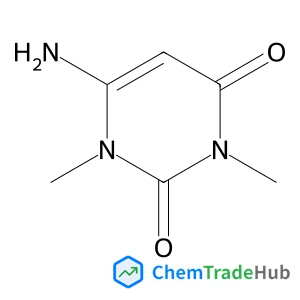
6-amino-1,3-dimethyl-1,2,3,4-tetrahydropyrimidine-2,4-dione
CAS Number:
6642-31-5
Molecular Formula:
C6H9N3O2

Recommended Suppliers




Disclaimer
This page provides academic journal information for reference and research purposes only. We are not affiliated with any journal publishers and do not handle publication submissions. For publication-related inquiries, please contact the respective journal publishers directly.
If you notice any inaccuracies in the information displayed, please contact us at support@chemtradehub.com. We will promptly review and address your concerns.