












Use of inherently conducting polymers and pulsed amperometry in flow injection analysis to detect oligonucleotides
Literature Information
Publication Date
2004-06-07
DOI
10.1039/B403136A
Impact Factor
4.616
Authors
Yanzhe Wu, Simon E. Moulton, Chee O. Too, Gordon G. Wallace, Dezhi Zhou
View Original
Abstract
Pulsed amperometry has been used to detect and discriminate between different base-pair oligonucleotides using flow injection analysis with polypyrrole modified electrodes. Oligonucleotides with 20-repeat units were immobilized as the sole counter anion during polymerisation of pyrrole onto a glassy carbon (GC) electrode. The modified electrode was then used in a flow injection analysis (FIA) set-up to selectively detect complementary oligonucleotides. Results showed that complementary oligo(dG)20 and non-complementary oligonucleotides can be distinguished by using the oligo(dC)20 modified electrode.
Related Literature
Heterotellurium-containing macrocycles towards degradable tellurium-functionalized polymers
Jieni Hu, Chuanhao Sun, Siqi Li, Yuan Yuan
2021-07-20
Communication
DOI: 10.1039/D1PY00703C
Chemical conjugation of nucleic acid aptamers and synthetic polymers
Maria Nerantzaki, Capucine Loth, Jean-François Lutz
2021-06-07
Minireview
DOI: 10.1039/D1PY00516B
Purpurin derivatives as visible-light photosensitizers for 3D printing and valuable biological applications
Pauline Sautrot-Ba, Vlasta Brezová, Jean-Pierre Malval, Annalisa Chiappone, Louise Breloy, Samir Abbad-Andaloussi, Davy-Louis Versace
2021-03-24
Paper
DOI: 10.1039/D1PY00126D
Engineering of pH-triggered nanoplatforms based on novel poly(2-methyl-2-oxazoline)-b-poly[2-(diisopropylamino)ethyl methacrylate] diblock copolymers with tunable morphologies for biomedical applications
Peter Černoch, Alessandro Jager, Zulfiya Černochová, Vladimir Sincari, Lindomar J. C. Albuquerque, Rafal Konefal, Ewa Pavlova, Fernando C. Giacomelli, Eliezer Jager
2021-04-14
Paper
DOI: 10.1039/D1PY00141H
Retraction: A polyurethane–chitosan brush as an injectable hydrogel for controlled drug delivery and tissue engineering
2021-04-08
Retraction
DOI: 10.1039/D1PY90044G
Toughened PLA-b-PCL-b-PLA triblock copolymer based biomaterials: effect of self-assembled nanostructure and stereocomplexation on the mechanical properties
Neha Mulchandani, Kazunari Masutani, Sachin Kumar, Hideki Yamane, Yoshiharu Kimura, Vimal Katiyar
2021-06-18
Paper
DOI: 10.1039/D1PY00429H
Helical polymer self-assembly and chiral nanostructure formation
Randall A. Scanga, James F. Reuther
2021-02-16
Review Article
DOI: 10.1039/D0PY01558J
Structural design of pyrene-functionalized TEMPO-containing polymers for enhanced electrochemical storage performance
Hatice Mutlu, Hongjiao Li, Wolfgang Wenzel
2021-04-06
Paper
DOI: 10.1039/D0PY01421D
You might also like
Compound Q&A
What precautions should be taken when handling 4-(2-Furylmethyl)thiomorpholine 1,1-dioxide (CAS: 79206-94-3)?
When handling 4-(2-Furylmethyl)thiomorpholine 1,1-dioxide (CAS: 79206-94-3), it ...
79206-94-34-(2-Furylmethyl)thi...
Compound Q&A
What precautions should be taken when handling 4-Chloro-N-[2-(4-morpholinyl)ethyl]benzamide (CAS: 71320-77-9)?
When handling 4-Chloro-N-[2-(4-morpholinyl)ethyl]benzamide (CAS: 71320-77-9), it...
71320-77-94-Chloro-N-[2-(4-mor...
Compound Q&A
How should waste containing 2-[2-(2-Methoxyethoxy)ethoxy]ethyl 4-methylbenzenesulfonate (CAS: 62921-74-8) be handled?
Waste containing this compound (CAS: 62921-74-8) should be handled according to ...
62921-74-82-[2-(2-Methoxyethox...
Compound Q&A
How should waste containing (S)-Methyl 2-amino-3-cyclohexylpropanoate be handled?
Waste containing (S)-Methyl 2-amino-3-cyclohexylpropanoate should be collected i...
40056-18-6(S)-Methyl 2-amino-3...
Compound Q&A
How is 5-({4-[(2S,4R)-4-Hydroxy-2-methyltetrahydro-2H-pyran-4-yl]-2-thienyl}sulfanyl)-1-methyl-1,3-dihydro-2H-indol-2-one (CAS: 166882-70-8) typically synthesized?
This compound can be synthesized using a multi-step process involving the conjug...
166882-70-85-({4-[(2S,4R)-4-Hyd...
Compound Q&A
Are there alternatives to (2E)-3-(3,4-Dichlorophenyl)acrylic acid (CAS: 7312-27-8) in synthesis?
There are several alternatives to (2E)-3-(3,4-Dichlorophenyl)acrylic acid in syn...
7312-27-8(2E)-3-(3,4-Dichloro...
Compound Q&A
How should Ethyl 6-(2-nitrophenyl)imidazo[2,1-b][1,3]thiazole-3-carboxylate (CAS: 925437-84-9) be stored?
Ethyl 6-(2-nitrophenyl)imidazo[2,1-b][1,3]thiazole-3-carboxylate (CAS: 925437-84...
925437-84-9Ethyl 6-(2-nitrophen...
Compound Q&A
How should waste containing 2-(1,3-Thiazol-2-yl)ethanamine (CAS: 18453-07-1) be handled?
Waste containing 2-(1,3-Thiazol-2-yl)ethanamine (CAS: 18453-07-1) should be coll...
18453-07-12-(1,3-Thiazol-2-yl)...
Compound Q&A
How is Methyl 5-iodo-2-methylbenzoate (CAS: 103440-54-6) typically synthesized?
Methyl 5-iodo-2-methylbenzoate can be synthesized through the iodination of meth...
103440-54-6Methyl 5-iodo-2-meth...
Compound Q&A
How is 5-Chloro[1,2,4]triazolo[1,5-a]pyridine (CAS: 1427399-34-5) typically synthesized?
5-Chloro[1,2,4]triazolo[1,5-a]pyridine is commonly synthesized via the condensat...
1427399-34-55-Chloro[1,2,4]triaz...
Source Journal
Analyst

CiteScore:
7.8
Self-citation Rate:
5.6%
Articles per Year:
653
Analyst publishes analytical and bioanalytical research that reports premier fundamental discoveries and inventions, and the applications of those discoveries, unconfined by traditional discipline barriers.
Recommended Compounds

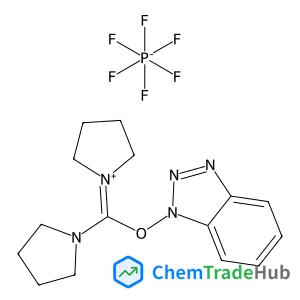
(1H-Benzotriazol-1-yloxy)(di-1-pyrrolidinyl)methylium hexafluorophosphate
CAS Number:
105379-24-6
Molecular Formula:
C15H21F6N5OP
![[4-Amino-2-(methylsulfanyl)-5-pyrimidinyl]methanol structure](https://static.chemtradehub.com/structs/588/588-36-3-fc73.webp "[4-Amino-2-(methylsulfanyl)-5-pyrimidinyl]methanol structure")
Recommended Suppliers






Disclaimer
This page provides academic journal information for reference and research purposes only. We are not affiliated with any journal publishers and do not handle publication submissions. For publication-related inquiries, please contact the respective journal publishers directly.
If you notice any inaccuracies in the information displayed, please contact us at support@chemtradehub.com. We will promptly review and address your concerns.