












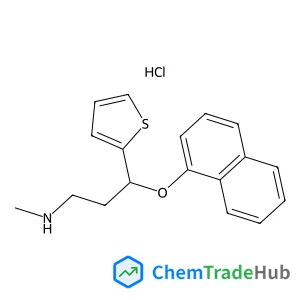
N-Methyl-3-(1-naphthyloxy)-3-(2-thienyl)-1-propanamine hydrochloride (1:1)
CAS Number:
1188266-11-6
Molecular Formula:
C18H20ClNOS
Michael Hill, Gerald Kehr, Gerhard Erker, Olga Kataeva, Roland Fröhlich
The diphenyl-ansa-zirconocene complex 2 adds HB(C6F5)2 at the CC double bond of its pendent Cp-allyl functional group to yield 3. During 3 days at room temperature the –B(C6F5)2 group takes part in an electrophilic substitution reaction at the adjacent Cp-ring to form 5 with formation of one equivalent of benzene. Complex 5 was characterized by X-ray diffraction
Thomas J. Penfold, Maarten Nachtegaal, Chris J. Milne, Majed Chergui
DOI: 10.1039/C4CP03301A
V. L. Chandraboss, B. Karthikeyan, S. Senthilvelan
DOI: 10.1039/C4CP03274H
Sigalit Aharon, Shany Gamliel, Bat El Cohen, Lioz Etgar
DOI: 10.1039/C4CP00460D
Shaobin Tang, Xinrui Cao
DOI: 10.1039/C4CP03291H
Mahesh R. Neupane, M. M. Sigalas, N. Aravantinos-Zafiris, Roger K. Lake
DOI: 10.1039/C4CP02328E
Carlos Zaldo, Concepción Cascales
DOI: 10.1039/C4CP03616F
Nan Qiu, Jing Zhang
DOI: 10.1039/C4CP03390F
L. A. Ferreira, A. Chervenak, S. Placko, A. Kestranek, P. P. Madeira, B. Y. Zaslavsky
DOI: 10.1039/C4CP02084G
Yuesheng Wang, Pin Liu, Lin Gu, Yong-Sheng Hu, Hong Li, George P. Demopoulos, Liquan Chen
DOI: 10.1039/C4CP02957G
N-(4-Methoxybenzyl)-2-pyridinamine (CAS: 52818-63-0) is increasingly being used ...
When handling Ethyl 4-(2-chlorophenyl)-1,3-thiazole-2-carboxylate, appropriate p...
Diethyldiselane (CAS: 628-39-7) is classified under the Globally Harmonized Syst...
The market for oxocopper (CAS: 12053-18-8) is primarily driven by its use in cat...
The market for 5-{[(2-Methyl-2-propanyl)oxy]carbonyl}-5-azaspiro[2.4]heptane-7-c...
2-(1-Pyrrolidinyl)-4-pyridinamine is a chemical compound with the CAS number 359...
2-(3-Pyridinyl)-1-azabicyclo[2.2.2]octane (CAS: 91556-75-1) is a crystalline sol...
(S)-Alpha-allyl-proline hydrochloride is usually synthesized via a Wittig reacti...
3-Methyl-1,2-oxazole-5-carboxylic acid (CAS: 4857-42-5) is an organic compound w...
Lys-SMCC-DM1 is synthesized via a multi-step process involving the coupling of S...

ChemComm publishes urgent research which is of outstanding significance and interest to experts in the field, while also appealing to the journal’s broad chemistry readership. Our communication format is ideally suited to short, urgent studies that are of such importance that they require accelerated publication. Our scope covers all topics in chemistry, and research at the interface of chemistry and other disciplines (such as materials science, nanoscience, physics, engineering and biology) where there is a significant novelty in the chemistry aspects. Major topic areas covered include: Analytical Chemistry Catalysis Chemical Biology and medicinal chemistry Computational Chemistry and Machine Learning Energy and sustainable chemistry Environmental Chemistry Green Chemistry Inorganic Chemistry Materials Chemistry Nanoscience Organic Chemistry Physical Chemistry Polymer Chemistry Supramolecular Chemistry
![1-[6-(1H-Imidazol-1-yl)-3-pyridinyl]methanamine structure](https://static.chemtradehub.com/structs/914/914637-08-4-8825.webp "1-[6-(1H-Imidazol-1-yl)-3-pyridinyl]methanamine structure")






