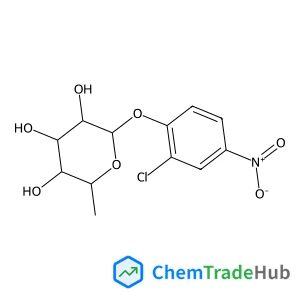
2-Chloro-4-nitrophenyl 6-deoxy-alpha-L-galactopyranoside
CAS Number:
157843-41-9
Molecular Formula:
C12H14ClNO7
A graphical abstract is available for this content
Yan Zhang, Dechun Li, Lin Wu, Liang Zhou, Yanan Du, Meng Wang, Ying Li
DOI: 10.1039/C6CP00397D
Jingbai Li, Andrey Yu. Rogachev
DOI: 10.1039/C5CP07002C
Jian Zhao, Alan Meng, Meng Zhang, Zhenjiang Li
DOI: 10.1039/C5CP04064G
DOI: 10.1039/C5CP05076F
Olga Russina, Fabrizio Lo Celso, Alessandro Triolo
DOI: 10.1039/C5CP04682C
Hongping Li, Yonghui Chang, Wenshuai Zhu, Changwei Wang, Chao Wang, Sheng Yin, Ming Zhang
DOI: 10.1039/C5CP04172D
Venkatesan Srinivasan, Murugesan Panneer, Madhavan Jaccob, Nagaraj Pavithra, Sambandam Anandan, Arunkumar Kathiravan
DOI: 10.1039/C5CP05338B
You Wang, Yun Wang, Wei Ren, Porun Liu, Huijun Zhao, Jun Chen, Jinxia Deng, Xianran Xing
DOI: 10.1039/C5CP03941J
Pai-Chi Li, Koichiro Shirota
DOI: 10.1039/C5CP04131G
B. Balke, S. Ouardi, S. Selle, T. Höche, C. Felser, W. Hermes, M. Schwind
DOI: 10.1039/C4CP04875J
(3.beta.)-3-Hydroxy-N,N-dimethyl-chol-5-en-24-amide (CAS: 79066-03-8) is primari...
5-(Aminomethyl)-2-methoxyphenol (CAS: 89702-89-6) is classified under GHS as a s...
Thieno[2,3-c]pyridin-7(6H)-one (CAS: 28981-13-7) is a heterocyclic organic compo...
1-[(6-Methoxy-3-pyridinyl)methyl]-4-piperidinamine dihydrochloride is generally ...
[(2E)-3-Phenyl-2-propen-1-yl]phosphonic acid (CAS: 146404-58-2) is regulated und...
6-Bromo-7-methoxyquinoline (CAS: 1620515-86-7) falls under the scope of the Glob...
This compound is primarily used in the pharmaceutical industry for the developme...
1-Ethyl-7-[2-methyl-6-(4H-1,2,4-triazol-3-yl)-3-pyridinyl]-3,5-dihydropyrazino[2...
Alternative reagents such as 2-[(dimethylamino)methyl]phenylboronic acid or rela...
3-(Piperidin-4-yloxy)pyridine (CAS: 310881-48-2) is an organic compound with the...

Chemistry Education Research and Practice (CERP) is the journal for teachers, researchers and other practitioners at all levels of chemistry education. It is published free of charge electronically four times a year, thanks to sponsorship by the Royal Society of Chemistry's Education Division. Coverage includes the following: Research, and reviews of research, in chemistry education Evaluations of effective innovative practice in the teaching of chemistry In-depth analyses of issues of direct relevance to chemistry education The objectives of the journal: To provide researchers with the means to publish their work in full in a journal exclusively dedicated to chemistry education To offer teachers of chemistry at all levels a place where they can share effective ideas and methods for the teaching and learning of chemistry To bridge the gap between the two groups so that researchers will have their results seen by those who could benefit from using them, and practitioners will gain from encountering the ideas and results of those who have made a particular study of the learning process
![4-[2-(Trichlorosilyl)ethyl]benzenesulfonyl chloride structure](https://static.chemtradehub.com/structs/797/79793-00-3-de16.webp "4-[2-(Trichlorosilyl)ethyl]benzenesulfonyl chloride structure")