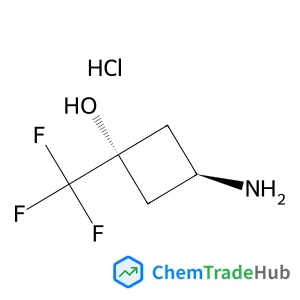
cis-3-Amino-1-(trifluoromethyl)cyclobutanol hydrochloride (1:1)
CAS Number:
1408075-16-0
Molecular Formula:
C5H9ClF3NO
Peng Liu, Caixia Yue, Zonghai Sheng, Guanhui Gao, Mingxing Li, Huqiang Yi, Cuifang Zheng, Bi Wang, Lintao Cai
Photodynamic therapy (PDT) has emerged as an effective treatment for tumor with minimal nonspecific damage to adjacent healthy tissues. Herein, redox-responsive self-quenching polysaccharide-based theranostic nanoparticles (DEX-SS-Ce6 NPs) were developed for tumor imaging and photodynamic therapy. The dextran–chlorin e6 conjugates (DEX-SS-Ce6) could self-assemble into nanoparticles with uniform sphere shape in aqueous solution and exhibit cellular redox-responsive “OFF/ON” behavior of a fluorescence signal. In addition, the DEX-SS-Ce6 NPs demonstrated an effective cellular uptake property and high phototoxicity upon near-infrared (NIR) laser irradiation. More importantly, DEX-SS-Ce6 NP treated mice presented enhanced tumor targeting ability and improved photodynamic therapeutic efficiency in an in vivo study, compared with free Ce6 treated mice. These results suggest that the DEX-SS-Ce6 NP is a great potential system for tumor imaging and photodynamic therapy.

Russian Journal of Coordination Chemistry

Current Opinion in Solid State & Materials Science

Russian Journal of Bioorganic Chemistry

Journal of Saudi Chemical Society

Russian Journal of Organic Chemistry

Journal of Peptide Science

Russian Journal of Applied Chemistry

Russian Journal of General Chemistry

Drug Discovery Today

Journal of Natural Medicines
Mark E. Wolf, Henry F. Schaefer, III
DOI: 10.1039/D1CP03302F
Yunxiang Lu, Yanmin Xu, Ling Lu, Zhijian Xu, Honglai Liu
DOI: 10.1039/D1CP02100A
Shun Kataoka, Makoto Harada, Tetsuo Okada
DOI: 10.1039/D1CP01655E
DOI: 10.1039/D1CP03146E
Xiaoyong Yang, Ming Jiang, Lixin Chen, Zhiwen Chen
DOI: 10.1039/D1CP02852A
Zachary Morrow, Hyuk-Yong Kwon, C. T. Kelley, Elena Jakubikova
DOI: 10.1039/D1CP03446D
Maddalena Bin, Rafat Yousif, Sharon Berkowicz, Sudipta Das, Daniel Schlesinger, Fivos Perakis
DOI: 10.1039/D1CP02126E
Zi Cheng Wong, Liviu Ungur
DOI: 10.1039/D1CP02795F
Dongyun Liu, Rongjia Wen, Qian Yu, Lennart Elfgren
DOI: 10.1039/D1CP04474E
Joharimanitra Randrianandraina, Michael Badawi, Bruno Cardey, Manuel Grivet, Jean-Emmanuel Groetz, Christophe Ramseyer, Freddy Torrealba Anzola, Caroline Chambelland, Didier Ducret
DOI: 10.1039/D1CP02624K
4-Nitrophenyl phosphate disodium salt hexahydrate is primarily used as a substra...
2-(Trifluoromethyl)-1,3-oxazole-4-carboxylic Acid (CAS: 1060816-01-4) is widely ...
2-Fluoro-4-biphenylcarboxylic acid should be stored in a cool, dry place at room...
Prednisolone-21-Carboxylic Acid is primarily used in the pharmaceutical industry...
4-(Hydrazinomethyl)-1,2,3-benzenetriol (CAS: 3614-72-0) should be stored in a co...
4-Amino-1-methyl-1H-pyrazole-5-carboxylic acid hydrochloride (CAS: 92534-70-8) i...
Dehydropachymic acid (CAS: 77012-31-8) is regulated by various agencies. It fall...
The market and research trends for 6-[(2,2-Dimethylpropanoyl)amino]nicotinic aci...
1,10-Phenanthroline-2,9-dicarbaldehyde should be stored in a cool, dry place awa...
5-Carbamoyl-11-oxo-10,11-dihydro-5H-dibenzo[b,f]azepin-10-yl acetate can be synt...

Polymer Chemistry welcomes submissions in all areas of polymer science that have a strong focus on macromolecular chemistry. Manuscripts may cover a broad range of fields, yet no direct application focus is required.


![1-[(4-Methylphenyl)sulfonyl]-3-(4,4,5,5-tetramethyl-1,3,2-dioxaborolan-2-yl)-1H-pyrrolo[2,3-b]pyridine-5-carbonitrile structure](https://static.chemtradehub.com/structs/143/1434747-57-5-fc0d.webp "1-[(4-Methylphenyl)sulfonyl]-3-(4,4,5,5-tetramethyl-1,3,2-dioxaborolan-2-yl)-1H-pyrrolo[2,3-b]pyridine-5-carbonitrile structure")