


Absolut “copper catalyzation perfected”; robust living polymerization of NIPAM: Guinness is good for SET-LRP
Literature Information
Publication Date
2013-09-11
DOI
10.1039/C3PY01075A
Impact Factor
5.582
Authors
Christopher Waldron, Qiang Zhang, Zaidong Li, Vasiliki Nikolaou, Gabit Nurumbetov, Jamie Godfrey, Ronan McHale, Gokhan Yilmaz, Rajan K. Randev, Mony Girault, Kayleigh McEwan, David M. Haddleton, Martijn Droesbeke, Alice J. Haddleton, Paul Wilson, Alexandre Simula, Jennifer Collins, Danielle J. Lloyd, James A. Burns, Christopher Summers, Claudia Houben, Athina Anastasaki, Muxiu Li, C. Remzi Becer, Jenny K. Kiviaho, Nuttapol Risangud
View Original
Abstract
The controlled polymerization of N-isopropyl acrylamide (NIPAM) is reported in a range of international beers, wine, ciders and spirits utilizing Cu(0)-mediated living radical polymerization (SET-LRP). Highly active Cu(0) is first formed in situ by the rapid disproportionation of [Cu(I)(Me6-Tren)Br] in the commercial water–alcohol mixtures. Rapid, yet highly controlled, radical polymerization follows (Đ values as low as 1.05) despite the numerous chemicals of diverse functionality present in these solvents e.g. alpha acids, sugars, phenols, terpenoids, flavonoids, tannins, metallo-complexes, anethole etc. The results herein demonstrate the robust nature of the aqueous SET-LRP protocol, underlining its ability to operate efficiently in a wide range of complex chemical environments.
Recommended Journals

Journal of Natural Medicines

Nature Medicine

Journal of Saudi Chemical Society

Russian Journal of General Chemistry

Journal of Peptide Science

Russian Chemical Bulletin

Current Opinion in Solid State & Materials Science

Current Opinion in Colloid & Interface Science

Saudi Pharmaceutical Journal

Russian Journal of Organic Chemistry
Related Literature
Exploring vibronic coupling in the benzene radical cation and anion with different levels of the GW approximation
Zi Cheng Wong, Liviu Ungur
2021-08-07
Paper
DOI: 10.1039/D1CP02795F
Kinetic Monte Carlo simulations of self-organization of Ge islands on Si(001)
Paramita Ghosh, Nidhi Gupta, Monika Dhankhar, Madhav Ranganathan
2021-08-09
Paper
DOI: 10.1039/D1CP00069A
Ground and excited electronic structures of metal encapsulated nanocages: the cases of endohedral M@C20H20 (M = K, Rb, Ca, Sr) and M@C36H36 (M = Na, K, Rb)
2021-08-03
Paper
DOI: 10.1039/D1CP03146E
Crucial impact of exchange between layers on temperature programmed desorption
Tobias Dickbreder, Ralf Bechstein, Angelika Kühnle
2021-08-06
Paper
DOI: 10.1039/D1CP01924D
Mechanistic insight into the roles of anions and cations in the degradation of poly(ethylene terephthalate) catalyzed by ionic liquids
Lei Zhou, Xingmei Lu, Yao Li, Xiaoqian Yao, Shenyu Cheng, Gangwei Chen, Chengsheng Ge
2021-08-16
Paper
DOI: 10.1039/D1CP02038B
Novel Janus diamane C4FCl: a stable and moderate bandgap semiconductor with a huge excitonic effect
2021-08-09
Paper
DOI: 10.1039/D1CP02632A
Deciphering the mechanism of action of 5FDQD and the design of new neutral analogues for the FMN riboswitch: a well-tempered metadynamics simulation study
2021-11-29
Paper
DOI: 10.1039/D1CP01348C
Fcc vs. hcp competition in colloidal hard-sphere nucleation: on their relative stability, interfacial free energy and nucleation rate
Ignacio Sanchez-Burgos, Eduardo Sanz, Carlos Vega, Jorge R. Espinosa
2021-08-13
Paper
DOI: 10.1039/D1CP01784E
Mechanical properties of nonstoichiometric cubic titanium carbide TiCy
2021-08-16
Paper
DOI: 10.1039/D1CP02697F
The NV−⋯N+ charged pair in diamond: a quantum-mechanical investigation
Anna Maria Ferrari, Khaled E. El-Kelany, Francesco Silvio Gentile, Maddalena D’Amore, Roberto Dovesi
2021-08-12
Paper
DOI: 10.1039/D1CP02363B
You might also like
Compound Q&A
What are the main uses of 4-Nitrophenyl phosphate disodium salt hexahydrate (CAS: 333338-18-4)?
4-Nitrophenyl phosphate disodium salt hexahydrate is primarily used as a substra...
333338-18-44-Nitrophenyl phosph...
Compound Q&A
What are the main uses of 2-(Trifluoromethyl)-1,3-oxazole-4-carboxylic Acid (CAS: 1060816-01-4)?
2-(Trifluoromethyl)-1,3-oxazole-4-carboxylic Acid (CAS: 1060816-01-4) is widely ...
1060816-01-42-(Trifluoromethyl)-...
Compound Q&A
How should 2-Fluoro-4-biphenylcarboxylic acid (CAS: 137045-30-8) be stored?
2-Fluoro-4-biphenylcarboxylic acid should be stored in a cool, dry place at room...
137045-30-82-Fluoro-4-biphenylc...
Compound Q&A
What industries use Prednisolone-21-Carboxylic Acid (CAS: 61549-70-0)?
Prednisolone-21-Carboxylic Acid is primarily used in the pharmaceutical industry...
61549-70-0Prednisolone-21-Carb...
Compound Q&A
How should 4-(Hydrazinomethyl)-1,2,3-benzenetriol (CAS: 3614-72-0) be stored?
4-(Hydrazinomethyl)-1,2,3-benzenetriol (CAS: 3614-72-0) should be stored in a co...
3614-72-04-(Hydrazinomethyl)-...
Compound Q&A
What industries use 4-Amino-1-methyl-1H-pyrazole-5-carboxylic acid hydrochloride (CAS: 92534-70-8)?
4-Amino-1-methyl-1H-pyrazole-5-carboxylic acid hydrochloride (CAS: 92534-70-8) i...
92534-70-84-Amino-1-methyl-1H-...
Compound Q&A
What regulatory guidelines apply to dehydropachymic acid (CAS: 77012-31-8)?
Dehydropachymic acid (CAS: 77012-31-8) is regulated by various agencies. It fall...
77012-31-8Dehydropachymic acid
Compound Q&A
What is the market or research trend for 6-[(2,2-Dimethylpropanoyl)amino]nicotinic acid (CAS: 898561-66-5)?
The market and research trends for 6-[(2,2-Dimethylpropanoyl)amino]nicotinic aci...
898561-66-56-[(2,2-Dimethylprop...
Compound Q&A
How should 1,10-Phenanthroline-2,9-dicarbaldehyde (CAS: 57709-62-3) be stored?
1,10-Phenanthroline-2,9-dicarbaldehyde should be stored in a cool, dry place awa...
57709-62-31,10-Phenanthroline-...
Compound Q&A
How is 5-Carbamoyl-11-oxo-10,11-dihydro-5H-dibenzo[b,f]azepin-10-yl acetate (CAS: 113952-21-9) typically synthesized?
5-Carbamoyl-11-oxo-10,11-dihydro-5H-dibenzo[b,f]azepin-10-yl acetate can be synt...
113952-21-95-Carbamoyl-11-oxo-1...
Source Journal
Polymer Chemistry

CiteScore:
8.6
Self-citation Rate:
7.3%
Articles per Year:
457
Polymer Chemistry welcomes submissions in all areas of polymer science that have a strong focus on macromolecular chemistry. Manuscripts may cover a broad range of fields, yet no direct application focus is required.
Recommended Compounds
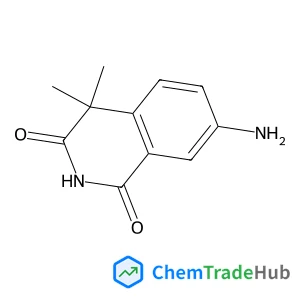
1,3(2H,4H)-Isoquinolinedione, 7-amino-4,4-dimethyl-
CAS Number:
14576-22-8
Molecular Formula:
C11H12N2O2

![(2E)-3-(3-Chlorophenyl)-N-{2-[4-(methylsulfonyl)-1-piperazinyl]-2-oxoethyl}acrylamide structure](https://static.chemtradehub.com/structs/250/2505001-54-5-c1e9.webp "(2E)-3-(3-Chlorophenyl)-N-{2-[4-(methylsulfonyl)-1-piperazinyl]-2-oxoethyl}acrylamide structure")
(2E)-3-(3-Chlorophenyl)-N-{2-[4-(methylsulfonyl)-1-piperazinyl]-2-oxoethyl}acrylamide
CAS Number:
2505001-54-5
Molecular Formula:
C16H20ClN3O4S

Recommended Suppliers






Disclaimer
This page provides academic journal information for reference and research purposes only. We are not affiliated with any journal publishers and do not handle publication submissions. For publication-related inquiries, please contact the respective journal publishers directly.
If you notice any inaccuracies in the information displayed, please contact us at support@chemtradehub.com. We will promptly review and address your concerns.