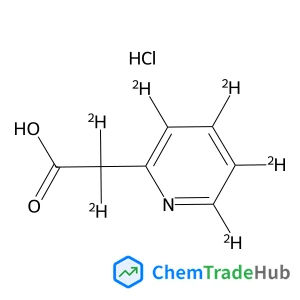
2,2-dideuterio-2-(3,4,5,6-tetradeuterio-2-pyridyl)acetic acid;hydrochloride
CAS Number:
1329799-67-8
Molecular Formula:
C7H2ClD6NO2
Mustafa Ciftci
A new photoredox catalyst system for atom transfer radical polymerization is developed on the basis of visible light photocatalysis using dimanganese decacarbonyl (Mn2(CO)10) that initiates and controls the polymerization at ambient temperature. The polymerization was performed by a Mn2(CO)10–alkyl halide system with visible- or sunlight in the presence of parts per million (ppm) copper catalysts. The photogenerated ˙Mn(CO)5 radicals are not only able to abstract halogen atoms from alkyl halides to generate carbon centered radicals but also reduce the CuIIBr2 to CuIBr directly, which was used as an activator in the Atom Transfer Radical Polymerization (ATRP) of vinyl monomers such as methyl methacrylate, methyl acrylate and styrene. The method was also used to synthesize graft copolymers from commercially available poly(vinyl chloride) without additional modification.

Russian Journal of Bioorganic Chemistry

Russian Journal of Coordination Chemistry

Drug Discovery Today

Journal of Saudi Chemical Society

Saudi Pharmaceutical Journal

Crystallography Reports

Russian Journal of General Chemistry

Current Opinion in Solid State & Materials Science

Russian Journal of Organic Chemistry

Journal of Natural Medicines
Yoichi Murakami, Kenji Kamada
DOI: 10.1039/D1CP02654B
Joanne L. Woodhouse, Alice Henley, Ross Lewin, John M. Ward, Helen C. Hailes, Anastasia V. Bochenkova, Helen H. Fielding
DOI: 10.1039/D1CP01901E
Igor A. Nikovskiy, Dmitry Y. Aleshin
DOI: 10.1039/D1CP04648A
Yunxiang Lu, Yanmin Xu, Ling Lu, Zhijian Xu, Honglai Liu
DOI: 10.1039/D1CP02100A
Sharmin Akter, Jorge A. Vargas, Kamal Sharkas, Juan E. Peralta, Koblar A. Jackson
DOI: 10.1039/D0CP06512A
Chun Zhang, Yi-Tao Sun, Xue Yan, Xue-Hui Guo, Ai-Min Ren, Wen-Long Wang
DOI: 10.1039/D1CP04268H
Zhizhou Wu, Liuyang Li, Xuedong Zhou, Xiujian Zhao, Baoshun Liu
DOI: 10.1039/D1CP03135J
Shaohua Lu, Yiyuan Cai, Xiaojun Hu
DOI: 10.1039/D1CP02286E
Mark E. Wolf, Henry F. Schaefer, III
DOI: 10.1039/D1CP03302F
Zeng Liang, Kejiang Li, Ziming Wang, Yushan Bu, Jianliang Zhang
DOI: 10.1039/D1CP02595C
4-Nitrophenyl phosphate disodium salt hexahydrate is primarily used as a substra...
2-(Trifluoromethyl)-1,3-oxazole-4-carboxylic Acid (CAS: 1060816-01-4) is widely ...
2-Fluoro-4-biphenylcarboxylic acid should be stored in a cool, dry place at room...
Prednisolone-21-Carboxylic Acid is primarily used in the pharmaceutical industry...
4-(Hydrazinomethyl)-1,2,3-benzenetriol (CAS: 3614-72-0) should be stored in a co...
4-Amino-1-methyl-1H-pyrazole-5-carboxylic acid hydrochloride (CAS: 92534-70-8) i...
Dehydropachymic acid (CAS: 77012-31-8) is regulated by various agencies. It fall...
The market and research trends for 6-[(2,2-Dimethylpropanoyl)amino]nicotinic aci...
1,10-Phenanthroline-2,9-dicarbaldehyde should be stored in a cool, dry place awa...
5-Carbamoyl-11-oxo-10,11-dihydro-5H-dibenzo[b,f]azepin-10-yl acetate can be synt...

Polymer Chemistry welcomes submissions in all areas of polymer science that have a strong focus on macromolecular chemistry. Manuscripts may cover a broad range of fields, yet no direct application focus is required.
phosphoryl}methyl 4-methylbenzenesulfonate structure](https://static.chemtradehub.com/structs/864/864068-45-1-ba7c.webp "{[3-(Hexadecyloxy)propoxy](hydroxy)phosphoryl}methyl 4-methylbenzenesulfonate structure")