












Prediction of synergism on frequency of responses in the attojoule range
Literature Information
Publication Date
2004-03-02
DOI
10.1039/B314008C
Impact Factor
3.676
Authors
Nelson P. Barrera, Soledad Torres, Bernardo Morales, Manuel Villalon
View Original
Abstract
Synergistic molecular responses control processes widely distributed in physical and biological systems. However, the prediction of the molecular basis for the synergism has not yet been addressed. We present a physicochemical model for the synergism based on the frequency (f) of response using the number of molecules (n) of the maximum joint response in the attojoule (aJ) range. The model predicts that individual responses containing the highest n and lowest kinetic energies (ε), trigger the highest rate of change in the generation of n of the synergistic response. In addition, the rate of change in the decay of synergism is correlated with ε and potential energy (εpot) values, but is independent of the range between ε magnitude of individual responses and the ε of joint response. To evaluate our approach, we applied a mathematical model on the synergistic increase on ciliary beat f (CBF) induced by ATP and Adenosine. This produced the highest value of n of the joint response at minimal ε of individual responses. Furthermore, higher synergism presents a higher sensitivity on initial steps of transduction mechanisms. Our findings may be fruitful in the investigation of molecular synergism in physical and biological systems.
Related Literature
A hydrate salt-promoted reductive coupling reaction of nitrodienes with unactivated alkenes
Mengmeng Zhang, Liming Yang, Chao Tian, Meng Zhou, Guangming Li
2019-01-31
Paper
DOI: 10.1039/C9OB00136K
Chemiluminescence molecular probe with a linear chain reaction amplification mechanism
Samer Gnaim, Doron Shabat
2019-01-21
Communication
DOI: 10.1039/C8OB03042A
Posttranscriptional spin labeling of RNA by tetrazine-based cycloaddition
Christof Domnick, Gregor Hagelueken, Frank Eggert, Olav Schiemann, Stephanie Kath-Schorr
2018-11-28
Communication
DOI: 10.1039/C8OB02597E
Metal-free difunctionalization of alkynes to access tetrasubstituted olefins through spontaneous selenosulfonylation of vinylidene ortho-quinone methide (VQM)
Zhili Chen, Hui Mao, Fangli Hu, Dongmei Li, Yu Tan, Fengqing Yang, Wenling Qin
2019-01-07
Paper
DOI: 10.1039/C8OB02967A
Straight access to highly fluorescent angular indolocarbazoles via merging Au- and Mo-catalysis
Fernando Martínez-Lara, Anisley Suárez, Samuel Suárez-Pantiga, M. José Tapia, Roberto Sanz
2020-06-10
Research Article
DOI: 10.1039/D0QO00405G
Sulfur polymer composites as controlled-release fertilisers
Joshua McErlean, Jessica A. Smith, Tom Hasell, Michael V. Perkins
2018-10-05
Paper
DOI: 10.1039/C8OB02130A
Copper-catalyzed trifluoromethylthiolation-peroxidation of alkenes and allenes
Yuanjin Chen, Yangyang Ma, Liangkui Li, Mingshuo Cui, Zhiping Li
2020-06-02
Research Article
DOI: 10.1039/D0QO00533A
Iron catalysed selective reduction of esters to alcohols
Sem Raj Tamang, Anthony F. Cozzolino, Michael Findlater
2018-12-18
Communication
DOI: 10.1039/C8OB02661K
Aromatization-driven deconstruction/refunctionalization of unstrained rings
Fangzhi Hu, Lubin Xu
2020-06-01
Highlight
DOI: 10.1039/D0QO00344A
Examining the vinyl moiety as a protecting group for hydroxyl (–OH) functionality under basic conditions
Vladimir V. Voronin, Maria S. Ledovskaya
2020-04-08
Research Article
DOI: 10.1039/D0QO00202J
You might also like
Compound Q&A
What industries use (1R,3S)-1,3-Cyclopentanediol (CAS: 16326-97-9)?
(1R,3S)-1,3-Cyclopentanediol finds applications in various industries. In the ph...
16326-97-9(1R,3S)-1,3-Cyclopen...
Compound Q&A
What precautions should be taken when handling N'-[4-(Dimethylamino)phenyl]-N,N-dimethyl-1,4-benzenediamine (CAS: 637-31-0)?
When handling N'-[4-(Dimethylamino)phenyl]-N,N-dimethyl-1,4-benzenediamine, it i...
637-31-0N'-[4-(Dimethylamino...
Compound Q&A
Are there alternatives to 5-(2,4-Difluorophenyl)-2-methoxypyrimidine (CAS: 1352318-16-1) in synthesis?
There are several alternatives to 5-(2,4-Difluorophenyl)-2-methoxypyrimidine in ...
1352318-16-15-(2,4-Difluoropheny...
Compound Q&A
What regulatory guidelines apply to 1-(3-Methoxyphenoxy)propan-2-ol (CAS: 382141-68-6)?
1-(3-Methoxyphenoxy)propan-2-ol (CAS: 382141-68-6) must comply with the Globally...
382141-68-61-(3-Methoxyphenoxy)...
Compound Q&A
Is Tetrodotoxin Citrate (CAS: 18660-81-6) safe?
Tetrodotoxin Citrate is extremely dangerous and should be handled with extreme c...
18660-81-6Tetrodotoxin Citrate
Compound Q&A
What are the main uses of 2-Methyl-2-propanyl [(1R,3S)-3-hydroxycyclopentyl]carbamate (CAS: 225641-84-9)?
2-Methyl-2-propanyl [(1R,3S)-3-hydroxycyclopentyl]carbamate (CAS: 225641-84-9) i...
225641-84-92-Methyl-2-propanyl ...
Compound Q&A
How should waste containing 4-(2-Hydroxyhexafluoroisopropyl)Benzoic Acid (CAS: 16261-80-6) be handled?
Waste containing 4-(2-Hydroxyhexafluoroisopropyl)Benzoic Acid (CAS: 16261-80-6) ...
16261-80-64-(2-Hydroxyhexafluo...
Compound Q&A
How is 2-Methyl-2-proanyl {(2S)-1-[(benzyloxy)amino]-3-hydroxy-3-methyl-1-oxo-2-butanyl}carbamate (CAS: 102507-19-7) typically synthesized?
2-Methyl-2-proanyl {(2S)-1-[(benzyloxy)amino]-3-hydroxy-3-methyl-1-oxo-2-butanyl...
102507-19-72-Methyl-2-propanyl ...
Compound Q&A
What is Benzeneethanamine, α-ethyl-, hydrochloride (1:1) (CAS: 20735-15-3)?
Benzeneethanamine, α-ethyl-, hydrochloride (1:1) is an organic compound with the...
20735-15-3Benzeneethanamine, α...
Compound Q&A
Are there alternatives to 3-{(E)-[4-(Dimethylamino)phenyl]diazenyl}benzoic acid (CAS: 20691-84-3) in synthesis?
In the synthesis of compounds similar to 3-{(E)-[4-(Dimethylamino)phenyl]diazeny...
20691-84-33-{(E)-[4-(Dimethyla...
Source Journal
Physical Chemistry Chemical Physics

CiteScore:
5.5
Self-citation Rate:
10.3%
Articles per Year:
3036
Physical Chemistry Chemical Physics (PCCP) is an international journal co-owned by 19 physical chemistry and physics societies from around the world. This journal publishes original, cutting-edge research in physical chemistry, chemical physics and biophysical chemistry. To be suitable for publication in PCCP, articles must include significant innovation and/or insight into physical chemistry; this is the most important criterion that reviewers and Editors will judge against when evaluating submissions. The journal has a broad scope and welcomes contributions spanning experiment, theory, computation and data science. Topical coverage includes spectroscopy, dynamics, kinetics, statistical mechanics, thermodynamics, electrochemistry, catalysis, surface science, quantum mechanics, quantum computing and machine learning. Interdisciplinary research areas such as polymers and soft matter, materials, nanoscience, energy, surfaces/interfaces, and biophysical chemistry are welcomed if they demonstrate significant innovation and/or insight into physical chemistry. Joined experimental/theoretical studies are particularly appreciated when complementary and based on up-to-date approaches.
Recommended Compounds
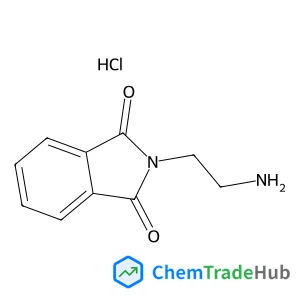
2-(2-Aminoethyl)-1H-isoindole-1,3(2H)-dione hydrochloride (1:1)
CAS Number:
30250-67-0
Molecular Formula:
C10H11ClN2O2
Recommended Suppliers






Disclaimer
This page provides academic journal information for reference and research purposes only. We are not affiliated with any journal publishers and do not handle publication submissions. For publication-related inquiries, please contact the respective journal publishers directly.
If you notice any inaccuracies in the information displayed, please contact us at support@chemtradehub.com. We will promptly review and address your concerns.