












Surface-enhanced resonance Raman scattering as an analytical tool for single molecule detection
Literature Information
Publication Date
2004-02-13
DOI
10.1039/B312812A
Impact Factor
4.616
Authors
Benissa Tolaieb, Carlos J. L. Constantino, Ricardo F. Aroca
View Original
Abstract
A perylene derivative, n-(n-butyl)-n′-(4-aminobutyl) perylene-3,4,9,10-tetracarboxylic acid diimide (simplified as nBu-PTCD-(CH2)4-NH2) has been chosen as the target molecule for studies involving single molecule detection (SMD) using Raman scattering. The enhancement of the Raman signal is the result of the multiplicative effects of two phenomena, resonance Raman scattering (RRS) and surface-enhanced Raman scattering (SERS), which leads to the resulting surface-enhanced resonance Raman scattering (SERRS) process. The SERRS spectra from a single molecule have been collected using both silver and gold colloids. The SMD detection of the fundamental vibrational frequencies characteristic of nBu-PTCD-(CH2)4-NH2 is complemented with the detection of some overtones and combinations from ring stretching modes at the single molecule level. The background characterization of the ensemble vibrational spectroscopy of the target perylene and its SERRS is also presented, which includes the UV-vis absorption, experimental and calculated Raman scattering and infrared absorption, and molecular organization using reflection-absorption infrared spectroscopy (RAIRS).
Related Literature
Understanding and controlling the glass transition of HTPB oligomers
Eleftheria Dossi, Jacob Earnshaw, Laurence Ellison, Gabriella Rabello dos Santos, Hamish Cavaye, Douglas J. Cleaver
2021-04-07
Paper
DOI: 10.1039/D1PY00233C
Synthesis of well-defined diblock copolymer nano-objects by RAFT non-aqueous emulsion polymerization of N-(2-acryloyloxy)ethyl pyrrolidone in non-polar media
R. R. Gibson, A. Fernyhough, O. M. Musa, S. P. Armes
2021-06-23
Paper
DOI: 10.1039/D1PY00572C
Conjugated microporous polymers using a copper-catalyzed [4 + 2] cyclobenzannulation reaction: promising materials for iodine and dye adsorption
Saleh Al-Mousawi
2021-03-17
Paper
DOI: 10.1039/D1PY00193K
Hierarchical ordering and multilayer structure of poly(ε-caprolactone) end-functionalized by a liquid crystalline unit: role of polymer crystallization
Wenqing Xu, Xing Li, Wenhua Yuan, Jian Zhou
2021-07-05
Paper
DOI: 10.1039/D1PY00702E
Visible light-degradable supramolecular gels comprising cross-linked polyrotaxanes capped with trithiocarbonate groups
Tae Woong Kang, Atsushi Tamura, Yoshinori Arisaka, Nobuhiko Yui
2021-06-09
Paper
DOI: 10.1039/D1PY00569C
One-shot synthesis of star gradient copolymers with controllable graft density
2021-04-06
Paper
DOI: 10.1039/D1PY00313E
Regulation of tectonic sequences in chain-folding-directed monodisperse isomeric oligomers precisely tailored by Ugi-hydrosilylation orthogonal cycles
Chao Li, Li Han, Xiping Chen, Xinyu Bao, Qi Sun, Hongwei Ma, Yang Li
2021-05-25
Communication
DOI: 10.1039/D1PY00416F
A highly efficient metal-free protocol for the synthesis of linear polydicyclopentadiene
Xuejin Yang, Laura M. Murphy, Scott M. Grayson
2021-04-14
Paper
DOI: 10.1039/D1PY00191D
Polyamides containing a biorenewable aromatic monomer based on coumalate esters: from synthesis to evaluation of the thermal and mechanical properties
Jurrie Noordijk, Bert Gebben, Monique H. M. Meeusen-Wierts, Katrien V. Bernaerts
2021-03-23
Paper
DOI: 10.1039/D1PY00005E
You might also like
Compound Q&A
What precautions should be taken when handling 4-(2-Furylmethyl)thiomorpholine 1,1-dioxide (CAS: 79206-94-3)?
When handling 4-(2-Furylmethyl)thiomorpholine 1,1-dioxide (CAS: 79206-94-3), it ...
79206-94-34-(2-Furylmethyl)thi...
Compound Q&A
What precautions should be taken when handling 4-Chloro-N-[2-(4-morpholinyl)ethyl]benzamide (CAS: 71320-77-9)?
When handling 4-Chloro-N-[2-(4-morpholinyl)ethyl]benzamide (CAS: 71320-77-9), it...
71320-77-94-Chloro-N-[2-(4-mor...
Compound Q&A
How should waste containing 2-[2-(2-Methoxyethoxy)ethoxy]ethyl 4-methylbenzenesulfonate (CAS: 62921-74-8) be handled?
Waste containing this compound (CAS: 62921-74-8) should be handled according to ...
62921-74-82-[2-(2-Methoxyethox...
Compound Q&A
How should waste containing (S)-Methyl 2-amino-3-cyclohexylpropanoate be handled?
Waste containing (S)-Methyl 2-amino-3-cyclohexylpropanoate should be collected i...
40056-18-6(S)-Methyl 2-amino-3...
Compound Q&A
How is 5-({4-[(2S,4R)-4-Hydroxy-2-methyltetrahydro-2H-pyran-4-yl]-2-thienyl}sulfanyl)-1-methyl-1,3-dihydro-2H-indol-2-one (CAS: 166882-70-8) typically synthesized?
This compound can be synthesized using a multi-step process involving the conjug...
166882-70-85-({4-[(2S,4R)-4-Hyd...
Compound Q&A
Are there alternatives to (2E)-3-(3,4-Dichlorophenyl)acrylic acid (CAS: 7312-27-8) in synthesis?
There are several alternatives to (2E)-3-(3,4-Dichlorophenyl)acrylic acid in syn...
7312-27-8(2E)-3-(3,4-Dichloro...
Compound Q&A
How should Ethyl 6-(2-nitrophenyl)imidazo[2,1-b][1,3]thiazole-3-carboxylate (CAS: 925437-84-9) be stored?
Ethyl 6-(2-nitrophenyl)imidazo[2,1-b][1,3]thiazole-3-carboxylate (CAS: 925437-84...
925437-84-9Ethyl 6-(2-nitrophen...
Compound Q&A
How should waste containing 2-(1,3-Thiazol-2-yl)ethanamine (CAS: 18453-07-1) be handled?
Waste containing 2-(1,3-Thiazol-2-yl)ethanamine (CAS: 18453-07-1) should be coll...
18453-07-12-(1,3-Thiazol-2-yl)...
Compound Q&A
How is Methyl 5-iodo-2-methylbenzoate (CAS: 103440-54-6) typically synthesized?
Methyl 5-iodo-2-methylbenzoate can be synthesized through the iodination of meth...
103440-54-6Methyl 5-iodo-2-meth...
Compound Q&A
How is 5-Chloro[1,2,4]triazolo[1,5-a]pyridine (CAS: 1427399-34-5) typically synthesized?
5-Chloro[1,2,4]triazolo[1,5-a]pyridine is commonly synthesized via the condensat...
1427399-34-55-Chloro[1,2,4]triaz...
Source Journal
Analyst

CiteScore:
7.8
Self-citation Rate:
5.6%
Articles per Year:
653
Analyst publishes analytical and bioanalytical research that reports premier fundamental discoveries and inventions, and the applications of those discoveries, unconfined by traditional discipline barriers.
Recommended Compounds
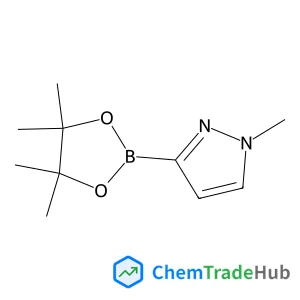
1-Methyl-3-(4,4,5,5-tetramethyl-1,3,2-dioxaborolan-2-yl)-1H-pyrazole
CAS Number:
1020174-04-2
Molecular Formula:
C10H17BN2O2

Recommended Suppliers





Disclaimer
This page provides academic journal information for reference and research purposes only. We are not affiliated with any journal publishers and do not handle publication submissions. For publication-related inquiries, please contact the respective journal publishers directly.
If you notice any inaccuracies in the information displayed, please contact us at support@chemtradehub.com. We will promptly review and address your concerns.