












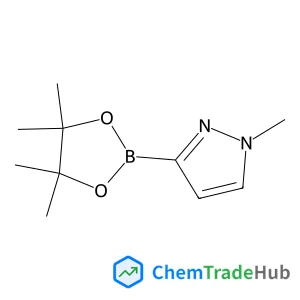
1-Methyl-3-(4,4,5,5-tetramethyl-1,3,2-dioxaborolan-2-yl)-1H-pyrazole
CAS Number:
1020174-04-2
Molecular Formula:
C10H17BN2O2
Catherine A Veasey, C. L. P. Thomas
A chromatography-based method for producing mass flux-response surfaces for differential mobility spectrometers is described as a replacement for exponential dilution and mixing approaches. An exponential dilution or mixing experiment typically takes 150 min; while the exponential function in the Gaussian elution profile obtained from linear chromatography may be exploited in approximately 10 s. The approach was demonstrated with a gas chromatograph-mass spectrometer and the correlation of the calibration results to nominal on-column masses was within experimental error for 19 separate analyses. The method was then applied to a gas chromatographic (10.6 eV UV) differential mobility spectrometer. Mass fluxes in the range 10 pg s−1 to 250 ng s−1 were generated over the 5 s to 10 s associated with the elution of a chromatographic peak. The characterisations were repeated for a range of electrical field strengths from 10 kV cm−1 to 30 kV cm−1. Triplicate runs indicated that the approach was reproducible and that response surfaces could be generated rapidly from chromatographic data. The effects of trace impurities associated with the chromatographic eluent on the relationship between compensation voltage and electrical field strength was observed. This emphasised the importance of managing this aspect of the operation if reliable estimates of alpha functions for the compounds under study were to be obtained. Application of this approach to other detection systems with an 85% reduction in the analytical operations required to produce a reliable calibration function was also noted.
Idan Hod, Zion Tachan, Menny Shalom, Arie Zaban
DOI: 10.1039/C3CP50242B
Mega Kar, Bjorn Winther-Jensen, Maria Forsyth, Douglas R. MacFarlane
DOI: 10.1039/C3CP51102B
Zoran Marković, Dragan Amić, Dejan Milenković, Jasmina M. Dimitrić-Marković, Svetlana Marković
DOI: 10.1039/C3CP44605K
Changqing Liu, Xiaobo Ji, Pingmin Zhang, Qiyuan Chen, Craig E. Banks
DOI: 10.1039/C3CP44171G
Martin Thomas, Martin Brehm, Reinhold Fligg, Peter Vöhringer, Barbara Kirchner
DOI: 10.1039/C3CP44302G
Qing Jie, Hengzhi Wang, Weishu Liu, Hui Wang, Gang Chen, Zhifeng Ren
DOI: 10.1039/C3CP50327E
Ryusuke Futamura, Miguel Jorge, José R. B. Gomes
DOI: 10.1039/C3CP50193K
Thomas Elder, Joseph J. Bozell, Diana Cedeno
DOI: 10.1039/C3CP44404J
Christoph Kölbl, Beate Stempfle
DOI: 10.1039/C3CP44693J
Eric S. Shamay, Nicholas A. Valley, Frederick G. Moore, Geraldine L. Richmond
DOI: 10.1039/C3CP50609F
When handling 4-(2-Furylmethyl)thiomorpholine 1,1-dioxide (CAS: 79206-94-3), it ...
When handling 4-Chloro-N-[2-(4-morpholinyl)ethyl]benzamide (CAS: 71320-77-9), it...
Waste containing this compound (CAS: 62921-74-8) should be handled according to ...
Waste containing (S)-Methyl 2-amino-3-cyclohexylpropanoate should be collected i...
This compound can be synthesized using a multi-step process involving the conjug...
There are several alternatives to (2E)-3-(3,4-Dichlorophenyl)acrylic acid in syn...
Ethyl 6-(2-nitrophenyl)imidazo[2,1-b][1,3]thiazole-3-carboxylate (CAS: 925437-84...
Waste containing 2-(1,3-Thiazol-2-yl)ethanamine (CAS: 18453-07-1) should be coll...
Methyl 5-iodo-2-methylbenzoate can be synthesized through the iodination of meth...
5-Chloro[1,2,4]triazolo[1,5-a]pyridine is commonly synthesized via the condensat...

Analyst publishes analytical and bioanalytical research that reports premier fundamental discoveries and inventions, and the applications of those discoveries, unconfined by traditional discipline barriers.
![5-Acetyl-2,3-dihydrobenzo[b]furan structure](https://static.chemtradehub.com/structs/908/90843-31-5-eea4.webp "5-Acetyl-2,3-dihydrobenzo[b]furan structure")





