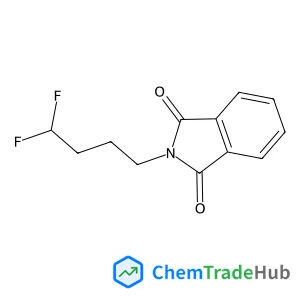
2-(4,4-Difluorobutyl)-1H-isoindole-1,3(2H)-dione
CAS Number:
1265341-14-7
Molecular Formula:
C12H11F2NO2
Kiyohiko Kawai, Aya Yokoohji, Sachiko Tojo, Tetsuro Majima
Using nucleoside derivatives, which are soluble in dichloromethane, we have experimentally demonstrated that the reduction potential of cytosine is lowered by base pairing with guanine.
M. Agåker, C. Schwanke, T. Petit, K. M. Lange, J.-E. Rubensson
DOI: 10.1039/C4CP03153A
Jinlian Hu, Haibo Zeng, Cong Wang, Zhigang Li, Caixia Kan, Youwen Liu
DOI: 10.1039/C4CP02299H
Thomas J. Penfold, Maarten Nachtegaal, Chris J. Milne, Majed Chergui
DOI: 10.1039/C4CP03301A
Filipa Gonçalves de Azevedo, John F. Griffiths, Silvana S. S. Cardoso
DOI: 10.1039/C4CP02990A
O. V. Magdysyuk, F. Adams, H.-P. Liermann, I. Spanopoulos, P. N. Trikalitis, M. Hirscher, R. E. Morris, M. J. Duncan, L. J. McCormick, R. E. Dinnebier
DOI: 10.1039/C4CP03298E
Geng-Geng Luo, Kai Fang, Ji-Huai Wu, Jing-Cao Dai, Qing-Hua Zhao
DOI: 10.1039/C4CP03343D
Xiaobiao Liu, Jie Tan, Aizhu Wang, Xiaoming Zhang, Mingwen Zhao
DOI: 10.1039/C4CP03478C
Hyun S. Park, Chong-Yong Lee, Erwin Reisner
DOI: 10.1039/C4CP03883E
Koichi Fumino, Sebastian Reimann
DOI: 10.1039/C4CP01476F
N-(4-Methoxybenzyl)-2-pyridinamine (CAS: 52818-63-0) is increasingly being used ...
When handling Ethyl 4-(2-chlorophenyl)-1,3-thiazole-2-carboxylate, appropriate p...
Diethyldiselane (CAS: 628-39-7) is classified under the Globally Harmonized Syst...
The market for oxocopper (CAS: 12053-18-8) is primarily driven by its use in cat...
The market for 5-{[(2-Methyl-2-propanyl)oxy]carbonyl}-5-azaspiro[2.4]heptane-7-c...
2-(1-Pyrrolidinyl)-4-pyridinamine is a chemical compound with the CAS number 359...
2-(3-Pyridinyl)-1-azabicyclo[2.2.2]octane (CAS: 91556-75-1) is a crystalline sol...
(S)-Alpha-allyl-proline hydrochloride is usually synthesized via a Wittig reacti...
3-Methyl-1,2-oxazole-5-carboxylic acid (CAS: 4857-42-5) is an organic compound w...
Lys-SMCC-DM1 is synthesized via a multi-step process involving the coupling of S...

ChemComm publishes urgent research which is of outstanding significance and interest to experts in the field, while also appealing to the journal’s broad chemistry readership. Our communication format is ideally suited to short, urgent studies that are of such importance that they require accelerated publication. Our scope covers all topics in chemistry, and research at the interface of chemistry and other disciplines (such as materials science, nanoscience, physics, engineering and biology) where there is a significant novelty in the chemistry aspects. Major topic areas covered include: Analytical Chemistry Catalysis Chemical Biology and medicinal chemistry Computational Chemistry and Machine Learning Energy and sustainable chemistry Environmental Chemistry Green Chemistry Inorganic Chemistry Materials Chemistry Nanoscience Organic Chemistry Physical Chemistry Polymer Chemistry Supramolecular Chemistry