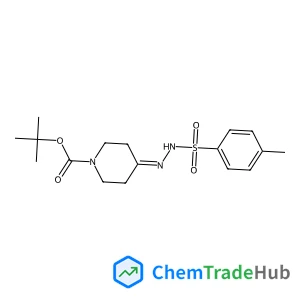
tert-Butyl 4-(2-(p-Tolylsulfonyl)hydrazono)piperidine-1-carboxylate
CAS Number:
1046478-89-0
Molecular Formula:
C17H25N3O4S
Sabine Werlich, Heidi Stockhorst, Ute Witting, Norbert Binding
The synthesis of a new tailor-made derivatization agent for the selective determination of (di)isocyanates is presented. Starting from cyanuric chloride, the reagent 4-methoxy-6-(4-methoxy-1-naphthyl)-1,3,5-triazine-2-(1-piperazine) (MMNTP) is synthesized by subsequent substitution of the three chlorine atoms. This new derivatization agent and the five urea derivatives of phenylisocyanate (PI), hexamethylene-diisocyanate (HDI), toluene-2,4-diisocyanate (2,4-TDI), toluene-2,6-diisocyanate (2,6-TDI) and methylenebisphenyl-4,4-diisocyanate (MDI) show good spectroscopic properties with small compound-to-compound variabilities (RSDε = 5.3 %, RSDrelative fluorescence = 9.4 %). Therefore, using UV detection, a single calibration is needed for the quantification of all diisocyanates and isocyanates respectively. For separation and analysis a HPLC method with a RP column and a binary gradient is presented. All derivatives are separated and show low limits of detection. In addition to the good spectroscopic properties and low limits of detection, good reactivity for the derivatizations at room temperature is observed. The aromatic diisocyanates can be measured immediately whereas aliphatic diisocyanates need 2 h incubation. These advantages make MMNTP a powerful and versatile derivatization agent for (di)isocyanates which is demonstrated by a real sample with solid phase sampling, where the reagent is coated on a sorbent.
Fausto Lucarelli, Silvia Capponcelli, Giovanna Marrazza, Luca Sangiorgi, Marco Mascini
DOI: 10.1039/B806514D
Ilaria Palchetti, Marco Mascini
DOI: 10.1039/B802920M
Andrew D. Spooner, Conrad Bessant, Claire Turner, Henri Knobloch, Mark Chambers
DOI: 10.1039/B905627K
Arunas Ramanavicius, Almira Ramanaviciene
DOI: 10.1039/B801501E
John S. Mitchell, Tim E. Lowe, John R. Ingram
DOI: 10.1039/B817083P
Abdolkarim Abbaspour, Abolhassan Noori
DOI: 10.1039/B806920D
Atsushi Urakawa, Franz Trachsel, Philipp Rudolf von Rohr, Alfons Baiker
DOI: 10.1039/B808984C
Isao Sasaki, Nobutsugu Minami, Annamalai Karthigeyan, Konstantin Iakoubovskii
DOI: 10.1039/B813073F
Kadir Aslan, Chris D. Geddes
DOI: 10.1039/B808292H
Guan-Liang Chen, Shing-Yi Suen, Sarah Vied, Kali Pickering, Christopher Perrin, Eric D. Conte
DOI: 10.1039/B814224F
When considering alternatives to 1-(4-Chlorophenyl)-N-hydroxymethanimine (CAS: 3...
This compound should be stored in a cool, dry place away from direct sunlight. I...
3-(4-Bromophenyl)-5-(2-fluorophenyl)-1,2,4-oxadiazole is synthesized through a m...
5-Chloro-2-(4-chlorophenyl)-4-methyl-6-[3-(1-piperidinyl)propoxy]pyrimidine (CAS...
2-Chloro-4-(difluoromethoxy)pyridine is used in the pharmaceutical industry for ...
3-Chloro-6-methylpyridazine (CAS: 1121-79-5) is classified under the Globally Ha...
Several alternatives can be used in the synthesis of Methyl 4,5-dimethyl-2-nitro...
Alternatives to (2E,2'E)-3,3'-(1,4-Phenylene)bisacrylaldehyde include other acry...
3-Amino-5-chloropyridin-2-ol hydrochloride is an organic compound with the CAS n...
When handling 6,7-Difluoro-2,3-dihydro-4H-chromen-4-one, it is essential to wear...

Analyst publishes analytical and bioanalytical research that reports premier fundamental discoveries and inventions, and the applications of those discoveries, unconfined by traditional discipline barriers.
![(2S)-2-{[(9H-Fluoren-9-ylmethoxy)carbonyl]amino}-4-(methylselanyl)butanoic acid structure](https://static.chemtradehub.com/structs/121/1217852-49-7-f252.webp "(2S)-2-{[(9H-Fluoren-9-ylmethoxy)carbonyl]amino}-4-(methylselanyl)butanoic acid structure")