












Study on interactions of endocrine disruptors with estrogen receptor using fluorescence polarization
Literature Information
Publication Date
2003-07-07
DOI
10.1039/B303985D
Impact Factor
4.616
Authors
Sachiko Suzuki, Takeshi Fukushima, Masako Maeda, Tomofumi Santa, Kazuhiro Imai
View Original
Abstract
In this study, we examined the affinities of many (21) compounds such as hormones, pharmaceuticals, industrial chemicals, and phytoestrogens to the estrogen receptor (ER) by ER binding assay using fluorescence polarization (FP). This method is based on the competitive binding assay using fluorescein-labeled estradiol (F–E2), in which the polarization values decreased with the addition of the compounds (competitors). The obtained sigmoidal inhibition curves were transformed into the pseudo-Hill plots, and the concentrations at 50% inhibition (IC50) and Hill coefficients were obtained from the regression equations. We examined the relationship between the chemical structures and estrogenic activities, and finally classified the tested compounds into three categories, agonists, partial agonists and antagonists based on their Hill coefficients.
Recommended Journals
Related Literature
Effect of lithium-trapping on nitrogen-doped graphene as an anchoring material for lithium–sulfur batteries: a density functional theory study
Gyu Seong Yi, Eun Seob Sim, Yong-Chae Chung
2017-09-27
Paper
DOI: 10.1039/C7CP04507G
Catalytic CO2 reduction to valuable chemicals using NiFe-based nanoclusters: a first-principles theoretical evaluation
Li Gong, Jie-Jie Chen
2017-09-25
Paper
DOI: 10.1039/C7CP06155B
Few-layered metallic 1T-MoS2/TiO2 with exposed (001) facets: two-dimensional nanocomposites for enhanced photocatalytic activities
HyukSu Han, Kang Min Kim, Chan-Woo Lee, Caroline S. Lee, Rajendra C. Pawar, Jacob L. Jones, Jeong Ho Ryu, Taeseup Song, Suk Hyun Kang, Heechae Choi, Sungwook Mhin
2017-09-25
Paper
DOI: 10.1039/C7CP05523D
Particle formation and growth from oxalic acid, methanesulfonic acid, trimethylamine and water: a combined experimental and theoretical study
Kristine D. Arquero, Jing Xu, Barbara J. Finlayson-Pitts
2017-10-13
Paper
DOI: 10.1039/C7CP04468B
The role of association of ions in ionic liquid/molecular solvent mixtures on metal extraction
J.-M. Andanson, P.-A. Cable, M. Traïkia, P. Husson
2017-10-09
Paper
DOI: 10.1039/C7CP05886A
Enhancing the resolution of 1H and 13C solid-state NMR spectra by reduction of anisotropic bulk magnetic susceptibility broadening
Julie L. Calahan, Joseph W. Lubach, Eric J. Munson
2017-09-25
Paper
DOI: 10.1039/C7CP04223J
Power of protein/tRNA functional assembly against aberrant aggregation
Charles Bou-Nader, Ludovic Pecqueur, David Cornu, Murielle Lombard, Manuela Dezi, Magali Nicaise, Christophe Velours, Marc Fontecave, Djemel Hamdane
2017-09-26
Paper
DOI: 10.1039/C7CP05599D
Strain induced atomic structure at the Ir-doped LaAlO3/SrTiO3 interface
R. Arras, B. Warot-Fonrose, T. Hungria, M. Lippmaa, H. Daimon, M. J. Casanove
2017-10-02
Paper
DOI: 10.1039/C7CP05918C
Thermoelectric properties of Se and Zn/Cd/Sn double substituted Co4Sb12 skutterudite compounds
Karthikeyan N., Sivaprasad Ghanta, Jaiganesh G., Anbarasu V., Partha Pratim Jana, Sivakumar K.
2017-09-29
Paper
DOI: 10.1039/C7CP04634K
Enhanced intersystem crossing in carbonylpyrenes
Shinaj K. Rajagopal, Ajith R. Mallia, Mahesh Hariharan
2017-10-03
Paper
DOI: 10.1039/C7CP04834C
You might also like
Compound Q&A
How should waste containing 2-Ethyl-4-Methyl-1H-Imidazole-5-Carbaldehyde (CAS: 88634-80-4) be handled?
Waste containing 2-Ethyl-4-Methyl-1H-Imidazole-5-Carbaldehyde (CAS: 88634-80-4) ...
88634-80-42-Ethyl-4-Methyl-1H-...
Compound Q&A
What industries use Triethoxy(octyl)silane (CAS: 1385031-14-0)?
Triethoxy(octyl)silane (CAS: 1385031-14-0) is widely used in the pharmaceuticals...
1385031-14-0Triethoxy(octyl)sila...
Compound Q&A
Are there alternatives to 3-iodo-7-nitro-1H-indazole (CAS: 864724-64-1) in synthesis?
Several alternatives to 3-iodo-7-nitro-1H-indazole (CAS: 864724-64-1) exist in t...
864724-64-13-iodo-7-nitro-1H-in...
Compound Q&A
Are there alternatives to Benzene, bis[(trimethoxysilyl)ethyl] (CAS: 266317-71-9) in synthesis?
Yes, there are alternatives to Benzene, bis[(trimethoxysilyl)ethyl] (CAS: 266317...
266317-71-9Benzene, bis[(trimet...
Compound Q&A
Is Isothiazole-3-carbonitrile (CAS: 1452-17-1) safe?
Isothiazole-3-carbonitrile (CAS: 1452-17-1) is generally considered safe when us...
1452-17-1Isothiazole-3-carbon...
Compound Q&A
Is (3-Chlorophenyl)methanol (CAS: 873-63-2) safe?
(3-Chlorophenyl)methanol (CAS: 873-63-2) is considered low to moderately toxic. ...
873-63-2(3-Chlorophenyl)meth...
Compound Q&A
How is (2S,3S)-2-Hydroxy-3-({[(2-methyl-2-propanyl)oxy]carbonyl}amino)-3-(2-naphthyl)propanoic acid (CAS: 959583-98-3) typically synthesized?
(2S,3S)-2-Hydroxy-3-({[(2-methyl-2-propanyl)oxy]carbonyl}amino)-3-(2-naphthyl)pr...
959583-98-3(2S,3S)-2-Hydroxy-3-...
Compound Q&A
What precautions should be taken when handling Methyl 2-(bromomethyl)-5-methoxybenzoate (CAS: 788081-99-2)?
Proper handling of methyl 2-(bromomethyl)-5-methoxybenzoate requires the use of ...
788081-99-2Methyl 2-(bromomethy...
Compound Q&A
What is 6,8-Dibromoimidazo[1,2-a]pyridine-2-carboxylic acid (CAS: 904805-36-3)?
6,8-Dibromoimidazo[1,2-a]pyridine-2-carboxylic acid (CAS: 904805-36-3) is an aro...
904805-36-36,8-Dibromoimidazo[1...
Compound Q&A
Is 3-Amino-5-bromo-2-pyridinecarbonitrile (CAS: 573675-27-1) safe?
3-Amino-5-bromo-2-pyridinecarbonitrile is considered safe when handled under pro...
573675-27-13-Amino-5-bromo-2-py...
Source Journal
Analyst

CiteScore:
7.8
Self-citation Rate:
5.6%
Articles per Year:
653
Analyst publishes analytical and bioanalytical research that reports premier fundamental discoveries and inventions, and the applications of those discoveries, unconfined by traditional discipline barriers.
Recommended Compounds
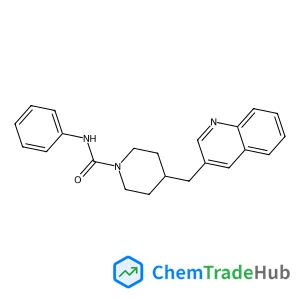
N-phenyl-4-(quinolin-3-ylmethyl)piperidine-1-carboxamide
CAS Number:
959151-50-9
Molecular Formula:
C22H23N3O
Recommended Suppliers







Disclaimer
This page provides academic journal information for reference and research purposes only. We are not affiliated with any journal publishers and do not handle publication submissions. For publication-related inquiries, please contact the respective journal publishers directly.
If you notice any inaccuracies in the information displayed, please contact us at support@chemtradehub.com. We will promptly review and address your concerns.