













Molecular tectonics: from enantiomerically pure sugars to enantiomerically pure triple stranded helical coordination network‡
Literature Information
Publication Date
2003-05-15
DOI
10.1039/B303238H
Impact Factor
6.222
Authors
Philippe Grosshans, Abdelaziz Jouaiti, Véronique Bulach, Jean-Marc Planeix, Mir Wais Hosseini, Jean-François Nicoud
View Original
Abstract
The self-assembly between a bis-monodentate tecton based on two pyridine units connected to an enantiomerically pure isomannide stereoisomer and HgCl2 leads to the formation of an enantiomerically pure triple stranded helical infinite coordination network which was structurally characterised by X-ray diffraction on single crystal.
Related Literature
Energy transfer in aggregates of bacteriochlorophyll c self-assembled with azulene derivatives
Martina Matěnová, Florian-Xuan Dang, Petr Pospíšil, Jan Alster, Jaroslav V. Burda, Jakub Pšenčík
2014-06-23
Paper
DOI: 10.1039/C4CP01311E
Failure mechanisms of nano-silicon anodes upon cycling: an electrode porosity evolution model
Etienne Radvanyi, Willy Porcher, Eric De Vito, Alexandre Montani, Sylvain Franger, Séverine Jouanneau Si Larbi
2014-06-09
Paper
DOI: 10.1039/C4CP02324B
A study into the extracted ion number for NASICON structured Na3V2(PO4)3 in sodium-ion batteries
Weixin Song, Xiaoyu Cao, Zhengping Wu, Jun Chen, Kaili Huangfu, Xiaowen Wang, Yaliang Huang, Xiaobo Ji
2014-06-25
Paper
DOI: 10.1039/C4CP01821D
A DFT + U study of NO evolution at reduced CeO2(110)
Guanzhong Lu
2014-06-30
Communication
DOI: 10.1039/C4CP02235A
Photocatalytic reduction of o-chloronitrobenzene under visible light irradiation over CdS quantum dot sensitized TiO2
2014-06-03
Paper
DOI: 10.1039/C4CP01250J
Electron momentum distribution and singlet–singlet annihilation in the organic anthracene molecular crystals using positron 2D-ACAR and fluorescence spectroscopy
Krishnan Sivaji, Arjunan Arulchakkaravarthi, Sambasivam Sankar
2014-05-16
Paper
DOI: 10.1039/C4CP01386G
Fully solution processed all inorganic nanocrystal solar cells
Troy K. Townsend, Edward E. Foos
2014-06-23
Paper
DOI: 10.1039/C4CP02403F
High-pressure phase transition of cesium chloride and cesium bromide
Shubo Wei, Chunye Zhu, Qian Li, Yuanyuan Zhou
2014-07-10
Paper
DOI: 10.1039/C4CP02452D
You might also like
Compound Q&A
What are the main uses of (3.beta.)-3-Hydroxy-N,N-dimethyl-chol-5-en-24-amide (CAS: 79066-03-8)?
(3.beta.)-3-Hydroxy-N,N-dimethyl-chol-5-en-24-amide (CAS: 79066-03-8) is primari...
79066-03-8(3.beta.)-3-Hydroxy-...
Compound Q&A
What regulatory guidelines apply to 5-(aminomethyl)-2-methoxyphenol (CAS: 89702-89-6)?
5-(Aminomethyl)-2-methoxyphenol (CAS: 89702-89-6) is classified under GHS as a s...
89702-89-65-(aminomethyl)-2-me...
Compound Q&A
What is Thieno[2,3-c]pyridin-7(6H)-one (CAS: 28981-13-7)?
Thieno[2,3-c]pyridin-7(6H)-one (CAS: 28981-13-7) is a heterocyclic organic compo...
28981-13-7Thieno[2,3-c]pyridin...
Compound Q&A
Is 1-[(6-Methoxy-3-pyridinyl)methyl]-4-piperidinamine dihydrochloride (CAS: 1185311-28-7) safe?
1-[(6-Methoxy-3-pyridinyl)methyl]-4-piperidinamine dihydrochloride is generally ...
1185311-28-71-[(6-Methoxy-3-pyri...
Compound Q&A
What regulatory guidelines apply to [(2E)-3-Phenyl-2-propen-1-yl]phosphonic acid (CAS: 146404-58-2)?
[(2E)-3-Phenyl-2-propen-1-yl]phosphonic acid (CAS: 146404-58-2) is regulated und...
146404-58-2[(2E)-3-Phenyl-2-pro...
Compound Q&A
What regulatory guidelines apply to 6-Bromo-7-methoxyquinoline (CAS: 1620515-86-7)?
6-Bromo-7-methoxyquinoline (CAS: 1620515-86-7) falls under the scope of the Glob...
1620515-86-76-Bromo-7-methoxyqui...
Compound Q&A
What industries use (2R)-1-(1-Benzofuran-2-yl)-N-propyl-2-pentanamine (CAS: 260550-89-8)?
This compound is primarily used in the pharmaceutical industry for the developme...
260550-89-8(2R)-1-(1-Benzofuran...
Compound Q&A
What are the main uses of 1-Ethyl-7-[2-methyl-6-(4H-1,2,4-triazol-3-yl)-3-pyridinyl]-3,5-dihydropyrazino[2,3-b]pyrazin-2(1H)-one (CAS: 1228013-15-7)?
1-Ethyl-7-[2-methyl-6-(4H-1,2,4-triazol-3-yl)-3-pyridinyl]-3,5-dihydropyrazino[2...
1228013-15-71-Ethyl-7-[2-methyl-...
Compound Q&A
Are there alternatives to {5-(Acryloylamino)-2-[(dimethylamino)methyl]phenyl}boronic acid (CAS: 1217500-78-1) in synthesis?
Alternative reagents such as 2-[(dimethylamino)methyl]phenylboronic acid or rela...
1217500-78-1{5-(Acryloylamino)-2...
Compound Q&A
What is 3-(Piperidin-4-yloxy)pyridine (CAS: 310881-48-2)?
3-(Piperidin-4-yloxy)pyridine (CAS: 310881-48-2) is an organic compound with the...
310881-48-23-(Piperidin-4-yloxy...
Source Journal
Chemical Communications

CiteScore:
8.6
Self-citation Rate:
4.7%
Articles per Year:
2458
ChemComm publishes urgent research which is of outstanding significance and interest to experts in the field, while also appealing to the journal’s broad chemistry readership. Our communication format is ideally suited to short, urgent studies that are of such importance that they require accelerated publication. Our scope covers all topics in chemistry, and research at the interface of chemistry and other disciplines (such as materials science, nanoscience, physics, engineering and biology) where there is a significant novelty in the chemistry aspects. Major topic areas covered include: Analytical Chemistry Catalysis Chemical Biology and medicinal chemistry Computational Chemistry and Machine Learning Energy and sustainable chemistry Environmental Chemistry Green Chemistry Inorganic Chemistry Materials Chemistry Nanoscience Organic Chemistry Physical Chemistry Polymer Chemistry Supramolecular Chemistry
Recommended Compounds

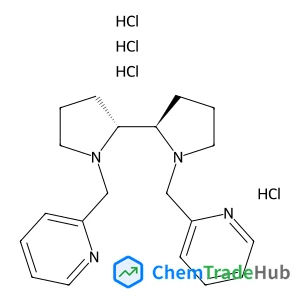
(2R,2'R)-1,1'-Bis(2-pyridinylmethyl)-2,2'-bipyrrolidine tetrahydrochloride
CAS Number:
1228077-88-0
Molecular Formula:
C20H30Cl4N4
Recommended Suppliers





Disclaimer
This page provides academic journal information for reference and research purposes only. We are not affiliated with any journal publishers and do not handle publication submissions. For publication-related inquiries, please contact the respective journal publishers directly.
If you notice any inaccuracies in the information displayed, please contact us at support@chemtradehub.com. We will promptly review and address your concerns.