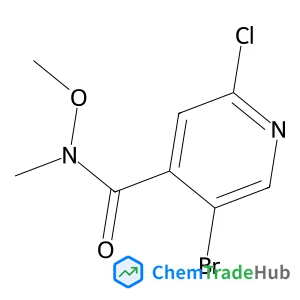
5-Bromo-2-chloro-N-methoxy-N-methylisonicotinamide
CAS Number:
1256790-08-5
Molecular Formula:
C8H8BrClN2O2
John S. Petersen
Photolithography is a crucial technology for both research and industry. The desire to be able to create ever finer features has fuelled a push towards lithographic methods that use electromagnetic radiation or charged particles with the shortest possible wavelength. At the same time, the physics and chemistry involved in employing light or particles with short wavelengths present great challenges. A new class of approaches to photolithography on the nanoscale involves the use of photoresists that can be activated with one colour of visible or near-ultraviolet light and deactivated with a second colour. Such methods hold the promise of attaining lithographic resolution that rivals or even exceeds that currently sought by industry, while at the same time using wavelengths of light that are inexpensive to produce and can be manipulated readily. The physical chemistry of 2-colour photolithography is a rich area of science that is only now beginning to be explored.
Christopher R. Travis, Lauren E. Mazur, Emily M. Peairs, Gillian H. Gaunt, Douglas D. Young
DOI: 10.1039/C9OB00327D
DOI: 10.1039/C9OB00338J
Kun Huang, Fabio Parmeggiani, Helene Ledru, Kristian Hollingsworth, Jordi Mas Pons, Andrea Marchesi, Peter Both, Ashley P. Mattey, Edward Pallister, Gregory S. Bulmer, Jolanda M. van Munster, W. Bruce Turnbull, M. Carmen Galan, Sabine L. Flitsch
DOI: 10.1039/C9OB01089K
Zhenzhen Zhan, Haojie Ma, Xinfeng Cui, Pengbo Jiang, Jinghong Pu, Yixin Zhang, Guosheng Huang
DOI: 10.1039/C9OB00531E
Asim Jana, Prabhas Bhaumick, Anoop Kumar Panday, Richa Mishra, Lokman H. Choudhury
DOI: 10.1039/C9OB00515C
Marlene L. Rothe, Ernesto Garibay, Shaun M. K. McKinnie
DOI: 10.1039/C8OB03109F
Ze-Nan Feng, Jin-Yun Luo, Yang Zhang, Guang-Fen Du, Lin He
DOI: 10.1039/C9OB00210C
Claire L. McMullin, Nasir A. Rajabi, James S. Hammerton
DOI: 10.1039/C9OB01092K
Gurudayal
DOI: 10.1039/C9OB00150F
Harry J. Shirley, Christopher D. Bray
DOI: 10.1039/C9OB00745H
(3.beta.)-3-Hydroxy-N,N-dimethyl-chol-5-en-24-amide (CAS: 79066-03-8) is primari...
5-(Aminomethyl)-2-methoxyphenol (CAS: 89702-89-6) is classified under GHS as a s...
Thieno[2,3-c]pyridin-7(6H)-one (CAS: 28981-13-7) is a heterocyclic organic compo...
1-[(6-Methoxy-3-pyridinyl)methyl]-4-piperidinamine dihydrochloride is generally ...
[(2E)-3-Phenyl-2-propen-1-yl]phosphonic acid (CAS: 146404-58-2) is regulated und...
6-Bromo-7-methoxyquinoline (CAS: 1620515-86-7) falls under the scope of the Glob...
This compound is primarily used in the pharmaceutical industry for the developme...
1-Ethyl-7-[2-methyl-6-(4H-1,2,4-triazol-3-yl)-3-pyridinyl]-3,5-dihydropyrazino[2...
Alternative reagents such as 2-[(dimethylamino)methyl]phenylboronic acid or rela...
3-(Piperidin-4-yloxy)pyridine (CAS: 310881-48-2) is an organic compound with the...

Physical Chemistry Chemical Physics (PCCP) is an international journal co-owned by 19 physical chemistry and physics societies from around the world. This journal publishes original, cutting-edge research in physical chemistry, chemical physics and biophysical chemistry. To be suitable for publication in PCCP, articles must include significant innovation and/or insight into physical chemistry; this is the most important criterion that reviewers and Editors will judge against when evaluating submissions. The journal has a broad scope and welcomes contributions spanning experiment, theory, computation and data science. Topical coverage includes spectroscopy, dynamics, kinetics, statistical mechanics, thermodynamics, electrochemistry, catalysis, surface science, quantum mechanics, quantum computing and machine learning. Interdisciplinary research areas such as polymers and soft matter, materials, nanoscience, energy, surfaces/interfaces, and biophysical chemistry are welcomed if they demonstrate significant innovation and/or insight into physical chemistry. Joined experimental/theoretical studies are particularly appreciated when complementary and based on up-to-date approaches.