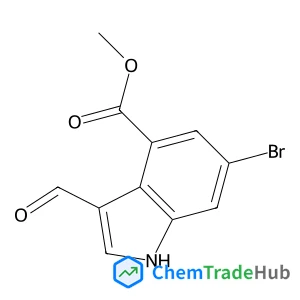
methyl 6-bromo-3-formyl-1H-indole-4-carboxylate
CAS Number:
1353636-63-1
Molecular Formula:
C11H8BrNO3
Krishnan Sivaji, Arjunan Arulchakkaravarthi, Sambasivam Sankar
We present the mapping of electron momentum distribution (EMD) in a single crystal of anthracene by two-dimensional angular correlation of positron annihilation radiation (2D-ACAR). The projected EMD is explained on the basis of the crystallographic features of the material. The EMD spectra provide information about the positron states and their behavior and also about the hindrance of the positronium (Ps) formation in this material. The EMD has exhibited evidence for the absence of free volume defects. The characteristic EMD features regarding the delocalized electronic states are explained. Further, scintillation characteristics such as fluorescence and time-correlated single photon counting have also been studied. The emission peaks are attributed to vibrational bands of fluorescence emission from the singlet excitons and lifetime components are observed to be due to singlet fission and the singlet–singlet excitons annihilation.

Polycyclic Aromatic Compounds

Herald of the Russian Academy of Sciences

Main Group Chemistry

Atomization and Sprays

Journal of the Indian Institute of Science

Biocatalysis and Biotransformation

Journal of Asian Natural Products Research

Electroanalysis

Bioorganic & Medicinal Chemistry Letters

Critical Reviews in Solid State and Materials Sciences
Marina V. Goryaeva, Svetlana O. Kushch, Olga G. Khudina, Yanina V. Burgart, Yulia S. Kudyakova, Marina A. Ezhikova, Mikhail I. Kodess, Pavel A. Slepukhin, Lilya Sh. Sadretdinova, Natalya P. Evstigneeva, Natalya A. Gerasimova, Victor I. Saloutin
DOI: 10.1039/C9OB00293F
Peiqi Zhou, Yubing Huang, Wanqing Wu, Wentao Yu, Jianxiao Li, Zhongzhi Zhu, Huanfeng Jiang
DOI: 10.1039/C9OB00377K
Claire L. McMullin, Nasir A. Rajabi, James S. Hammerton
DOI: 10.1039/C9OB01092K
Kristýna Cagašová, Maryam Ghavami, Zhong-Ke Yao, Paul R. Carlier
DOI: 10.1039/C9OB01139K
Zhengzhou Chu, Chengcai Xia
DOI: 10.1039/C9OB01224A
Kentaro Harada, Ryo Sekiya, Takeshi Maehara, Takeharu Haino
DOI: 10.1039/C9OB00388F
Kun Huang, Fabio Parmeggiani, Helene Ledru, Kristian Hollingsworth, Jordi Mas Pons, Andrea Marchesi, Peter Both, Ashley P. Mattey, Edward Pallister, Gregory S. Bulmer, Jolanda M. van Munster, W. Bruce Turnbull, M. Carmen Galan, Sabine L. Flitsch
DOI: 10.1039/C9OB01089K
Shinichi Sato, Hiroya Asami, Tomoko Hasegawa, Jun-Ya Kohno, Hiroyuki Nakamura
DOI: 10.1039/C9OB00584F
(3.beta.)-3-Hydroxy-N,N-dimethyl-chol-5-en-24-amide (CAS: 79066-03-8) is primari...
5-(Aminomethyl)-2-methoxyphenol (CAS: 89702-89-6) is classified under GHS as a s...
Thieno[2,3-c]pyridin-7(6H)-one (CAS: 28981-13-7) is a heterocyclic organic compo...
1-[(6-Methoxy-3-pyridinyl)methyl]-4-piperidinamine dihydrochloride is generally ...
[(2E)-3-Phenyl-2-propen-1-yl]phosphonic acid (CAS: 146404-58-2) is regulated und...
6-Bromo-7-methoxyquinoline (CAS: 1620515-86-7) falls under the scope of the Glob...
This compound is primarily used in the pharmaceutical industry for the developme...
1-Ethyl-7-[2-methyl-6-(4H-1,2,4-triazol-3-yl)-3-pyridinyl]-3,5-dihydropyrazino[2...
Alternative reagents such as 2-[(dimethylamino)methyl]phenylboronic acid or rela...
3-(Piperidin-4-yloxy)pyridine (CAS: 310881-48-2) is an organic compound with the...

Physical Chemistry Chemical Physics (PCCP) is an international journal co-owned by 19 physical chemistry and physics societies from around the world. This journal publishes original, cutting-edge research in physical chemistry, chemical physics and biophysical chemistry. To be suitable for publication in PCCP, articles must include significant innovation and/or insight into physical chemistry; this is the most important criterion that reviewers and Editors will judge against when evaluating submissions. The journal has a broad scope and welcomes contributions spanning experiment, theory, computation and data science. Topical coverage includes spectroscopy, dynamics, kinetics, statistical mechanics, thermodynamics, electrochemistry, catalysis, surface science, quantum mechanics, quantum computing and machine learning. Interdisciplinary research areas such as polymers and soft matter, materials, nanoscience, energy, surfaces/interfaces, and biophysical chemistry are welcomed if they demonstrate significant innovation and/or insight into physical chemistry. Joined experimental/theoretical studies are particularly appreciated when complementary and based on up-to-date approaches.