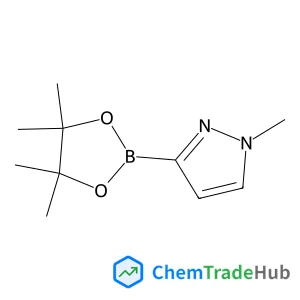
1-Methyl-3-(4,4,5,5-tetramethyl-1,3,2-dioxaborolan-2-yl)-1H-pyrazole
CAS Number:
1020174-04-2
Molecular Formula:
C10H17BN2O2
Colin Rhodes, Graham J. Hutchings
A study of the role of the copper promoter in the iron oxide/chromia high temperature water gas shift reaction is reported and discussed. The rate of reaction using both CuO/Fe3O4/Cr2O3 and Fe3O4/Cr2O3 catalysts is zero order in H2O and first order in CO over a wide range of reactant compositions and reaction pressures. The activation energy for the Fe3O4/Cr2O3 catalyst is found to be 118 ± 9 kJ mol−1 which is in agreement with previous literature data. The addition of CuO to the Fe3O4/Cr2O3 catalyst significantly decreases the activation energy to ca. 75–80 kJ mol−1. TPR studies using H2/He and H2/CO indicate that the addition of CuO partially stabilises the catalyst with respect to reduction with CO, indicating that one role of CuO as a promoter is to permit the use of higher partial pressures of CO in the reactant gases. Model experiments with CH3OH/CO mixtures show that the addition of CuO to the Fe3O4/Cr2O3 catalyst promotes the formation of methyl formate significantly. Based on these findings, the possible role of CuO in the promoted catalyst is discussed.
Tae Woong Kang, Atsushi Tamura, Yoshinori Arisaka, Nobuhiko Yui
DOI: 10.1039/D1PY00569C
Lishan Li, Yiwen Li, Shuyuan Wang, Liandong Ye, Wei Zhang, Nianchen Zhou, Zhengbiao Zhang, Xiulin Zhu
DOI: 10.1039/D1PY00099C
Charlotte E. Ellis, Tomoya Fukui, Cristina Cordoba, Arthur Blackburn, Ian Manners
DOI: 10.1039/D1PY00571E
Katharina Breul, Sebastian Seiffert
DOI: 10.1039/D1PY00121C
DOI: 10.1039/D1PY00313E
Xuejin Yang, Laura M. Murphy, Scott M. Grayson
DOI: 10.1039/D1PY00191D
Josina L. Bohlen, Bragavie Kulendran, Hannah Rothfuss, Peter W. Roesky
DOI: 10.1039/D1PY00552A
Ioannis Moutsios, Konstantina Tsitoni, Gkreti-Maria Manesi, Nikos Hadjichristidis
DOI: 10.1039/D1PY00258A
Georges M. Pavlov, Anna A. Gosteva, Olga V. Okatova, Olga A. Dommes, Irina I. Gavrilova
DOI: 10.1039/D0PY01725F
When handling 4-(2-Furylmethyl)thiomorpholine 1,1-dioxide (CAS: 79206-94-3), it ...
When handling 4-Chloro-N-[2-(4-morpholinyl)ethyl]benzamide (CAS: 71320-77-9), it...
Waste containing this compound (CAS: 62921-74-8) should be handled according to ...
Waste containing (S)-Methyl 2-amino-3-cyclohexylpropanoate should be collected i...
This compound can be synthesized using a multi-step process involving the conjug...
There are several alternatives to (2E)-3-(3,4-Dichlorophenyl)acrylic acid in syn...
Ethyl 6-(2-nitrophenyl)imidazo[2,1-b][1,3]thiazole-3-carboxylate (CAS: 925437-84...
Waste containing 2-(1,3-Thiazol-2-yl)ethanamine (CAS: 18453-07-1) should be coll...
Methyl 5-iodo-2-methylbenzoate can be synthesized through the iodination of meth...
5-Chloro[1,2,4]triazolo[1,5-a]pyridine is commonly synthesized via the condensat...

Physical Chemistry Chemical Physics (PCCP) is an international journal co-owned by 19 physical chemistry and physics societies from around the world. This journal publishes original, cutting-edge research in physical chemistry, chemical physics and biophysical chemistry. To be suitable for publication in PCCP, articles must include significant innovation and/or insight into physical chemistry; this is the most important criterion that reviewers and Editors will judge against when evaluating submissions. The journal has a broad scope and welcomes contributions spanning experiment, theory, computation and data science. Topical coverage includes spectroscopy, dynamics, kinetics, statistical mechanics, thermodynamics, electrochemistry, catalysis, surface science, quantum mechanics, quantum computing and machine learning. Interdisciplinary research areas such as polymers and soft matter, materials, nanoscience, energy, surfaces/interfaces, and biophysical chemistry are welcomed if they demonstrate significant innovation and/or insight into physical chemistry. Joined experimental/theoretical studies are particularly appreciated when complementary and based on up-to-date approaches.