












Noncatalytic Heck coupling reaction using supercritical water
Literature Information
Publication Date
2003-06-02
DOI
10.1039/B302683C
Impact Factor
6.222
Authors
Rong Zhang, Masahiro Sato
View Original
Abstract
Heck coupling of iodobenzene with styrene can be promoted in supercritical water without using catalyst, and the conversion reaches over 70% within 10 min in the presence of base, such as KOAc, in which case the yield of stilbene is 55.6% (both trans- and cis-stilbene).
Related Literature
Direct spectroscopy of contact charge transfer states: Possible consequences for tryptophan excited-state deactivation pathways by O2 and formation of reactive oxygen species
Swen Siegert, Ferdinand Vogeler, Joachim Schiedt, Rainer Weinkauf
2010-03-27
Paper
DOI: 10.1039/B926289J
The effect of Mn oxidation state on metal core electron excitations in manganese dimers: a time-dependent density functional investigation
Adrian R. Jaszewski, Rob Stranger, Ronald J. Pace
2009-04-30
Paper
DOI: 10.1039/B900694J
Preparation, structure, and stability of Pt and Pd monolayer modified Pd and Pt electrocatalysts
P. P. Wells, E. M. Crabb, C. R. King, R. Wiltshire, B. Billsborrow, D. Thompsett, A. E. Russell
2009-05-12
Paper
DOI: 10.1039/B823504J
Electron energy loss spectroscopy and anion formation in gas phase coronene
2009-05-19
Paper
DOI: 10.1039/B904614C
On the occurrence of stable and supersaturated metastable states in metallic core-shell nanoparticles
O. A. Oviedo, M. M. Mariscal, E. P. M. Leiva
2010-03-16
Paper
DOI: 10.1039/B924348H
EPR spectroscopic investigation of radical-induced degradation of partially fluorinated aromatic model compounds for fuelcell membranes
Frank Schönberger, Jochen Kerres, Herbert Dilger, Emil Roduner
2009-05-12
Paper
DOI: 10.1039/B817070C
Application of high level wavefunction methods in quantum mechanics/molecular mechanics hybrid schemes
2010-03-02
Perspective
DOI: 10.1039/B918608E
Theoretical study of the gas-phase ozonolysis of β-pinene (C10H16)
T. L. Nguyen, J. Peeters, L. Vereecken
2009-05-07
Paper
DOI: 10.1039/B822984H
Infrared spectroscopy of ‘forbidden’ peptide sequences
Timothy D. Vaden, Sally A. N. Gowers, Lavina C. Snoek
2009-05-08
Paper
DOI: 10.1039/B903039E
A stepwise atomic, valence-molecular, and full-molecular optimisation of the Hartree–Fock/Kohn–Sham energy
Branislav Jansík, Stinne Høst, Mikael P. Johansson, Jeppe Olsen, Poul Jørgensen, Trygve Helgaker
2009-05-19
Paper
DOI: 10.1039/B901987A
You might also like
Compound Q&A
What are the main uses of (3.beta.)-3-Hydroxy-N,N-dimethyl-chol-5-en-24-amide (CAS: 79066-03-8)?
(3.beta.)-3-Hydroxy-N,N-dimethyl-chol-5-en-24-amide (CAS: 79066-03-8) is primari...
79066-03-8(3.beta.)-3-Hydroxy-...
Compound Q&A
What regulatory guidelines apply to 5-(aminomethyl)-2-methoxyphenol (CAS: 89702-89-6)?
5-(Aminomethyl)-2-methoxyphenol (CAS: 89702-89-6) is classified under GHS as a s...
89702-89-65-(aminomethyl)-2-me...
Compound Q&A
What is Thieno[2,3-c]pyridin-7(6H)-one (CAS: 28981-13-7)?
Thieno[2,3-c]pyridin-7(6H)-one (CAS: 28981-13-7) is a heterocyclic organic compo...
28981-13-7Thieno[2,3-c]pyridin...
Compound Q&A
Is 1-[(6-Methoxy-3-pyridinyl)methyl]-4-piperidinamine dihydrochloride (CAS: 1185311-28-7) safe?
1-[(6-Methoxy-3-pyridinyl)methyl]-4-piperidinamine dihydrochloride is generally ...
1185311-28-71-[(6-Methoxy-3-pyri...
Compound Q&A
What regulatory guidelines apply to [(2E)-3-Phenyl-2-propen-1-yl]phosphonic acid (CAS: 146404-58-2)?
[(2E)-3-Phenyl-2-propen-1-yl]phosphonic acid (CAS: 146404-58-2) is regulated und...
146404-58-2[(2E)-3-Phenyl-2-pro...
Compound Q&A
What regulatory guidelines apply to 6-Bromo-7-methoxyquinoline (CAS: 1620515-86-7)?
6-Bromo-7-methoxyquinoline (CAS: 1620515-86-7) falls under the scope of the Glob...
1620515-86-76-Bromo-7-methoxyqui...
Compound Q&A
What industries use (2R)-1-(1-Benzofuran-2-yl)-N-propyl-2-pentanamine (CAS: 260550-89-8)?
This compound is primarily used in the pharmaceutical industry for the developme...
260550-89-8(2R)-1-(1-Benzofuran...
Compound Q&A
What are the main uses of 1-Ethyl-7-[2-methyl-6-(4H-1,2,4-triazol-3-yl)-3-pyridinyl]-3,5-dihydropyrazino[2,3-b]pyrazin-2(1H)-one (CAS: 1228013-15-7)?
1-Ethyl-7-[2-methyl-6-(4H-1,2,4-triazol-3-yl)-3-pyridinyl]-3,5-dihydropyrazino[2...
1228013-15-71-Ethyl-7-[2-methyl-...
Compound Q&A
Are there alternatives to {5-(Acryloylamino)-2-[(dimethylamino)methyl]phenyl}boronic acid (CAS: 1217500-78-1) in synthesis?
Alternative reagents such as 2-[(dimethylamino)methyl]phenylboronic acid or rela...
1217500-78-1{5-(Acryloylamino)-2...
Compound Q&A
What is 3-(Piperidin-4-yloxy)pyridine (CAS: 310881-48-2)?
3-(Piperidin-4-yloxy)pyridine (CAS: 310881-48-2) is an organic compound with the...
310881-48-23-(Piperidin-4-yloxy...
Source Journal
Chemical Communications

CiteScore:
8.6
Self-citation Rate:
4.7%
Articles per Year:
2458
ChemComm publishes urgent research which is of outstanding significance and interest to experts in the field, while also appealing to the journal’s broad chemistry readership. Our communication format is ideally suited to short, urgent studies that are of such importance that they require accelerated publication. Our scope covers all topics in chemistry, and research at the interface of chemistry and other disciplines (such as materials science, nanoscience, physics, engineering and biology) where there is a significant novelty in the chemistry aspects. Major topic areas covered include: Analytical Chemistry Catalysis Chemical Biology and medicinal chemistry Computational Chemistry and Machine Learning Energy and sustainable chemistry Environmental Chemistry Green Chemistry Inorganic Chemistry Materials Chemistry Nanoscience Organic Chemistry Physical Chemistry Polymer Chemistry Supramolecular Chemistry
Recommended Compounds
![(3E)-3-[4-Hydroxy-3,5-bis(2-methyl-2-propanyl)benzylidene]dihydro-2(3H)-furanone structure](https://static.chemtradehub.com/structs/102/102271-49-8-cba7.webp "(3E)-3-[4-Hydroxy-3,5-bis(2-methyl-2-propanyl)benzylidene]dihydro-2(3H)-furanone structure")
(3E)-3-[4-Hydroxy-3,5-bis(2-methyl-2-propanyl)benzylidene]dihydro-2(3H)-furanone
CAS Number:
102271-49-8
Molecular Formula:
C19H26O3
![N-[(6-Bromo-3-pyridinyl)methyl]ethanamine structure](https://static.chemtradehub.com/structs/120/120740-05-8-ca55.webp "N-[(6-Bromo-3-pyridinyl)methyl]ethanamine structure")
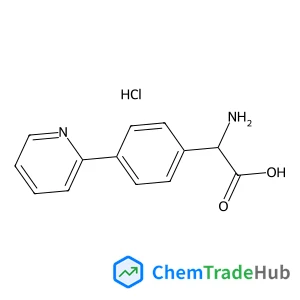
2-Amino-2-(4-(pyridin-2-YL)phenyl)acetic acid hydrochloride
CAS Number:
1135818-89-1
Molecular Formula:
C13H13ClN2O2
Recommended Suppliers





Disclaimer
This page provides academic journal information for reference and research purposes only. We are not affiliated with any journal publishers and do not handle publication submissions. For publication-related inquiries, please contact the respective journal publishers directly.
If you notice any inaccuracies in the information displayed, please contact us at support@chemtradehub.com. We will promptly review and address your concerns.