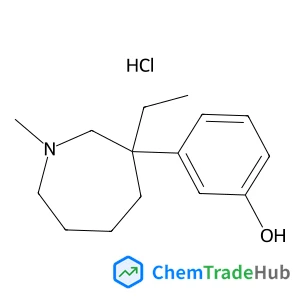
3-(3-Ethyl-1-methyl-3-azepanyl)phenol hydrochloride (1:1)
CAS Number:
59263-76-2
Molecular Formula:
C15H24ClNO
The 2A″ state of ClOO and BrOO is investigated using single- and multi-reference DFT (density functional theory). Unrestricted DFT (UDFT) carried out with the BLYP functional exaggerates the ionic character of the X–OO bond (X = Cl, Br) and by this its bond dissociation energy, while UDFT with the B3LYP functional underestimates ionic character and bond dissociation energies. In previous investigations, this was overlooked and has led to a misleading interpretation of single determinant UDFT results for XOO(2A″). The correct description of the two radicals can only be achieved by an appropriate configurational state mixing between the doublet ground state (leading to ionic character) and the first excited state, a quartet state leading to covalent character of the X–OO bond. REKS (spin-restricted ensemble-referenced Kohn–Sham) theory provides a multireference description and is capable of describing bonding in XOO correctly provided it is carried out with the hybrid functional B3LYP rather than BLYP, which is the result of the self-interaction error of pure exchange functionals and the inclusion of non-specific non-dynamic electron correlation effects suppressing the specific ones introduced by REKS. The relevance of results for the DFT description of related compounds (HOOO radical, MOO with M = Cu, Ag or Au) or multi-reference problems in general is discussed.
Yuan Zhang, Mengjiao Cao, Bing Yuan, Tianying Guo
DOI: 10.1039/C7PY01714F
Xiaomin Zhu, Rongfeng Zou, Peng Sun, Qi Wang, Junchen Wu
DOI: 10.1039/C7PY01901G
Theresa Ramelot, Dominik Konkolewicz, Scott Graner
DOI: 10.1039/C7PY00669A
Haibo Wu, Zhiming Wang, Lei Tao
DOI: 10.1039/C7PY01718A
Min Zeng, Decheng Wu, Yen Wei, Jinying Yuan
DOI: 10.1039/C8PY00029H
Manuel Hartweg, Elham Radvar, Dominic Collis, Mehedi Reza, Janne Ruokolainen, Robert Rambo, Ian W. Hamley, Helena S. Azevedo, C. Remzi Becer
DOI: 10.1039/C7PY01953J
Nemal S. Gobalasingham, Seyma Ekiz, Robert M. Pankow, Eva Bundgaard, Barry C. Thompson
DOI: 10.1039/C7PY00859G
Jianhua Han, Zhihuan Weng, Zuoqiang Wu, Jingwen Cai, Jinyan Wang, Xigao Jian
DOI: 10.1039/C7PY00802C
A. C. Manikas, V. Pagliarulo, P. Ferraro, S. Cavalli
DOI: 10.1039/C7PY00462A
When handling 4-(2-Furylmethyl)thiomorpholine 1,1-dioxide (CAS: 79206-94-3), it ...
When handling 4-Chloro-N-[2-(4-morpholinyl)ethyl]benzamide (CAS: 71320-77-9), it...
Waste containing this compound (CAS: 62921-74-8) should be handled according to ...
Waste containing (S)-Methyl 2-amino-3-cyclohexylpropanoate should be collected i...
This compound can be synthesized using a multi-step process involving the conjug...
There are several alternatives to (2E)-3-(3,4-Dichlorophenyl)acrylic acid in syn...
Ethyl 6-(2-nitrophenyl)imidazo[2,1-b][1,3]thiazole-3-carboxylate (CAS: 925437-84...
Waste containing 2-(1,3-Thiazol-2-yl)ethanamine (CAS: 18453-07-1) should be coll...
Methyl 5-iodo-2-methylbenzoate can be synthesized through the iodination of meth...
5-Chloro[1,2,4]triazolo[1,5-a]pyridine is commonly synthesized via the condensat...

Physical Chemistry Chemical Physics (PCCP) is an international journal co-owned by 19 physical chemistry and physics societies from around the world. This journal publishes original, cutting-edge research in physical chemistry, chemical physics and biophysical chemistry. To be suitable for publication in PCCP, articles must include significant innovation and/or insight into physical chemistry; this is the most important criterion that reviewers and Editors will judge against when evaluating submissions. The journal has a broad scope and welcomes contributions spanning experiment, theory, computation and data science. Topical coverage includes spectroscopy, dynamics, kinetics, statistical mechanics, thermodynamics, electrochemistry, catalysis, surface science, quantum mechanics, quantum computing and machine learning. Interdisciplinary research areas such as polymers and soft matter, materials, nanoscience, energy, surfaces/interfaces, and biophysical chemistry are welcomed if they demonstrate significant innovation and/or insight into physical chemistry. Joined experimental/theoretical studies are particularly appreciated when complementary and based on up-to-date approaches.
![[4-(Heptyloxy)phenyl]boronic acid structure](https://static.chemtradehub.com/structs/136/136370-19-9-ad33.webp "[4-(Heptyloxy)phenyl]boronic acid structure")