


Grafting challenging monomers from proteins using aqueous ICAR ATRP under bio-relevant conditions
Literature Information
Publication Date
2017-06-13
DOI
10.1039/C7PY00669A
Impact Factor
5.582
Authors
Theresa Ramelot, Dominik Konkolewicz, Scott Graner
View Original
Abstract
Aqueous initiators for continuous activator regeneration atom transfer radical polymerization (ICAR ATRP) was applied to graft well defined acrylamide, N,N-dimethylacrylamide and N-vinylimidazole homo and block copolymers from a model protein initiator (bovine serum albumin (BSA)) under bio-relevant conditions. Using N-vinylimidazole as a ligand catalytic biohybrid nanoparticles were prepared by loading palladium into a block copolymer of poly(N-vinylimidazole)-b-poly(oligo(ethylene oxide) acrylate) grafted from BSA. The protein–polymer biohybrid catalyst successfully catalyzes Suzuki–Miyaura couplings in aqueous media under aerobic conditions.
Recommended Journals

Journal of Catalysis

Molecular Pharmacology

Helvetica Chimica Acta

Journal of Organometallic Chemistry

Kinetics and Catalysis

Proceedings of the National Academy of Sciences of the United States of America

Journal of Medicinal Chemistry

Organic Preparations and Procedures International

Russian Chemical Reviews

Pharmacological Reviews
Related Literature
Temperature-dependent self-diffusion coefficients of water and six selected molecular liquids for calibration in accurate 1H NMRPFG measurements
Manfred Holz, Stefan R. Heil, Antonio Sacco
2000-10-03
Paper
DOI: 10.1039/B005319H
Interaction of methanol with lanthanum oxide surfaces and LaOx/Cu(111) interfaces. Part I. Adsorption and thermal decomposition
Alison M. De Asha, John T. S. Critchley, A. Elina Siokou, Roger M. Nix
2000-09-22
Paper
DOI: 10.1039/B005602M
Modelling of a fuel-rich premixed propene–oxygen–argon flame and comparison with experiments
H. Böhm, A. Lamprecht, B. Atakan, K. Kohse-Höinghaus
2000-10-06
Paper
DOI: 10.1039/B005252N
Thermodynamic study of organic compounds in di-n-butyl ether. Enthalpy and Gibbs energy of solvation
Luca Bernazzani, Maria R. Carosi, Norberto Ceccanti, Giovanni Conti, Paolo Gianni, Vincenzo Mollica, Maria R. Tinè, Luciano Lepori, Enrico Matteoli
2000-10-16
Paper
DOI: 10.1039/B004804F
You might also like
Compound Q&A
What precautions should be taken when handling 4-(2-Furylmethyl)thiomorpholine 1,1-dioxide (CAS: 79206-94-3)?
When handling 4-(2-Furylmethyl)thiomorpholine 1,1-dioxide (CAS: 79206-94-3), it ...
79206-94-34-(2-Furylmethyl)thi...
Compound Q&A
What precautions should be taken when handling 4-Chloro-N-[2-(4-morpholinyl)ethyl]benzamide (CAS: 71320-77-9)?
When handling 4-Chloro-N-[2-(4-morpholinyl)ethyl]benzamide (CAS: 71320-77-9), it...
71320-77-94-Chloro-N-[2-(4-mor...
Compound Q&A
How should waste containing 2-[2-(2-Methoxyethoxy)ethoxy]ethyl 4-methylbenzenesulfonate (CAS: 62921-74-8) be handled?
Waste containing this compound (CAS: 62921-74-8) should be handled according to ...
62921-74-82-[2-(2-Methoxyethox...
Compound Q&A
How should waste containing (S)-Methyl 2-amino-3-cyclohexylpropanoate be handled?
Waste containing (S)-Methyl 2-amino-3-cyclohexylpropanoate should be collected i...
40056-18-6(S)-Methyl 2-amino-3...
Compound Q&A
How is 5-({4-[(2S,4R)-4-Hydroxy-2-methyltetrahydro-2H-pyran-4-yl]-2-thienyl}sulfanyl)-1-methyl-1,3-dihydro-2H-indol-2-one (CAS: 166882-70-8) typically synthesized?
This compound can be synthesized using a multi-step process involving the conjug...
166882-70-85-({4-[(2S,4R)-4-Hyd...
Compound Q&A
Are there alternatives to (2E)-3-(3,4-Dichlorophenyl)acrylic acid (CAS: 7312-27-8) in synthesis?
There are several alternatives to (2E)-3-(3,4-Dichlorophenyl)acrylic acid in syn...
7312-27-8(2E)-3-(3,4-Dichloro...
Compound Q&A
How should Ethyl 6-(2-nitrophenyl)imidazo[2,1-b][1,3]thiazole-3-carboxylate (CAS: 925437-84-9) be stored?
Ethyl 6-(2-nitrophenyl)imidazo[2,1-b][1,3]thiazole-3-carboxylate (CAS: 925437-84...
925437-84-9Ethyl 6-(2-nitrophen...
Compound Q&A
How should waste containing 2-(1,3-Thiazol-2-yl)ethanamine (CAS: 18453-07-1) be handled?
Waste containing 2-(1,3-Thiazol-2-yl)ethanamine (CAS: 18453-07-1) should be coll...
18453-07-12-(1,3-Thiazol-2-yl)...
Compound Q&A
How is Methyl 5-iodo-2-methylbenzoate (CAS: 103440-54-6) typically synthesized?
Methyl 5-iodo-2-methylbenzoate can be synthesized through the iodination of meth...
103440-54-6Methyl 5-iodo-2-meth...
Compound Q&A
How is 5-Chloro[1,2,4]triazolo[1,5-a]pyridine (CAS: 1427399-34-5) typically synthesized?
5-Chloro[1,2,4]triazolo[1,5-a]pyridine is commonly synthesized via the condensat...
1427399-34-55-Chloro[1,2,4]triaz...
Source Journal
Polymer Chemistry

CiteScore:
8.6
Self-citation Rate:
7.3%
Articles per Year:
457
Polymer Chemistry welcomes submissions in all areas of polymer science that have a strong focus on macromolecular chemistry. Manuscripts may cover a broad range of fields, yet no direct application focus is required.
Recommended Compounds

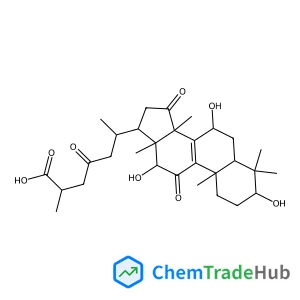
(3beta,7beta,12beta)-3,7,12-Trihydroxy-11,15,23-trioxolanost-8-en-26-oic acid
CAS Number:
98665-22-6
Molecular Formula:
C30H44O8
Recommended Suppliers



Disclaimer
This page provides academic journal information for reference and research purposes only. We are not affiliated with any journal publishers and do not handle publication submissions. For publication-related inquiries, please contact the respective journal publishers directly.
If you notice any inaccuracies in the information displayed, please contact us at support@chemtradehub.com. We will promptly review and address your concerns.