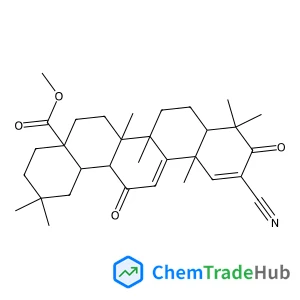
Methyl 2-cyano-3,12-dioxooleana-1,9(11)-dien-28-oate
CAS Number:
218600-53-4
Molecular Formula:
C32H43NO4
Ludovic Tuduri, Valérie Desauziers, Jean Louis Fanlo
Adsorptive solid-phase microextraction (SPME) fibres have proven to be a reliable means of sampling volatile organic compounds (VOCs) in air. In this work, polydimethylsiloxane/carboxen (PDMS/CAR) fibres were used to test a new approach of air sampling strategy with SPME in the lab which could lighten calibration procedure and enhance the use of this already rapid, simple, convenient and cost effective sampling technique. Indeed, only one curve can be used whatever the extraction time chosen by the analyst under constant conditions of air velocity and temperature. Ficks' law of diffusion was used to model SPME grab sampling when the fibre was totally exposed to the air sample. Experimental sampling rates were then determined by GC-FID for different sampling conditions, i.e. in a flowing air stream of known velocity (“dynamic mode”) and in a stagnant air (“static mode”). These sampling rates were found to be 3.50 and 17.80 mL min−1 for acetone, 4.06 and 21.20 mL min−1 for 1,2-dichloroethane, 5.10 and 27.80 mL min−1 for toluene and 5.36 and 30.80 mL min−1 for butyl acetate, for static and dynamic sampling modes respectively. Deviation from linearity of the calibration curves, indicating that a significant fraction of the adsorption sites are occupied, were determined. They were found to be approximately equal to 0.9, 1.57, 3.82 and 4.37 nmol for acetone, dichloroethane, toluene and butyl acetate, respectively. Experimentally determined sampling rates of these isolated compounds were also valid when a complex equimolar gaseous mixture was investigated, but deviation from linearity appears earlier. Then, for a given application, sampling times should be chosen very carefully to avoid competitive adsorption and hence, bad quantitative analysis results.
Jeng-Lung Chen, Chi-Liang Chen, Jyh-Fu Lee, Jin-Ming Chen, Yu-Chen Tsai, Ping-Hung Yeh, Wu Ching Chou, Chung-Li Dong
DOI: 10.1039/C6CP01192F
Alejandro Morales-Bayuelo, Sudip Pan, Julio Caballero, Pratim K. Chattaraj
DOI: 10.1039/C5CP02647D
Thierry O. Wambo
DOI: 10.1039/C5CP02312B
Lingxue Kong, Weimin Gao
DOI: 10.1039/C5CP03366G
DOI: 10.1039/C6CP02491B
Zarah Medina Baiyee, Chi Chen
DOI: 10.1039/C5CP02694F
M. Smerieri, L. Savio
DOI: 10.1039/C6CP02999J
Kai-Hung Wang, Chih-Wei Chang
DOI: 10.1039/C5CP03175C
M. Rauhalahti, A. Muñoz-Castro, D. Sundholm
DOI: 10.1039/C6CP03808E
When handling 4-(2-Furylmethyl)thiomorpholine 1,1-dioxide (CAS: 79206-94-3), it ...
When handling 4-Chloro-N-[2-(4-morpholinyl)ethyl]benzamide (CAS: 71320-77-9), it...
Waste containing this compound (CAS: 62921-74-8) should be handled according to ...
Waste containing (S)-Methyl 2-amino-3-cyclohexylpropanoate should be collected i...
This compound can be synthesized using a multi-step process involving the conjug...
There are several alternatives to (2E)-3-(3,4-Dichlorophenyl)acrylic acid in syn...
Ethyl 6-(2-nitrophenyl)imidazo[2,1-b][1,3]thiazole-3-carboxylate (CAS: 925437-84...
Waste containing 2-(1,3-Thiazol-2-yl)ethanamine (CAS: 18453-07-1) should be coll...
Methyl 5-iodo-2-methylbenzoate can be synthesized through the iodination of meth...
5-Chloro[1,2,4]triazolo[1,5-a]pyridine is commonly synthesized via the condensat...

Analyst publishes analytical and bioanalytical research that reports premier fundamental discoveries and inventions, and the applications of those discoveries, unconfined by traditional discipline barriers.
![1,2-Diphenyl-4-[2-(phenylsulfinyl)ethyl]-3,5-pyrazolidinedione structure](https://static.chemtradehub.com/structs/57-/57-96-5-efcc.webp "1,2-Diphenyl-4-[2-(phenylsulfinyl)ethyl]-3,5-pyrazolidinedione structure")
![4-{2-[4-(2-Methyl-2-propanyl)phenyl]ethoxy}quinazoline structure](https://static.chemtradehub.com/structs/120/120928-09-8-d3db.webp "4-{2-[4-(2-Methyl-2-propanyl)phenyl]ethoxy}quinazoline structure")