














Harnessing the potential of lead-free Sn–Ge based perovskite solar cells by unlocking the recombination channels
Literature Information
Publication Date
2021-07-26
DOI
10.1039/D1SE00687H
Impact Factor
6.367
Authors
Yulia Galagan, Hamid Ez-Zahraouy
View Original
Abstract
Perovskite solar cells (PSCs) have celebrated a decade of investigation as a promising photovoltaic technology. However, they contain lead, so inorganic lead-free PSCs can be designed as green and clean energy sources. To overcome the current obstacles in lead-free PSCs, the stability and performance gap should be minimized. The drift-diffusion simulation model is a conducive way to understand the working mechanism in a thin-film solar cell. Here we adopted a computational approach to design and investigate the performance of CsSn0.5Ge0.5I3 as a light harvester. We optimize the thickness of the perovskite, for its use in an inverted planar structure (FTO/PCBM/CsSn0.5Ge0.5I3/Spiro-OMeTAD/Au). Furthermore, cerium oxide (CeOx) and PTAA are used as alternative electron and hole transport layers, respectively. We studied the effect of trap density in the bulk CsSn0.5Ge0.5I3 and its impact on performance, recombination rate, and diffusion length. The open-circuit voltage (Voc) showed a significant improvement and the correlation with the trap density at the interface layers is established. We noted that the defect density at the perovskite/hole selective layer interface has a profound impact on the performance of lead-free PSCs as compared to the electron selective layer/perovskite interface. After optimizing defect parameters, the lead-free PSC can deliver a PCE of 24.20%, with Voc = 1170 mV, Jsc = 25.80 mA cm−2, and FF = 80.33%. Our findings provide access guidelines and pave the way for lead-free PSCs based on the Sn–Ge combination to approach their limit.
Related Literature
Hydroxyapatite as a key biomaterial: quantum-mechanical simulation of its surfaces in interaction with biomolecules
Marta Corno, Albert Rimola, Vera Bolis, Piero Ugliengo
2010-05-18
Perspective
DOI: 10.1039/C002146F
Thiol-capped CdTenanocrystals: progress and perspectives of the related research fields
Nikolai Gaponik, Andrey L. Rogach
2010-06-11
Perspective
DOI: 10.1039/C000916D
Formation of O adatom pairs and charge transfer upon O2 dissociation on reduced TiO2(110)
Yingge Du, Nathaniel A. Deskins, Zhenrong Zhang, Zdenek Dohnalek, Michel Dupuis, Igor Lyubinetsky
2010-03-25
Paper
DOI: 10.1039/C000250J
EPR spectrum of the Y@C82 metallofullerene isolated in solid argon matrix: hyperfine structure from EPR spectroscopy and relativistic DFT calculations
Eugenii Ya. Misochko, Alexander V. Akimov, Vasilii A. Belov, Daniil A. Tyurin, Vyacheslav P. Bubnov, Ivan E. Kareev, Eduard B. Yagubskii
2010-06-09
Paper
DOI: 10.1039/B926279B
Myoglobin embedded in saccharide amorphous matrices: water-dependent domains evidenced by small angle X-ray scattering
Alessandro Longo, Sergio Giuffrida, Grazia Cottone, Lorenzo Cordone
2010-05-12
Paper
DOI: 10.1039/B926977K
A density-functional theory study of electrochemical adsorption of sulfuric acid anions on Pt(111)
Juan A. Santana, Carlos R. Cabrera, Yasuyuki Ishikawa
2010-06-28
Paper
DOI: 10.1039/C000981D
Measurement of hetero-nuclear distances using a symmetry-based pulse sequence in solid-state NMR
Lei Chen, Olivier Lafon, Julien Trébosc, Feng Deng, Jean-Paul Amoureux
2010-06-24
Paper
DOI: 10.1039/B926546E
A pulse chromatographic study of the adsorption properties of the amino-MIL-53 (Al) metal–organic framework
Sarah Couck, Tom Rémy, Gino V. Baron, Jorge Gascon, Freek Kapteijn, Joeri F. M. Denayer
2010-06-09
Paper
DOI: 10.1039/B927115E
Existence of dual species composed of Cu+ in CuMFI being bridged by C2H2
Atsushi Itadani, Takashi Yumura, Takahiro Ohkubo, Hisayoshi Kobayashi, Yasushige Kuroda
2010-05-07
Paper
DOI: 10.1039/C000967A
You might also like
Compound Q&A
How should waste containing N-Methoxy-N-methyl-1,3-thiazole-5-carboxamide (CAS: 898825-89-3) be handled?
Waste containing N-Methoxy-N-methyl-1,3-thiazole-5-carboxamide (CAS: 898825-89-3...
898825-89-3N-Methoxy-N-methyl-1...
Compound Q&A
How should N-(4-Biphenylyl)dibenzo[b,d]furan-4-amine (CAS: 1318338-47-4) be stored?
N-(4-Biphenylyl)dibenzo[b,d]furan-4-amine should be stored in a tightly sealed c...
1318338-47-4N-(4-Biphenylyl)dibe...
Compound Q&A
What is the market or research trend for 3-Acetamido-5-amino-2,4,6-triiodobenzoic acid (CAS: 1713-07-1)?
The market for 3-Acetamido-5-amino-2,4,6-triiodobenzoic acid (CAS: 1713-07-1) is...
1713-07-13-Acetamido-5-amino-...
Compound Q&A
How should Benzyl 2-O-acetyl-3,4,6-tri-O-benzyl-beta-D-galactopyranoside (CAS: 61820-03-9) be stored?
Benzyl 2-O-acetyl-3,4,6-tri-O-benzyl-beta-D-galactopyranoside (CAS: 61820-03-9) ...
61820-03-9Benzyl 2-O-acetyl-3,...
Compound Q&A
What regulatory guidelines apply to 2-Ethylpiperazine dihydrochloride (CAS: 438050-52-3)?
2-Ethylpiperazine dihydrochloride (CAS: 438050-52-3) is regulated under the Glob...
438050-52-32-Ethylpiperazine di...
Compound Q&A
What regulatory guidelines apply to 1,1'-[1,3-Phenylenebis(methylene)]bis(3-methyl-1H-pyrrole-2,5-dione) (CAS: 119462-56-5)?
1,1'-[1,3-Phenylenebis(methylene)]bis(3-methyl-1H-pyrrole-2,5-dione) (CAS: 11946...
119462-56-51,1'-[1,3-Phenyleneb...
Compound Q&A
Are there alternatives to 5-Fluoro-2-(1-pyrrolidinyl)pyridine (CAS: 1287217-79-1) in synthesis?
Several alternatives can be used in the synthesis of 5-Fluoro-2-(1-pyrrolidinyl)...
1287217-79-15-Fluoro-2-(1-pyrrol...
Compound Q&A
What precautions should be taken when handling 1-((2R,3R,4R,5R)-5-((bis(4-methoxyphenyl)(phenyl)methoxy)methyl)-4-hydroxy-3-methoxytetrahydrofuran-2-yl)-5-methylpyrimidine-2,4(1H,3H)-dione (CAS: 153631-19-7)?
Proper personal protective equipment (PPE) must be worn when handling this compo...
153631-19-71-((2R,3R,4R,5R)-5-(...
Compound Q&A
What precautions should be taken when handling 6-Bromoimidazo[1,2-a]pyridin-8-amine (CAS: 676371-00-9)?
When handling 6-Bromoimidazo[1,2-a]pyridin-8-amine, it is important to wear appr...
676371-00-96-Bromoimidazo[1,2-a...
Compound Q&A
Are there alternatives to (2S,4R)-4-(4-Nitrobenzyl)pyrrolidine-2-carboxylic acid hydrochloride (CAS: 1049740-22-8) in synthesis?
Alternatives to (2S,4R)-4-(4-Nitrobenzyl)pyrrolidine-2-carboxylic acid hydrochlo...
1049740-22-8(2S,4R)-4-(4-Nitrobe...
Source Journal
Recommended Compounds


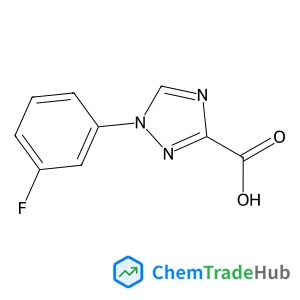
1-(3-Fluorophenyl)-1H-1,2,4-triazole-3-carboxylic acid
CAS Number:
1292369-51-7
Molecular Formula:
C9H6FN3O2
Recommended Suppliers






Disclaimer
This page provides academic journal information for reference and research purposes only. We are not affiliated with any journal publishers and do not handle publication submissions. For publication-related inquiries, please contact the respective journal publishers directly.
If you notice any inaccuracies in the information displayed, please contact us at support@chemtradehub.com. We will promptly review and address your concerns.