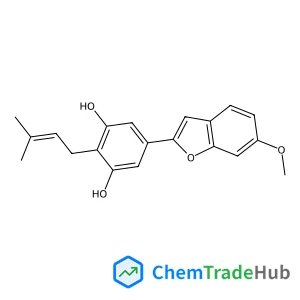
5-(6-Methoxy-1-benzofuran-2-yl)-2-(3-methyl-2-buten-1-yl)-1,3-benzenediol
CAS Number:
1017277-40-5
Molecular Formula:
C20H20O4
Ternary small-molecule organic solar cells (OSCs) are efficiently optimized and fabricated with small-molecule benzodithiophene terthiophene rhodanine (BTR) as the donor and a blend of Y6 and bisPC71BM or PC71BM as the acceptor. The power conversion efficiencies (PCEs) of BTR:Y6 binary OSCs, BTR:Y6:bisPC71BM and BTR:Y6:PC71BM optimized ternary OSCs are 11.56%, 12.97% and 12.25%, respectively. BTR:Y6:bisPC71BM optimized ternary OSCs show a relatively high open circuit voltage (VOC) of 0.916 V, short-circuit current density (JSC) of 20.2 mA cm−2 and fill factor (FF) of 70.1% compared with BTR:Y6 binary OSCs and BTR:Y6:PC71BM optimized ternary OSCs. The VOC of ternary OSCs monotonically increases with increasing bisPC71BM content in the blend acceptor, which can be mainly ascribed to the shallow LUMO and enlarged energy bandgap. The highest JSC and FF are attributed to the complementary absorption of the BTR:Y6 binary photoactive layer and have good compatibility. We successfully demonstrate that a bisadduct analogue of [70]PCBM (bisPC71BM) is a better third component material than a single analogue of [70]PCBM (PC71BM). The blend of BTR, Y6, and bisPC71BM (the optimized BTR:Y6:bisPC71BM ratio of 1 : 1 : 0.2) is a promising method to prepare efficient ternary OSCs.

Chemical Communications

Journal of Saudi Chemical Society

Drug Discovery Today

Russian Journal of Coordination Chemistry

Russian Journal of General Chemistry

Crystallography Reports

Current Opinion in Colloid & Interface Science

Current Opinion in Solid State & Materials Science

Russian Journal of Bioorganic Chemistry

Journal of Peptide Science
Banxian Ruan, Min Li, Chao Liu, Enduo Gao, Zhenbin Zhang, Xia Chang, Baihui Zhang, Hongjian Li
DOI: 10.1039/D2CP04531A
Manjula Jaisal, Rajesh Kumar Reddy Sannapureddi, Arjun Rana, Bharathwaj Sathyamoorthy
DOI: 10.1039/D2CP04837J
Yufei Xue, Zhong Shen
DOI: 10.1039/D2CP03860A
Szymon Sarbak, Gargi Sharma, Cecil S. Joseph, Weronika E. Kucia, Krzysztof Dobek, Robert H. Giles, Andrzej Dobek
DOI: 10.1039/D2CP90241A
Hui-Min Ni, Jing-Jing He, Fang-Wen Guo, Jia-Bei Dong, Tian-Yi Lu, Wen-Dou Cui, Jia-Ren Yuan, Yan-Dong Guo
DOI: 10.1039/D2CP05066H
Niranjan Kumar, Roman S. Pleshkov, B. S. Prathibha, Vladimir N. Polkovnikov, Nikolay I. Chkhalo
DOI: 10.1039/D3CP90011H
Anum Shahid Malik, Lisa A. Fredin
DOI: 10.1039/D2CP04939B
Shuai Wang, Lihong Liang
DOI: 10.1039/D2CP04221E
Van V. Vu, Binh Khanh Mai
DOI: 10.1039/D2CP04476E
Júlia M. A. Alves, Natália L. Vrech, Ataualpa A. C. Braga
DOI: 10.1039/D2CP04603B
When handling 2-Methyl-2-propanyl 5-amino-2-thiophenecarboxylate (CAS: 1498311-5...
5-Bromo-1,2-dichloro-3-fluorobenzene (CAS: 1000572-93-9) is a crystalline solid ...
(2R)-2-Amino-2-(4-bromophenyl)ethanol (CAS: 354153-64-3) should be stored in a c...
Methyl 4-(aminomethyl)tetrahydro-2H-pyran-4-carboxylate hydrochloride (CAS: 3627...
1,4-Dimethyl-1H-pyrazole-5-sulfonyl chloride is primarily used as an intermediat...
Dinaphtho[1,2-b:2',1'-d]furan is generally safe when handled with appropriate pe...
The market for 7-Methyl-7,9-dihydro-1H-purine-2,6,8(3H)-trione (CAS: 612-37-3) i...
2-(4-Chlorophenyl)malonaldehyde (CAS: 205676-17-1) is a colorless or light yello...
2-Methylchrysene (CAS: 3351-32-4) is typically synthesized via the reaction of c...
N-(6-aminopyrimidin-4-yl)acetamide (CAS: 89533-23-3) is generally considered saf...
![3-[7-Amino-3-(3-pyridinyl)pyrazolo[1,5-a]pyrimidin-6-yl]phenol structure](https://static.chemtradehub.com/structs/861/861249-77-6-025b.webp "3-[7-Amino-3-(3-pyridinyl)pyrazolo[1,5-a]pyrimidin-6-yl]phenol structure")