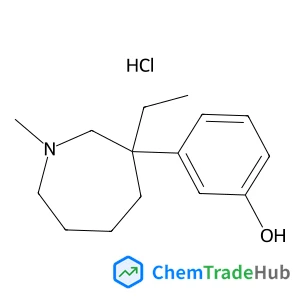
3-(3-Ethyl-1-methyl-3-azepanyl)phenol hydrochloride (1:1)
CAS Number:
59263-76-2
Molecular Formula:
C15H24ClNO
Wolfgang Sprengel, Hans-Eckhardt Schaefer
Structural vacancies are of interest for an understanding of the crystal structure and the properties of metal oxides. Here we report on the identification and study of structural vacancies in titanium monoxide TiOy with a B1 (NaCl) structure. Structural vacancies were identified by coincident Doppler broadening studies of the positron–electron annihilation radiation. The analysis shows that the nearest-neighbor atoms of vacancies are oxygen atoms. Taking into account the B1 structure of titanium monoxide this means that vacancies are located on the titanium sublattice. Positron trapping in titanium vacancies allows the study of the electronic structure of these vacancies by positron lifetime spectroscopy which shows that the valence electron density in the titanium vacancy increases with decreasing oxygen content y in TiOy. The increase of the valence electron density is accompanied by a decrease of the mean number of nearest-neighbor oxygen atoms in the vicinity of the titanium vacancy from 6 to 5 atoms.
Sten Sarman, Aatto Laaksonen
DOI: 10.1039/C4CP04891A
DOI: 10.1039/C4CP04966G
Yehan Tao, Xiaofang Li, Tiantian Wu, Yakang Jin, Zhongyang Zhang
DOI: 10.1039/C4CP04102J
Zhongzhu Wang, Hong Bi, Peihong Wang, Min Wang, Zhiwei Liu, Lei shen, Xiansong Liu
DOI: 10.1039/C4CP04985C
Li Zheng, Xinhong Cheng, Yuehui Yu, Yahong Xie, Xiaolong Li, Zhongjian Wang
DOI: 10.1039/C4CP04957H
Xin Zhou, Wei Quan Tian, PingAn Hu
DOI: 10.1039/C4CP04968C
Jeffrey R. Christianson, J. R. Schmidt
DOI: 10.1039/C4CP04814H
Eva Zurek, Wojciech Grochala
DOI: 10.1039/C4CP04445B
Dong Nyoung Heo, Ji Sun Park, Jin Ho Lee, Jun Hee Lee, Wan Doo Kim, Il Keun Kwon, Su A. Park
DOI: 10.1039/C4CP04801F
Manas Ranjan Dash, B. Rajakumar
DOI: 10.1039/C4CP04677C
When handling 4-(2-Furylmethyl)thiomorpholine 1,1-dioxide (CAS: 79206-94-3), it ...
When handling 4-Chloro-N-[2-(4-morpholinyl)ethyl]benzamide (CAS: 71320-77-9), it...
Waste containing this compound (CAS: 62921-74-8) should be handled according to ...
Waste containing (S)-Methyl 2-amino-3-cyclohexylpropanoate should be collected i...
This compound can be synthesized using a multi-step process involving the conjug...
There are several alternatives to (2E)-3-(3,4-Dichlorophenyl)acrylic acid in syn...
Ethyl 6-(2-nitrophenyl)imidazo[2,1-b][1,3]thiazole-3-carboxylate (CAS: 925437-84...
Waste containing 2-(1,3-Thiazol-2-yl)ethanamine (CAS: 18453-07-1) should be coll...
Methyl 5-iodo-2-methylbenzoate can be synthesized through the iodination of meth...
5-Chloro[1,2,4]triazolo[1,5-a]pyridine is commonly synthesized via the condensat...

Physical Chemistry Chemical Physics (PCCP) is an international journal co-owned by 19 physical chemistry and physics societies from around the world. This journal publishes original, cutting-edge research in physical chemistry, chemical physics and biophysical chemistry. To be suitable for publication in PCCP, articles must include significant innovation and/or insight into physical chemistry; this is the most important criterion that reviewers and Editors will judge against when evaluating submissions. The journal has a broad scope and welcomes contributions spanning experiment, theory, computation and data science. Topical coverage includes spectroscopy, dynamics, kinetics, statistical mechanics, thermodynamics, electrochemistry, catalysis, surface science, quantum mechanics, quantum computing and machine learning. Interdisciplinary research areas such as polymers and soft matter, materials, nanoscience, energy, surfaces/interfaces, and biophysical chemistry are welcomed if they demonstrate significant innovation and/or insight into physical chemistry. Joined experimental/theoretical studies are particularly appreciated when complementary and based on up-to-date approaches.
![5-Acetyl-2,3-dihydrobenzo[b]furan structure](https://static.chemtradehub.com/structs/908/90843-31-5-eea4.webp "5-Acetyl-2,3-dihydrobenzo[b]furan structure")