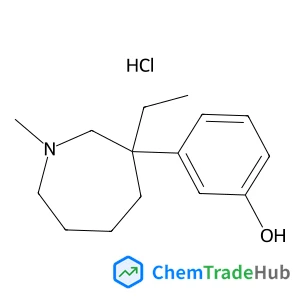
3-(3-Ethyl-1-methyl-3-azepanyl)phenol hydrochloride (1:1)
CAS Number:
59263-76-2
Molecular Formula:
C15H24ClNO
Manas Ranjan Dash, B. Rajakumar
Rate coefficients for the reactions of C2H radicals with methane (k1), ethane (k2), propane (k3), ethylene (k4), and propylene (k5) were computed using canonical variational transition state theory (CVT) coupled with hybrid-meta density functional theory (DFT) over a wide range of temperatures from 150 to 5000 K. The quantum chemical tunneling effect was corrected by the small curvature tunneling (SCT) method. The dynamic calculations are performed using the variational transition state theory (VTST) with the interpolated single-point energies (ISPE) method at the CCSD(T)/cc-pVTZ//M06-2X/6-31+G(d,p) level of theory. Intrinsic reaction coordinate (IRC) calculations were performed to verify that the transition states are connected to the reactants and products. The rate coefficients obtained over the studied temperature range yield the following Arrhenius expressions (cm3 molecule−1 s−1): k1 = 4.69 × 10⁻¹⁹T2.44 exp[331/T], k2 = 4.29 × 10⁻¹⁷T2.11 exp[432/T], k3 = 4.81 × 10⁻¹⁷T1.98 exp[697/T], k4 = 7.54 × 10⁻²¹T2.96 exp[1942/T], and k5 = 8.04 × 10⁻²³T3.44 exp[3011/T] cm3 molecule−1 s−1. Branching ratio calculation for the reactions of C2H radicals with ethylene and propylene shows that the abstraction reactions are not important at lower temperatures. However, as the temperature increases, abstraction reactions become more important.
Riham El Kurdi, Digambara Patra
DOI: 10.1039/C6CP08607A
Weizhao Cai, Rong Zhang, Shanti Deemyad
DOI: 10.1039/C6CP08171A
DOI: 10.1039/C6CP07827C
Xiaojun Wu, Jinlong Yang
DOI: 10.1039/C6CP07402B
Sergio Giuffrida, Lorenzo Cordone
DOI: 10.1039/C6CP06848K
Stanley Udochukwu Ofoegbu, Tiago L. P. Galvão, José R. B. Gomes, João Tedim, Helena I. S. Nogueira, M. G. S. Ferreira
DOI: 10.1039/C7CP00241F
Penghui Li, Fang Wang, Shiqian Wei, Xinyu Li
DOI: 10.1039/C6CP08409E
DOI: 10.1039/C6CP06939H
Christof Drechsel-Grau, Dominik Marx
DOI: 10.1039/C6CP05679B
When handling 4-(2-Furylmethyl)thiomorpholine 1,1-dioxide (CAS: 79206-94-3), it ...
When handling 4-Chloro-N-[2-(4-morpholinyl)ethyl]benzamide (CAS: 71320-77-9), it...
Waste containing this compound (CAS: 62921-74-8) should be handled according to ...
Waste containing (S)-Methyl 2-amino-3-cyclohexylpropanoate should be collected i...
This compound can be synthesized using a multi-step process involving the conjug...
There are several alternatives to (2E)-3-(3,4-Dichlorophenyl)acrylic acid in syn...
Ethyl 6-(2-nitrophenyl)imidazo[2,1-b][1,3]thiazole-3-carboxylate (CAS: 925437-84...
Waste containing 2-(1,3-Thiazol-2-yl)ethanamine (CAS: 18453-07-1) should be coll...
Methyl 5-iodo-2-methylbenzoate can be synthesized through the iodination of meth...
5-Chloro[1,2,4]triazolo[1,5-a]pyridine is commonly synthesized via the condensat...

Physical Chemistry Chemical Physics (PCCP) is an international journal co-owned by 19 physical chemistry and physics societies from around the world. This journal publishes original, cutting-edge research in physical chemistry, chemical physics and biophysical chemistry. To be suitable for publication in PCCP, articles must include significant innovation and/or insight into physical chemistry; this is the most important criterion that reviewers and Editors will judge against when evaluating submissions. The journal has a broad scope and welcomes contributions spanning experiment, theory, computation and data science. Topical coverage includes spectroscopy, dynamics, kinetics, statistical mechanics, thermodynamics, electrochemistry, catalysis, surface science, quantum mechanics, quantum computing and machine learning. Interdisciplinary research areas such as polymers and soft matter, materials, nanoscience, energy, surfaces/interfaces, and biophysical chemistry are welcomed if they demonstrate significant innovation and/or insight into physical chemistry. Joined experimental/theoretical studies are particularly appreciated when complementary and based on up-to-date approaches.