












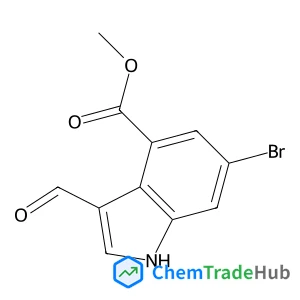
methyl 6-bromo-3-formyl-1H-indole-4-carboxylate
CAS Number:
1353636-63-1
Molecular Formula:
C11H8BrNO3
Bao-Qing Ma, Philip Coppens
A novel 2D triangular brick-wall framework based on CMCR and bpe with included ruthenocene guest molecules is formed with time by conversion of a 1D wave-like polymer structure with an accompanying bowl-to-boat conformational change of the CMCR molecules.
Kentaro Harada, Ryo Sekiya, Takeshi Maehara, Takeharu Haino
DOI: 10.1039/C9OB00388F
Hwee Ting Ang, Jason P. G. Rygus, Dennis G. Hall
DOI: 10.1039/C9OB01043B
Deepika Kathuria, Pankaj Gupta, Sumit S. Chourasiya, Subash C. Sahoo, Uwe Beifuss, Asit K. Chakraborti, Prasad V. Bharatam
DOI: 10.1039/C9OB00610A
Chun-Lan Xie, Jin-Mei Xia, Cui-Ping Xing, Zhu-Hua Luo, Zongze Shao, Xiao-Jun Yan, Shan He, Xian-Wen Yang
DOI: 10.1039/C9OB01159E
Alejandro Dana, Pablo H. Di Chenna, Benjamin Darses, Fernando J. Durán, Philippe Dauban
DOI: 10.1039/C9OB00272C
Lin Qiu, Zhongqing Wen, Yuling Li, Kai Tian, Youchao Deng
DOI: 10.1039/C9OB00324J
(3.beta.)-3-Hydroxy-N,N-dimethyl-chol-5-en-24-amide (CAS: 79066-03-8) is primari...
5-(Aminomethyl)-2-methoxyphenol (CAS: 89702-89-6) is classified under GHS as a s...
Thieno[2,3-c]pyridin-7(6H)-one (CAS: 28981-13-7) is a heterocyclic organic compo...
1-[(6-Methoxy-3-pyridinyl)methyl]-4-piperidinamine dihydrochloride is generally ...
[(2E)-3-Phenyl-2-propen-1-yl]phosphonic acid (CAS: 146404-58-2) is regulated und...
6-Bromo-7-methoxyquinoline (CAS: 1620515-86-7) falls under the scope of the Glob...
This compound is primarily used in the pharmaceutical industry for the developme...
1-Ethyl-7-[2-methyl-6-(4H-1,2,4-triazol-3-yl)-3-pyridinyl]-3,5-dihydropyrazino[2...
Alternative reagents such as 2-[(dimethylamino)methyl]phenylboronic acid or rela...
3-(Piperidin-4-yloxy)pyridine (CAS: 310881-48-2) is an organic compound with the...

ChemComm publishes urgent research which is of outstanding significance and interest to experts in the field, while also appealing to the journal’s broad chemistry readership. Our communication format is ideally suited to short, urgent studies that are of such importance that they require accelerated publication. Our scope covers all topics in chemistry, and research at the interface of chemistry and other disciplines (such as materials science, nanoscience, physics, engineering and biology) where there is a significant novelty in the chemistry aspects. Major topic areas covered include: Analytical Chemistry Catalysis Chemical Biology and medicinal chemistry Computational Chemistry and Machine Learning Energy and sustainable chemistry Environmental Chemistry Green Chemistry Inorganic Chemistry Materials Chemistry Nanoscience Organic Chemistry Physical Chemistry Polymer Chemistry Supramolecular Chemistry
![Bis(N,N''-dimethylpiperazine)tetra[copper(I) iodide] structure](https://static.chemtradehub.com/structs/140/1401708-91-5-2b86.webp "Bis(N,N''-dimethylpiperazine)tetra[copper(I) iodide] structure")
![4-[(4-Bromophenyl)sulfonyl]thiomorpholine structure](https://static.chemtradehub.com/structs/223/223555-81-5-2d67.webp "4-[(4-Bromophenyl)sulfonyl]thiomorpholine structure")
![Ethanone, 1-[4-chloro-2-(methylthio)-5-pyrimidinyl]- structure](https://static.chemtradehub.com/structs/661/66116-82-3-863e.webp "Ethanone, 1-[4-chloro-2-(methylthio)-5-pyrimidinyl]- structure")




