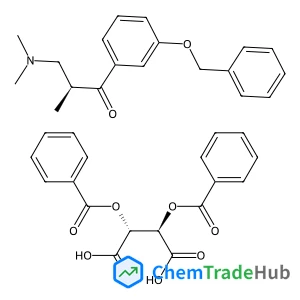
(S)-1-(3-(Benzyloxy)phenyl)-3-(dimethylamino)-2-methylpropan-1-one (2r,3r)-2,3-bis(benzoyloxy)succinate
CAS Number:
1004315-81-4
Molecular Formula:
C37H37NO10
Shunji Ito, Mitsuhiro Kurita, Sigeru Kikuchi, Toyonobu Asao, Yoshitora Ito, Masaji Oda, Hideo Sotokawa, Akio Tajiri, Noboru Morita
An optically active 1,2-homoheptafulvalene was successfully synthesized and subjected to spectroscopic investigation. The cycloaddition of the optically active hydrocarbon with tetracyanoethylene (TCNE) and 4-phenyl-1,2,4-triazoline-3,5-dione (PTAD) gave a [4 + 2] cycloadduct and a mixture of [8 + 2] cycloadducts, respectively, which are both optically active.
P. Moriel, A. B. García
DOI: 10.1039/C4GC00755G
Luis Herrera-Estrella, Anne-Laure Chauvin
DOI: 10.1039/C4GC00631C
Samuel E. Evans, John Z. Staniforth, Richard J. Darton, R. Mark Ormerod
DOI: 10.1039/C4GC00782D
Andrew P. Abbott, Robert C. Harris, Karl S. Ryder
DOI: 10.1039/C4GC00952E
Beatrice Bechi, Susanne Herter, Shane McKenna, Christopher Riley, Silke Leimkühler, Nicholas J. Turner, Andrew J. Carnell
DOI: 10.1039/C4GC01321B
Ling-Hong Gong, Yi-Yu Cai, Xin-Hao Li, Ya-Nan Zhang, Juan Su, Jie-Sheng Chen
DOI: 10.1039/C4GC00981A
Denis Prat, John Hayler, Andy Wells
DOI: 10.1039/C4GC01149J
Kiki Adi Kurnia, João A. P. Coutinho
DOI: 10.1039/C4GC00954A
DOI: 10.1039/C4GC00602J
Yuchao Lu, Peng Wei, Yuxin Pei, Hengfu Xu, Xiaoting Xin
DOI: 10.1039/C4GC00770K
2-Methylbenzene-1,4-diamine dihydrochloride (CAS: 615-45-2) should be stored in ...
(1S,4S)-2,5-Diazabicyclo[2.2.1]heptane dihydrobromide is generally considered sa...
(6-Chloropyridazin-3-YL)methanamine finds applications in the pharmaceutical ind...
2-Fluoro-3-methylphenol is primarily used in the synthesis of pharmaceuticals, p...
When handling 3-Methoxy-4-nitrobenzonitrile, it is important to wear appropriate...
When handling 1,3-Oxazolo[4,5-b]pyridine-2(3H)-thione (CAS: 211949-57-4), it is ...
4-Ethynylbenzamide (CAS: 90347-86-7) falls under various regulatory guidelines i...
3-(2-Ethylphenyl)-2-thioxo-4-imidazolidinone is primarily used as an intermediat...
(2-Fluoro-6-methoxyphenyl)acetic acid, also known as 4-fluoro-3-methoxybenzoic a...
Market trends for 2-[4-(Hydroxymethyl)phenoxy]ethanol (CAS: 102196-18-9) indicat...

Organic & Biomolecular Chemistry (OBC) publishes original and high impact research and reviews in organic chemistry. We welcome research that shows new or significantly improved protocols or methodologies in total synthesis, synthetic methodology or physical and theoretical organic chemistry as well as research that shows a significant advance in the organic chemistry or molecular design aspects of chemical biology, catalysis, supramolecular and macromolecular chemistry, theoretical chemistry, mechanism-oriented physical organic chemistry, medicinal chemistry or natural products. Articles published in the journal should report new work which makes a highly-significant impact in the field. Routine and incremental work is generally not suitable for publication in the journal. More details about key areas of our scope are below. In all cases authors should include in their article clear rationale for why their research has been carried out.
![(1R,6R)-6-({[(2-Methyl-2-propanyl)oxy]carbonyl}amino)-3-cyclohexene-1-carboxylic acid structure](https://static.chemtradehub.com/structs/865/865689-24-3-5fef.webp "(1R,6R)-6-({[(2-Methyl-2-propanyl)oxy]carbonyl}amino)-3-cyclohexene-1-carboxylic acid structure")