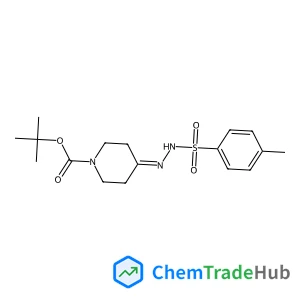
tert-Butyl 4-(2-(p-Tolylsulfonyl)hydrazono)piperidine-1-carboxylate
CAS Number:
1046478-89-0
Molecular Formula:
C17H25N3O4S
Methasit Pornprompanya, Stefan C. Müller, Hana Ševčíková
An experimental investigation of the effects of imposed dc electric fields on pseudo-one-dimensional pulse waves in the Belousov–Zhabotinsky (BZ) system with pyrogallol as substrate and ferroin as catalyst is reported for the first time. The global tendencies of the investigated electric field effects, accounting for acceleration, deceleration and annihilation of waves, correspond to those found in the classical BZ reaction with malonic acid as substrate. Unlike the classical BZ system, a saturation-type relationship in the propagation velocity dependence on electric field intensity has been found. Upon switching the polarity of the applied electric field from negative to positive, reversal of the propagation direction of the waves in the pyrogallol system was observed.

Russian Journal of Coordination Chemistry

Journal of Natural Medicines

Russian Chemical Bulletin

Current Opinion in Colloid & Interface Science

Nature Medicine

Journal of Peptide Science

Saudi Pharmaceutical Journal

Russian Journal of Bioorganic Chemistry

Russian Journal of Organic Chemistry

New Journal of Chemistry
András Stirling, Andrea Hamza, Tibor András Rokob, Imre Pápai
DOI: 10.1039/B804662J
Yoshiro Hirai, Masayuki Kirihara
DOI: 10.1039/B802502A
Tetsuo Okujima, Noboru Ono
DOI: 10.1039/B719964C
Jong Won Chung, Byeong-Kwan An, Ji Whan Kim, Jang-Joo Kim, Soo Young Park
DOI: 10.1039/B802749H
Hiroshi Shimizu, Masahiro Murakami
DOI: 10.1039/B704105E
Lin Yang, Hua-Jie Wang, Hua-Yan Yang, Shan-Hu Liu, Bao-Fang Zhang, Kui Wang, Xiao-Ming Ma, Zhi Zheng
DOI: 10.1039/B804274H
Mathieu Mével, Cécile Neveu, Cristine Gonçalves, Jean-Jacques Yaouanc, Chantal Pichon, Paul-Alain Jaffrès, Patrick Midoux
DOI: 10.1039/B805226C
Kyung-Soo Moon, Eunji Lee, Myongsoo Lee
DOI: 10.1039/B801108G
Anatoly Chernyshev, Todd Fleischmann, Eric M. Koehn, Scott A. Lesley, Amnon Kohen
DOI: 10.1039/B700977A
When considering alternatives to 1-(4-Chlorophenyl)-N-hydroxymethanimine (CAS: 3...
This compound should be stored in a cool, dry place away from direct sunlight. I...
3-(4-Bromophenyl)-5-(2-fluorophenyl)-1,2,4-oxadiazole is synthesized through a m...
5-Chloro-2-(4-chlorophenyl)-4-methyl-6-[3-(1-piperidinyl)propoxy]pyrimidine (CAS...
2-Chloro-4-(difluoromethoxy)pyridine is used in the pharmaceutical industry for ...
3-Chloro-6-methylpyridazine (CAS: 1121-79-5) is classified under the Globally Ha...
Several alternatives can be used in the synthesis of Methyl 4,5-dimethyl-2-nitro...
Alternatives to (2E,2'E)-3,3'-(1,4-Phenylene)bisacrylaldehyde include other acry...
3-Amino-5-chloropyridin-2-ol hydrochloride is an organic compound with the CAS n...
When handling 6,7-Difluoro-2,3-dihydro-4H-chromen-4-one, it is essential to wear...

Physical Chemistry Chemical Physics (PCCP) is an international journal co-owned by 19 physical chemistry and physics societies from around the world. This journal publishes original, cutting-edge research in physical chemistry, chemical physics and biophysical chemistry. To be suitable for publication in PCCP, articles must include significant innovation and/or insight into physical chemistry; this is the most important criterion that reviewers and Editors will judge against when evaluating submissions. The journal has a broad scope and welcomes contributions spanning experiment, theory, computation and data science. Topical coverage includes spectroscopy, dynamics, kinetics, statistical mechanics, thermodynamics, electrochemistry, catalysis, surface science, quantum mechanics, quantum computing and machine learning. Interdisciplinary research areas such as polymers and soft matter, materials, nanoscience, energy, surfaces/interfaces, and biophysical chemistry are welcomed if they demonstrate significant innovation and/or insight into physical chemistry. Joined experimental/theoretical studies are particularly appreciated when complementary and based on up-to-date approaches.