












Electrocatalytic oxidation of CO on Ru(0001) surfaces: The influence of surface disorder
Literature Information
Publication Date
2002-03-12
DOI
10.1039/B109547A
Impact Factor
3.676
Authors
J. Lee, W. B. Wang, M. S. Zei, G. Ertl
View Original
Abstract
Smooth and rough (created by argon ion sputtering) Ru(0001) surfaces were structurally characterized by reflection high energy electron diffraction (RHEED), and their activity in electrooxidation of CO in 0.1 M HClO4 solution was probed by cyclic voltammetry (CV). While the peak potentials of CO-oxidation on the smooth surface varied with the CO,OH-adsorbate composition (which changed in subsequent scans), these were markedly (∼0.3 V) lower with the rough surface. This difference is attributed to the varying properties of the Ru–O bond whose activation is considered to be rate-limiting. The enhanced activity of the rough surface is also reflected by the fact that the entire amount of adsorbed CO becomes completely oxidized during the first anodic scan, while with the flat surface at least three cycles are required.
Related Literature
Conversion of reducing carbohydrates into hydrophilic substituted imidazoles
Eckehard Cuny
2013-09-03
Paper
DOI: 10.1039/C3GC41203B
In situ coating of diatom frustules with silver nanoparticles
Jeremiah Toster, Qin Lin Zhou, Nicole M. Smith, K. Swaminathan Iyer, Federico Rosei, Colin L. Raston
2013-06-11
Communication
DOI: 10.1039/C3GC40660A
l-Proline supported on ionic liquid-modified magnetic nanoparticles as a highly efficient and reusable organocatalyst for direct asymmetric aldol reaction in water
Yu Kong, Rong Tan, Lili Zhao
2013-07-16
Paper
DOI: 10.1039/C3GC40772A
An efficient electrochemical method for the atom economical synthesis of some benzoxazole derivatives
Hamid Salehzadeh, Davood Nematollahi, Hooman Hesari
2013-06-20
Paper
DOI: 10.1039/C3GC40954F
One-pot ionic liquid pretreatment and saccharification of switchgrass
Noppadon Sathitsuksanoh, Pavan Kambam, Lucas Sandoval, Debjani Mitra, Sonny Zhang
2013-07-09
Paper
DOI: 10.1039/C3GC40545A
Mineral neogenesis as an inspiration for mild, solvent-free synthesis of bulk microporous metal–organic frameworks from metal (Zn, Co) oxides
Cristina Mottillo, Yuneng Lu, Minh-Hao Pham, Matthew J. Cliffe, Trong-On Do, Tomislav Friščić
2013-06-03
Paper
DOI: 10.1039/C3GC40520F
Rhodium-catalyzed hydrogenation of olefins in γ-valerolactone-based ionic liquids
Andrea Strádi, Márk Molnár, Mihály Óvári, Gábor Dibó, Frank U. Richter, László T. Mika
2013-05-13
Communication
DOI: 10.1039/C3GC40360B
Base initiated depolymerization of polycarbonates to epoxide and carbon dioxide co-monomers: a computational study
Donald J. Darensbourg, Andrew D. Yeung, Sheng-Hsuan Wei
2013-04-09
Paper
DOI: 10.1039/C3GC40475G
Metal- and solvent-free synthesis of N-sulfonylformamidines
Navneet Chandak, Pawan Kumar, Jitander K. Kapoor, Pawan K. Sharma
2013-06-13
Paper
DOI: 10.1039/C3GC40797G
Tungstate based poly(ionic liquid) entrapped magnetic nanoparticles: a robust oxidation catalyst
Ali Pourjavadi, Seyed Hassan Hosseini, Firouz Matloubi Moghaddam, Behzad Koushki Foroushani, Craig Bennett
2013-08-08
Paper
DOI: 10.1039/C3GC41307A
You might also like
Compound Q&A
What precautions should be taken when handling 4-Methyl-6-(trifluoromethyl)quinoline (CAS: 40716-16-3)?
When handling 4-Methyl-6-(trifluoromethyl)quinoline (CAS: 40716-16-3), safety go...
40716-16-34-Methyl-6-(trifluor...
Compound Q&A
What is 4-(3,5-Difluorophenyl)aniline (CAS: 405058-00-6)?
4-(3,5-Difluorophenyl)aniline is an aromatic organic compound with the CAS numbe...
405058-00-64-(3,5-Difluoropheny...
Compound Q&A
How is 5-{[4-(Trifluoromethyl)phenyl]sulfanyl}-1,2,3-thiadiazole-4-carboxylic acid (CAS: 338982-07-3) typically synthesized?
5-{[4-(Trifluoromethyl)phenyl]sulfanyl}-1,2,3-thiadiazole-4-carboxylic acid can ...
338982-07-35-{[4-(Trifluorometh...
Compound Q&A
What is the market or research trend for 4-Benzylaniline hydrochloride (CAS: 6317-57-3)?
The market for 4-Benzylaniline hydrochloride (CAS: 6317-57-3) is steadily growin...
6317-57-34-Benzylaniline hydr...
Compound Q&A
Is [3-(Diethylsulfamoyl)phenyl]boronic acid (CAS: 871329-58-7) safe?
[3-(Diethylsulfamoyl)phenyl]boronic acid is generally considered safe when handl...
871329-58-7[3-(Diethylsulfamoyl...
Compound Q&A
What are the main uses of 3-Bromo-2,5-dimethoxyaniline (CAS: 115929-62-9)?
3-Bromo-2,5-dimethoxyaniline is mainly used in the pharmaceutical and chemical i...
115929-62-93-Bromo-2,5-dimethox...
Compound Q&A
What regulatory guidelines apply to N-Methyl-1-(5-methyl-1H-indol-3-yl)methanamine (CAS: 915922-67-7)?
N-Methyl-1-(5-methyl-1H-indol-3-yl)methanamine (CAS: 915922-67-7) is subject to ...
915922-67-7N-Methyl-1-(5-methyl...
Compound Q&A
What industries use Carbamic acid, N-[(5S)-5,6-diamino-6-oxohexyl]-, 1,1-dimethylethyl ester (CAS: 24828-96-4)?
This compound is primarily used in the pharmaceutical industry for the synthesis...
24828-96-4Carbamic acid, N-[(5...
Compound Q&A
How should 2-Methyl-2-propanyl [(1S,3R)-3-aminocyclohexyl]carbamate (CAS: 1298101-47-9) be stored?
2-Methyl-2-propanyl [(1S,3R)-3-aminocyclohexyl]carbamate (CAS: 1298101-47-9) sho...
1298101-47-92-Methyl-2-propanyl ...
Compound Q&A
What industries use Ethyl 2-bromo-4,4,4-trifluorobutanoate (CAS: 367-33-9)?
Ethyl 2-bromo-4,4,4-trifluorobutanoate (CAS: 367-33-9) is utilized in the pharma...
367-33-9Ethyl 2-bromo-4,4,4-...
Source Journal
Physical Chemistry Chemical Physics

CiteScore:
5.5
Self-citation Rate:
10.3%
Articles per Year:
3036
Physical Chemistry Chemical Physics (PCCP) is an international journal co-owned by 19 physical chemistry and physics societies from around the world. This journal publishes original, cutting-edge research in physical chemistry, chemical physics and biophysical chemistry. To be suitable for publication in PCCP, articles must include significant innovation and/or insight into physical chemistry; this is the most important criterion that reviewers and Editors will judge against when evaluating submissions. The journal has a broad scope and welcomes contributions spanning experiment, theory, computation and data science. Topical coverage includes spectroscopy, dynamics, kinetics, statistical mechanics, thermodynamics, electrochemistry, catalysis, surface science, quantum mechanics, quantum computing and machine learning. Interdisciplinary research areas such as polymers and soft matter, materials, nanoscience, energy, surfaces/interfaces, and biophysical chemistry are welcomed if they demonstrate significant innovation and/or insight into physical chemistry. Joined experimental/theoretical studies are particularly appreciated when complementary and based on up-to-date approaches.
Recommended Compounds
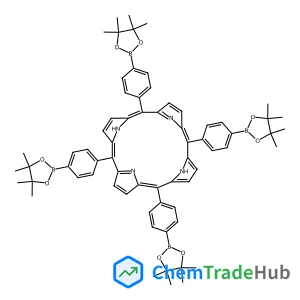
5,10,15,20-tetrakis(4-boronic acid pinacol ester phenyl) porphyrin
CAS Number:
1332748-00-1
Molecular Formula:
C68H74B4N4O8
![Imidazo[1,2-c]pyrimidine structure](https://static.chemtradehub.com/structs/274/274-78-2-8b4c.webp "Imidazo[1,2-c]pyrimidine structure")
Recommended Suppliers






Disclaimer
This page provides academic journal information for reference and research purposes only. We are not affiliated with any journal publishers and do not handle publication submissions. For publication-related inquiries, please contact the respective journal publishers directly.
If you notice any inaccuracies in the information displayed, please contact us at support@chemtradehub.com. We will promptly review and address your concerns.