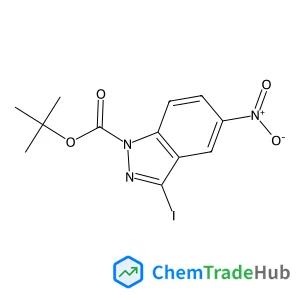
Tert-butyl 3-iodo-5-nitro-1H-indazole-1-carboxylate
CAS Number:
459133-69-8
Molecular Formula:
C12H12IN3O4
Gary Knight, A. R. Ravishankara, James B. Burkholder
The UV absorption spectrum of gas phase HO2NO2 (PNA, peroxynitric acid) was measured over the wavelength range 220 to 350 nm at temperatures between 273 and 343 K using a diode array spectrometer. Contributions to the measured spectra from HNO3, H2O2 and NO2 were subtracted by using mass spectral detection of HNO3 and H2O2 and UV/Vis absorption for NO2. Our HO2NO2 absorption spectra have been scaled to the previously reported absorption cross section data of Molina and Molina [L. T. Molina and M. J. Molina, J. Photochem., 1981, 15, 97] and Singer et al. [R. J. Singer, J. N. Crowley, J. P. Burrows, W. Schneider and G. K. Moortgat, J. Photochem. Photobiol., A: Chemistry, 1989, 48, 17] at 250 nm. Our measured HO2NO2 cross sections at wavelengths longer than 290 nm are compared with literature values and the discrepancies are discussed. An empirical parametrization of the measured HO2NO2 cross section temperature dependence for use in atmospheric model calculations is presented.
Navneet Chandak, Pawan Kumar, Jitander K. Kapoor, Pawan K. Sharma
DOI: 10.1039/C3GC40797G
Go Hamasaka, Takao Osako, Yoichi M. A. Yamada, Chao-Jun Li, Audrey Moores
DOI: 10.1039/C3GC40789F
Sarina Sarina, Eric R. Waclawik, Huaiyong Zhu
DOI: 10.1039/C3GC40450A
Jeremiah Toster, Qin Lin Zhou, Nicole M. Smith, K. Swaminathan Iyer, Federico Rosei, Colin L. Raston
DOI: 10.1039/C3GC40660A
Joseph P. Adams, Catherine M. Alder, Ian Andrews, Ann M. Bullion, Matthew Campbell-Crawford, Michael G. Darcy, John D. Hayler, Richard K. Henderson, Catriona A. Oare, Israil Pendrak, Anikó M. Redman, Leanna E. Shuster, Helen F. Sneddon, Matthew D. Walker
DOI: 10.1039/C3GC40225H
Daqian Xu, Wenfang Wang, Chengxia Miao, Qiaohong Zhang, Chungu Xia, Wei Sun
DOI: 10.1039/C3GC41206G
Michael R. Reithofer, Yin Ngai Sum, Yugen Zhang
DOI: 10.1039/C3GC40790J
Fei Gao, Ronghua Jin, Dacheng Zhang, Quanxi Liang, Qunqun Ye, Guohua Liu
DOI: 10.1039/C3GC40547H
Shaoyan Zhang, Guoli Fan, Feng Li
DOI: 10.1039/C3GC40658J
Lirong Tang, Biao Huang, Nating Yang, Tao Li, Qilin Lu, Wenyi Lin, Xuerong Chen
DOI: 10.1039/C3GC40965A
When handling 4-Methyl-6-(trifluoromethyl)quinoline (CAS: 40716-16-3), safety go...
4-(3,5-Difluorophenyl)aniline is an aromatic organic compound with the CAS numbe...
5-{[4-(Trifluoromethyl)phenyl]sulfanyl}-1,2,3-thiadiazole-4-carboxylic acid can ...
The market for 4-Benzylaniline hydrochloride (CAS: 6317-57-3) is steadily growin...
[3-(Diethylsulfamoyl)phenyl]boronic acid is generally considered safe when handl...
3-Bromo-2,5-dimethoxyaniline is mainly used in the pharmaceutical and chemical i...
N-Methyl-1-(5-methyl-1H-indol-3-yl)methanamine (CAS: 915922-67-7) is subject to ...
This compound is primarily used in the pharmaceutical industry for the synthesis...
2-Methyl-2-propanyl [(1S,3R)-3-aminocyclohexyl]carbamate (CAS: 1298101-47-9) sho...
Ethyl 2-bromo-4,4,4-trifluorobutanoate (CAS: 367-33-9) is utilized in the pharma...

Physical Chemistry Chemical Physics (PCCP) is an international journal co-owned by 19 physical chemistry and physics societies from around the world. This journal publishes original, cutting-edge research in physical chemistry, chemical physics and biophysical chemistry. To be suitable for publication in PCCP, articles must include significant innovation and/or insight into physical chemistry; this is the most important criterion that reviewers and Editors will judge against when evaluating submissions. The journal has a broad scope and welcomes contributions spanning experiment, theory, computation and data science. Topical coverage includes spectroscopy, dynamics, kinetics, statistical mechanics, thermodynamics, electrochemistry, catalysis, surface science, quantum mechanics, quantum computing and machine learning. Interdisciplinary research areas such as polymers and soft matter, materials, nanoscience, energy, surfaces/interfaces, and biophysical chemistry are welcomed if they demonstrate significant innovation and/or insight into physical chemistry. Joined experimental/theoretical studies are particularly appreciated when complementary and based on up-to-date approaches.
![(4aR,5S,6R,8aS)-5-[2-(3-Furyl)ethyl]-8a-(hydroxymethyl)-5,6-dimethyl-3,4,4a,5,6,7,8,8a-octahydro-1-naphthalenecarboxylic acid structure](https://static.chemtradehub.com/structs/184/18411-75-1-d4cd.webp "(4aR,5S,6R,8aS)-5-[2-(3-Furyl)ethyl]-8a-(hydroxymethyl)-5,6-dimethyl-3,4,4a,5,6,7,8,8a-octahydro-1-naphthalenecarboxylic acid structure")
![[3-(2,6-Dichlorophenyl)-5-isopropyl-1,2-oxazol-4-yl]methanol structure](https://static.chemtradehub.com/structs/278/278597-30-1-5c79.webp "[3-(2,6-Dichlorophenyl)-5-isopropyl-1,2-oxazol-4-yl]methanol structure")