


Radiopharmacological evaluation of a caspase-3 responsive probe with optimized pharmacokinetics for PET imaging of tumor apoptosis
Literature Information
Publication Date
2020-04-16
DOI
10.1039/D0OB00690D
Impact Factor
3.876
Authors
Ke Li, Siqin Ye, Qingzhu Liu, Ying Peng, Gaochao Lv
View Original
Abstract
Early evaluation of the therapy efficiency can promote the development of anti-tumor drugs and optimization of the treatment method. Caspase-3 is a key biomarker for early apoptosis. Detection of caspase-3 activity is essential for quick assessment of the curative effect. We have reported a PET probe that could image drug-induced tumor apoptosis in vivo. However, high liver uptake limits its application. In order to optimize the pharmacokinetics of the previous probe, we introduced a hydrophilic peptide sequence to minimize liver uptake. The structure of the new probe was confirmed by mass spectrometry and nuclear magnetic resonance. This probe was able to cross the cell membrane freely and could be converted into a dimer through the condensation reaction of 2-cyano-6-aminobenzothiazole (CBT) and cysteine in response to intracellular activated caspase-3 and glutathione (GSH). The hydrophobic dimers further self-assembled into nanoparticles, which could enhance the probe aggregation in apoptotic tumor tissues. In vivo experiments showed that the tumor uptake of the new probe was higher than that of the previous probe, while the liver uptake of the new probe was significantly reduced. The new probe might be promising in imaging apoptotic tumors with suitable pharmacokinetics.
Recommended Journals

Russian Journal of Applied Chemistry

Saudi Pharmaceutical Journal

Russian Journal of Bioorganic Chemistry

Journal of Peptide Science

Russian Journal of Coordination Chemistry

Chemical Communications

Chemistry Education Research and Practice

Journal of Saudi Chemical Society

Organic Process Research & Development

New Journal of Chemistry
Related Literature
Mechanical disassembly of human picobirnavirus like particles indicates that cargo retention is tuned by the RNA–coat protein interaction
Javier M. Rodríguez
2023-10-05
Communication
DOI: 10.1039/D3NH00195D
Post-synthetic modification of zeolitic imidazolate framework-90 via Schiff base reaction for ultrahigh iodine capture
Zilong Zhang, Yanchun Chen, Yiheng Sun, Zilu Chen, Zhan-Yun Zhang, Dongcheng Liu, Huan-Cheng Hu
2023-10-31
Paper
DOI: 10.1039/D3TA04686A
Topology driven and soft phonon mode enabled Na-ion diffusion in quaternary chalcogenides, Na3ZnGaX4 (X = S, and Se)
Santhoshkumar Sundaramoorthy, Amitava Choudhury, Naresh C. Osti, Alexander I. Kolesnikov, Matthew B. Stone, Yongqiang Cheng
2023-10-04
Paper
DOI: 10.1039/D3TA04479C
Amorphous C/SbSx composites from natural stibnite as low cost and high performance lithium/sodium-ion battery anodes
Shuonan Wang, Kai Zhang, Hao Liu, Libing Liao
2023-10-26
Paper
DOI: 10.1039/D3TA05355E
van der Waals 2D transition metal dichalcogenide/organic hybridized heterostructures: recent breakthroughs and emerging prospects of the device
Sherif Kamal, Yahya Khan, Marko Kralj
2023-10-30
Review Article
DOI: 10.1039/D3NH00310H
Solar light selective-harvesting eco-friendly colloidal quantum dots for transparent luminescent solar concentrators
Ehsan Hamzehpoor, Jiabin Liu, Xin Liu, Gurpreet Singh Selopal, Dmytro F. Perepichka, Zhiming M. Wang
2023-10-13
Paper
DOI: 10.1039/D3TA05351B
siRNA-loaded DNA nanostructures restore endothelial leakiness
Arun Richard Chandrasekaran
2023-10-04
Editorial
DOI: 10.1039/D3NH90040A
Defect engineering enhances plasmonic-hot electrons exploitation for CO2 reduction over polymeric catalysts
Zhehao Sun, Kaili Liu, Ary Anggara Wibowo, Julien Langley, Chao Zhang, Sandra E. Saji, Felipe Kremer, Dmitri Golberg, Hieu T. Nguyen, Nicholas Cox
2023-09-05
Communication
DOI: 10.1039/D3NH00348E
You might also like
Compound Q&A
What regulatory guidelines apply to 6-Bromo-2-methylimidazo[1,2-a]pyrimidine (CAS: 1111638-05-1)?
6-Bromo-2-methylimidazo[1,2-a]pyrimidine (CAS: 1111638-05-1) falls under various...
1111638-05-16-Bromo-2-methylimid...
Compound Q&A
Are there alternatives to 1-Pyrrolidineethanol, β-methyl-α-phenyl-, (αS,βR) (CAS: 123620-80-4) in synthesis?
While there are no direct alternatives, similar compounds like 1-Pyrrolidineetha...
123620-80-41-Pyrrolidineethanol...
Compound Q&A
Is 4-Methyl-2,6-bis(2-methyl-2-propanyl)phenyl methylcarbamate (CAS: 1918-11-2) safe?
4-Methyl-2,6-bis(2-methyl-2-propanyl)phenyl methylcarbamate (CAS: 1918-11-2) is ...
1918-11-24-Methyl-2,6-bis(2-m...
Compound Q&A
How should 2-(3-Bromo-4-fluorophenyl)-1,3-dioxolane (CAS: 77771-04-1) be stored?
2-(3-Bromo-4-fluorophenyl)-1,3-dioxolane (CAS: 77771-04-1) should be stored in a...
77771-04-12-(3-Bromo-4-fluorop...
Compound Q&A
What are the physical and chemical properties of 4,5,6,7-Tetrahydro-1H-indazole hydrochloride (CAS: 18161-11-0)?
4,5,6,7-Tetrahydro-1H-indazole hydrochloride is a white crystalline solid with a...
18161-11-04,5,6,7-Tetrahydro-1...
Compound Q&A
What is (2R)-1-Methoxy-3-phenyl-2-propanamine (CAS: 59919-07-2)?
(2R)-1-Methoxy-3-phenyl-2-propanamine is a chiral organic compound with the CAS ...
59919-07-2(2R)-1-Methoxy-3-phe...
Compound Q&A
What industries use Ethyl 1-(1-phenylethyl)-1H-imidazole-5-carboxylate (CAS: 56649-47-9)?
Ethyl 1-(1-phenylethyl)-1H-imidazole-5-carboxylate is used in various industries...
56649-47-9Ethyl 1-(1-phenyleth...
Compound Q&A
What regulatory guidelines apply to 4-[(1E,3S)-1-(4-Hydroxyphenyl)-1,4-pentadien-3-yl]phenol (CAS: 17676-24-3)?
4-[(1E,3S)-1-(4-Hydroxyphenyl)-1,4-pentadien-3-yl]phenol (CAS: 17676-24-3) falls...
17676-24-34-[(1E,3S)-1-(4-Hydr...
Compound Q&A
What industries use (S)-3-Amino-5-phenylpentanoic acid hydrochloride (CAS: 331846-97-0)?
(S)-3-Amino-5-phenylpentanoic acid hydrochloride is primarily used in the pharma...
331846-97-0(S)-3-Amino-5-phenyl...
Compound Q&A
How is 7-methoxy-1-benzothiophene-2-carboxylic acid (CAS: 88791-07-5) typically synthesized?
7-Methoxy-1-benzothiophene-2-carboxylic acid is typically synthesized by reactin...
88791-07-57-methoxy-1-benzothi...
Source Journal
Organic & Biomolecular Chemistry

CiteScore:
3.4
Self-citation Rate:
10.3%
Articles per Year:
1041
Organic & Biomolecular Chemistry (OBC) publishes original and high impact research and reviews in organic chemistry. We welcome research that shows new or significantly improved protocols or methodologies in total synthesis, synthetic methodology or physical and theoretical organic chemistry as well as research that shows a significant advance in the organic chemistry or molecular design aspects of chemical biology, catalysis, supramolecular and macromolecular chemistry, theoretical chemistry, mechanism-oriented physical organic chemistry, medicinal chemistry or natural products. Articles published in the journal should report new work which makes a highly-significant impact in the field. Routine and incremental work is generally not suitable for publication in the journal. More details about key areas of our scope are below. In all cases authors should include in their article clear rationale for why their research has been carried out.
Recommended Compounds
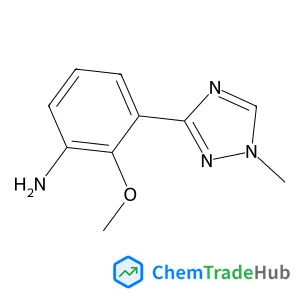
2-Methoxy-3-(1-methyl-1H-1,2,4-triazol-3-yl)aniline
CAS Number:
1609394-10-6
Molecular Formula:
C10H12N4O
Recommended Suppliers




Disclaimer
This page provides academic journal information for reference and research purposes only. We are not affiliated with any journal publishers and do not handle publication submissions. For publication-related inquiries, please contact the respective journal publishers directly.
If you notice any inaccuracies in the information displayed, please contact us at support@chemtradehub.com. We will promptly review and address your concerns.