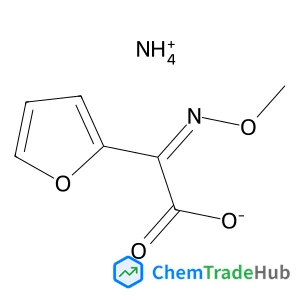
Ammonium (Z)-2-(furan-2-yl)-2-(methoxyimino)acetate
CAS Number:
97148-39-5
Molecular Formula:
C7H10N2O4
Jaroslav V. Burda, Jiří Šponer, Jerzy Leszczynski
The energetics and structures of guaninecytosine (GC) and adeninethymine (AT) Watson–Crick base pairs metalated by the square planar platinum adducts trans-PtCl2(NH3), trans-PtCl(NH3)2+ and Pt(NH3)32+ at the N7 purine position have been investigated using advanced quantum chemical methods. The molecular complexes were optimized using Becke3LYP density functional theory (DFT) approach. For each base pair we evaluated two structures, one of them with and the other without the formation of intrasystem H bonds between the ligands attached to the metal and the exocyclic 6 position of the purine nucleobase. Interaction energies were evaluated and decomposed into individual pairwise and many-body terms. For some systems, the Becke3LYP approach provided biased interaction energy decomposition when including the correction for the basis set superposition error. Thus, these systems were re-evaluated with a second-order Møller–Plesset (MP2) perturbation approach resulting in correct decomposition. The calculations show, among other results, that the GC base pair is significantly strengthened by polarization effects when Pt(NH3)32+ is bound to its N7 position. This observation is in agreement with recent solution experiments on platinated base pairs. The calculations suggest that the effect exerted by Pt(NH3)32+ on the base pair stability is larger compared with the effect exerted by inner-shell binding of hydrated divalent cations of zinc and magnesium groups.
Xi Huang, Huihui Liu, Jiyun Wang, Caiqiao Xiong
DOI: 10.1039/C9SC90270H
DOI: 10.1039/CS9881700317
Geetha Bolla, Sudhir Mittapalli, Ashwini Nangia
DOI: 10.1039/C3CE41885E
Solène Savourey, Guillaume Lefèvre, Jean-Claude Berthet, Thibault Cantat
DOI: 10.1039/C4CC05908E
DOI: 10.1039/C9SC04988F
Matteo Lusi, Leonard J. Barbour
DOI: 10.1039/C3CE41572D
Fei Liang, Limin Wang
DOI: 10.1039/C3CE41915K
Sk. Asif Ikbal, Sanfaori Brahma, Sankar Prasad Rath
DOI: 10.1039/C4CC06092J
1H-Indazole-6-carbonitrile finds applications in pharmaceuticals, where it serve...
Waste containing Dioctyl (2E)-2-butenedioate (CAS: 2997-85-5) should be collecte...
Sodium [(1,2-benzoxazol-3-ylmethyl)sulfonyl]azanide is primarily used in pharmac...
Dimethyl 4-(4,4,5,5-tetramethyl-1,3,2-dioxaborolan-2-yl)-2,6-pyridinedicarboxyla...
Waste containing 2-Fluoro-6-hydrazinopyridine (CAS: 80714-39-2) should be manage...
6-Formyl-2-pyridinecarboxylic acid is an organic compound with the molecular for...
Research trends for this compound indicate a focus on its potential applications...
9H-Tribenzo[b,d,f]azepine is typically synthesized via a multi-step process invo...
1-Cyclopropyl-7-ethoxy-6-fluoro-8-methoxy-4-oxo-1,4-dihydro-3-quinolinecarboxyli...
Waste containing Methyl 3-oxo-1,2,3,4-tetrahydro-6-quinoxalinecarboxylate (CAS: ...

Physical Chemistry Chemical Physics (PCCP) is an international journal co-owned by 19 physical chemistry and physics societies from around the world. This journal publishes original, cutting-edge research in physical chemistry, chemical physics and biophysical chemistry. To be suitable for publication in PCCP, articles must include significant innovation and/or insight into physical chemistry; this is the most important criterion that reviewers and Editors will judge against when evaluating submissions. The journal has a broad scope and welcomes contributions spanning experiment, theory, computation and data science. Topical coverage includes spectroscopy, dynamics, kinetics, statistical mechanics, thermodynamics, electrochemistry, catalysis, surface science, quantum mechanics, quantum computing and machine learning. Interdisciplinary research areas such as polymers and soft matter, materials, nanoscience, energy, surfaces/interfaces, and biophysical chemistry are welcomed if they demonstrate significant innovation and/or insight into physical chemistry. Joined experimental/theoretical studies are particularly appreciated when complementary and based on up-to-date approaches.