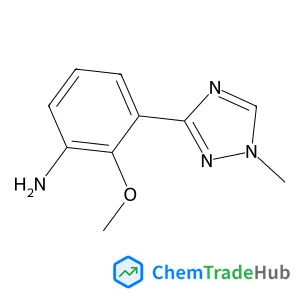
2-Methoxy-3-(1-methyl-1H-1,2,4-triazol-3-yl)aniline
CAS Number:
1609394-10-6
Molecular Formula:
C10H12N4O
Bernhard Urban, Vladimir E. Bondybey
Threshold photoionization spectroscopy [zero kinetic energy (ZEKE), pulsed field ionization (PFI), mass analysed threshold ionisation (MATI)] usually takes advantage of multip hoton excitation through bound intermediate states, but we show that excellent quality, high-resolution spectra can also be obtained in one-color experiments using two- and three-photon ionization. An enhancement similar to resonance Raman yields changed spectra if the excitation proceeds ia continuous intermediate states. A molecule which after absorbing a photon started to dissociate is stabilized on the ionic surface by a delayed second photon, with the observed spectra reflecting geometry changes due to this arrested dissociation process. Using two colors, the technique should be applicable to almost any molecule, and yield a detailed insight into its dissociation dynamics.

Chinese Journal of Chemistry

Bioorganic & Medicinal Chemistry Letters

Polycyclic Aromatic Compounds

Acta Metallurgica Sinica-English Letters

NDT & E International

Journal of Asian Natural Products Research

Biocatalysis and Biotransformation

Colloid Journal

Herald of the Russian Academy of Sciences

Journal of Chemical Sciences
Edwin C. Constable, Kate Harris, Catherine E. Housecroft, Markus Neuburger, Silvia Schaffner
DOI: 10.1039/B811204E
Gullapalli Kumaraswamy, Kadivendi Sadaiah, Duggirala Subrahmanya Ramakrishna, Naresh Police, Balasubramanian Sridhar, Jagadeesh Bharatam
DOI: 10.1039/B810770J
Yu Sung Chun, Ki Kon Lee, Young Ok Ko, Hyunik Shin, Sang-gi Lee
DOI: 10.1039/B813369G
James P. Collman, Richard A. Decréau
DOI: 10.1039/B808070B
Makoto Oba, Yasunori Okada, Kozaburo Nishiyama, Shigeru Shimada, Wataru Ando
DOI: 10.1039/B811112J
Jian Chen, Fang Zeng, Shuizhu Wu, Jianqing Zhao, Qiming Chen, Zhen Tong
DOI: 10.1039/B810677K
Katharine Geramita, Jennifer McBee, Yuefei Tao, Rachel A. Segalman, T. Don Tilley
DOI: 10.1039/B813440E
Wen-Ming Wan, Cai-Yuan Pan
DOI: 10.1039/B811618K
1H-Indazole-6-carbonitrile finds applications in pharmaceuticals, where it serve...
Waste containing Dioctyl (2E)-2-butenedioate (CAS: 2997-85-5) should be collecte...
Sodium [(1,2-benzoxazol-3-ylmethyl)sulfonyl]azanide is primarily used in pharmac...
Dimethyl 4-(4,4,5,5-tetramethyl-1,3,2-dioxaborolan-2-yl)-2,6-pyridinedicarboxyla...
Waste containing 2-Fluoro-6-hydrazinopyridine (CAS: 80714-39-2) should be manage...
6-Formyl-2-pyridinecarboxylic acid is an organic compound with the molecular for...
Research trends for this compound indicate a focus on its potential applications...
9H-Tribenzo[b,d,f]azepine is typically synthesized via a multi-step process invo...
1-Cyclopropyl-7-ethoxy-6-fluoro-8-methoxy-4-oxo-1,4-dihydro-3-quinolinecarboxyli...
Waste containing Methyl 3-oxo-1,2,3,4-tetrahydro-6-quinoxalinecarboxylate (CAS: ...

Physical Chemistry Chemical Physics (PCCP) is an international journal co-owned by 19 physical chemistry and physics societies from around the world. This journal publishes original, cutting-edge research in physical chemistry, chemical physics and biophysical chemistry. To be suitable for publication in PCCP, articles must include significant innovation and/or insight into physical chemistry; this is the most important criterion that reviewers and Editors will judge against when evaluating submissions. The journal has a broad scope and welcomes contributions spanning experiment, theory, computation and data science. Topical coverage includes spectroscopy, dynamics, kinetics, statistical mechanics, thermodynamics, electrochemistry, catalysis, surface science, quantum mechanics, quantum computing and machine learning. Interdisciplinary research areas such as polymers and soft matter, materials, nanoscience, energy, surfaces/interfaces, and biophysical chemistry are welcomed if they demonstrate significant innovation and/or insight into physical chemistry. Joined experimental/theoretical studies are particularly appreciated when complementary and based on up-to-date approaches.