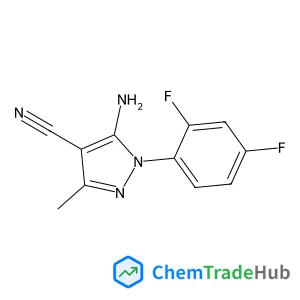
5-Amino-1-(2,4-difluorophenyl)-3-methyl-1H-pyrazole-4-carbonitrile
CAS Number:
1020057-92-4
Molecular Formula:
C11H8F2N4
Claude Schweitzer, Zahra Mehrdad, Farokh Shafii, Reinhard Schmidt
The photosensitized production of singlet molecular oxygen O2(1Δg) during oxygen quenching of excited triplet states, T1, and the deactivation of O2(1Δg) by the sensitizer have been investigated for a set of biphenyl derivatives, in carbon tetrachloride, dichloromethane and acetonitrile. The rate constants of the quenching of T1 by ground state oxygen, O2(3Σg−), leading to O2(3Σg−) and of O2(1Δg) quenching by ground state sensitizers, S0, have been subjected to a common analysis. It is shown that the rate constants for both processes are described by one Marcus-type plot in each solvent. This indicates that both processes proceed ia exciplexes (T13Σ) and (S01Δ) of the same partial charge transfer (pCT) from sensitizer to O2 . These findings are in accordance with results obtained previously with a series of naphthalene derivatives. Further comparative analysis leads to a relation for the estimation of the average charge transfer character of the (T13Σ) and (S01Δ) pCT complexes, which is consistent with the existing concept of the reorganization energy. The average charge transfer character varies only slightly between the series of biphenyl and naphthalene derivatives, and is shown to increase in each case with solvent polarity. The overall reorganization energies could be separated into constant intramolecular and solvent-dependent outer reorganization contributions. The small but significant differences in the reorganization energy indicate that the structure of pCT complexes varies between these two series.

Journal of Natural Medicines

Chemical Communications

Russian Journal of Coordination Chemistry

Russian Chemical Bulletin

Acta Materialia

Russian Journal of Organic Chemistry

Current Opinion in Solid State & Materials Science

New Journal of Chemistry

Journal of Saudi Chemical Society

Current Opinion in Colloid & Interface Science
Jia-Ming Liu, Li-ping Lin, Xin-Xing Wang, Shao-Qin Lin, Wen-Lian Cai, Li-Hong Zhang, Zhi-Yong Zheng
DOI: 10.1039/C2AN35130G
Alex H. Wrede, Faisal Al-Masri, Reza Montazami
DOI: 10.1039/C9AY01576K
Yang Hu, Jinlong Wang
DOI: 10.1039/C9AY01506J
C. W. Tsao, C. H. Lin, C. C. Chang, W. Y. Chen
DOI: 10.1039/C2AN35189G
Ping Wu, Yang Gao, Yimei Lu, Hui Zhang, Chenxin Cai
DOI: 10.1039/C3AN01375H
Naoya Jinno, Mari Murakami, Kiyoshi Mizohata, Masahiko Hashimoto, Kazuhiko Tsukagoshi
DOI: 10.1039/C0AN00820F
Rui Gusmão, Cristina Ariño, José Manuel Díaz-Cruz, Miquel Esteban
DOI: 10.1039/B918293D
Michaela Meyns, Sebastian Primpke, Gunnar Gerdts
DOI: 10.1039/C9AY01193E
Ethyl 4-chlorothieno[2,3-b]pyridine-5-carboxylate (CAS: 59713-58-5) can be synth...
5-Methyl-1H-indole-3-carbaldehyde (CAS: 52562-50-2) is subject to various regula...
(1,3-Dimethyl-2,4-dioxo-1,2,3,4-tetrahydro-5-pyrimidinyl)boronic acid is a white...
Waste containing Sulfocostunolide A (CAS: 1016983-51-9) should be handled with c...
When handling Murraxocin (CAS: 88478-44-8), ensure proper personal protective eq...
Formvar (CAS: 63148-64-1) is an alkyd resin characterized by a high molecular we...
(S)-4-benzyl-2-((benzyloxy)methyl)morpholine is generally safe when handled with...
Methyl 1-(5-bromo-2-pyrimidinyl)cyclopropanecarboxylate (CAS: 1447607-69-3) is p...
2-Methyl-1-phenyl-1-propanamine hydrochloride (CAS: 24290-47-9) is generally con...
3-(4-Bromophenyl)-2-methylpropanoic acid is synthesized through a multi-step pro...

Physical Chemistry Chemical Physics (PCCP) is an international journal co-owned by 19 physical chemistry and physics societies from around the world. This journal publishes original, cutting-edge research in physical chemistry, chemical physics and biophysical chemistry. To be suitable for publication in PCCP, articles must include significant innovation and/or insight into physical chemistry; this is the most important criterion that reviewers and Editors will judge against when evaluating submissions. The journal has a broad scope and welcomes contributions spanning experiment, theory, computation and data science. Topical coverage includes spectroscopy, dynamics, kinetics, statistical mechanics, thermodynamics, electrochemistry, catalysis, surface science, quantum mechanics, quantum computing and machine learning. Interdisciplinary research areas such as polymers and soft matter, materials, nanoscience, energy, surfaces/interfaces, and biophysical chemistry are welcomed if they demonstrate significant innovation and/or insight into physical chemistry. Joined experimental/theoretical studies are particularly appreciated when complementary and based on up-to-date approaches.
![Imidazo[1,5-a]pyrazine structure](https://static.chemtradehub.com/structs/274/274-49-7-d749.webp "Imidazo[1,5-a]pyrazine structure")
![2-Methyl-2-propanyl 1,6-diazaspiro[3.4]octane-6-carboxylate structure](https://static.chemtradehub.com/structs/115/1158749-79-1-81ee.webp "2-Methyl-2-propanyl 1,6-diazaspiro[3.4]octane-6-carboxylate structure")