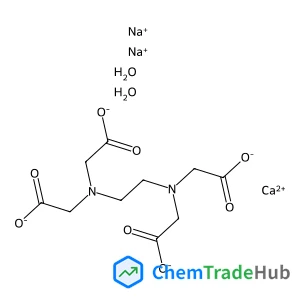
EthylenediaminetetraaceticacidcalciumDisodiumsalthydrate
CAS Number:
23411-34-9
Molecular Formula:
C10H16CaN2Na2O10
Ying Shang, Na Li, Tingting Liu, Bo-Han Li, Kunqian Yu, Yi Zang, James T. Brewster, II, Maria L. Odyniec, Maria Weber, Steven D. Bull, Jia Li, Tony D. James, Xiao-Peng He, He Tian
Herein, we report a protein-based hybridization strategy that exploits the host-guest chemistry of HSA (human serum albumin) to solubilize the otherwise cell impermeable ONOO− fluorescent probe Pinkment-OAc. Formation of a HSA/Pinkment-OAc supramolecular hybrid was confirmed by SAXS and solution-state analyses. This HSA/Pinkment-OAc hybrid provided an enhanced fluorescence response towards ONOO−versusPinkment-OAc alone, as determined by in vitro experiments. The HSA/Pinkment-OAc hybrid was also evaluated in RAW 264.7 macrophages and HeLa cancer cell lines, which displayed an enhanced cell permeability enabling the detection of SIN-1 and LPS generated ONOO− and the in vivo imaging of acute inflammation in LPS-treated mice. A remarkable 5.6 fold (RAW 264.7), 8.7-fold (HeLa) and 2.7-fold increased response was seen relative to Pinkment-OAc alone at the cellular level and in vivo, respectively. We anticipate that HSA/fluorescent probe hybrids will soon become ubiquitous and routinely applied to overcome solubility issues associated with hydrophobic fluorescent imaging agents designed to detect disease related biomarkers.
Mitsuhiko Miyazaki, Akihiro Takeda, Shun-ichi Ishiuchi, Makoto Sakai, Otto Dopfer, Masaaki Fujii
DOI: 10.1039/C0CP01961E
Ewa Kurach, David Djurado, Jan Rimarčik, Aleksandra Kornet, Marek Wlostowski, Vladimir Lukeš, Jacques Pécaut, Malgorzata Zagorska, Adam Pron
DOI: 10.1039/C0CP01553A
Joshua W. Hollett, Peter M. W. Gill
DOI: 10.1039/C0CP02154G
Emilie Klecha, Imad Arfaoui, Johannes Richardi, Dorothée Ingert, Marie-Paule Pileni
DOI: 10.1039/C0CP01237H
G. Benay, R. Schurhammer, G. Wipff
DOI: 10.1039/C0CP01975E
Iain D. Mackie, Gino A. DiLabio
DOI: 10.1039/C0CP01537G
Franziska Fennel, Stefan Lochbrunner
DOI: 10.1039/C0CP01211D
Darren Yang, Gaurav Arya
DOI: 10.1039/C0CP01487G
DOI: 10.1039/C0CP00990C
1H-Indazole-6-carbonitrile finds applications in pharmaceuticals, where it serve...
Waste containing Dioctyl (2E)-2-butenedioate (CAS: 2997-85-5) should be collecte...
Sodium [(1,2-benzoxazol-3-ylmethyl)sulfonyl]azanide is primarily used in pharmac...
Dimethyl 4-(4,4,5,5-tetramethyl-1,3,2-dioxaborolan-2-yl)-2,6-pyridinedicarboxyla...
Waste containing 2-Fluoro-6-hydrazinopyridine (CAS: 80714-39-2) should be manage...
6-Formyl-2-pyridinecarboxylic acid is an organic compound with the molecular for...
Research trends for this compound indicate a focus on its potential applications...
9H-Tribenzo[b,d,f]azepine is typically synthesized via a multi-step process invo...
1-Cyclopropyl-7-ethoxy-6-fluoro-8-methoxy-4-oxo-1,4-dihydro-3-quinolinecarboxyli...
Waste containing Methyl 3-oxo-1,2,3,4-tetrahydro-6-quinoxalinecarboxylate (CAS: ...
Our journal has a wide-ranging scope which covers the full breadth of the chemical sciences. The research we publish contains the sorts of novel ideas, challenging questions and progressive thinking that bring undiscovered breakthroughs within reach. Your paper could focus on a single area, or cross many. It could be beyond the accepted bounds of the chemical sciences. It might address an immediate challenge, contribute to a future breakthrough or be wholly conceptual. We’re a team from every field of the chemical sciences, and know from experience that breakthroughs that drive the solutions to global challenges can come from anywhere, at any time. You could even start an entirely new area of research. Too bold? Too progressive? No such thing
![Sodium (2Z)-7-{[(2R)-2-amino-2-carboxyethyl]sulfanyl}-2-({[(1S)-2,2-dimethylcyclopropyl]carbonyl}amino)-2-heptenoate structure](https://static.chemtradehub.com/structs/811/81129-83-1-441c.webp "Sodium (2Z)-7-{[(2R)-2-amino-2-carboxyethyl]sulfanyl}-2-({[(1S)-2,2-dimethylcyclopropyl]carbonyl}amino)-2-heptenoate structure")