













A molecular dynamics simulation study of the unfolding of barnase induced by reaction field perturbation
Literature Information
Publication Date
DOI
10.1039/A903413G
Impact Factor
3.676
Authors
View Original
Abstract
We present a novel method to study protein unfolding by molecular dynamics (MD) simulations. A term resembling a reaction field is added as a perturbation to the Ewald sum, the most commonly used method to calculate electrostatic interactions in MD simulations. This reaction field perturbation (RFP) mimics qualitatively on the level of molecular interactions the changes in a protein solvent system when denaturants (e.g., urea or guadinium chloride) are added. The method is tunable by two parameters that control strength and “type’' (i.e., different regions of the electrostatic interactions can be weakened selectively) of the perturbations. The approach is tested by a detailed unfolding study of barnase based on several simulations, starting from two initial structures and with varying strength of the RFP. Unfolding is studied by following the changes in the radius of gyration, in the root mean square deviation and in the solvent accessible surface area of the protein. On the local level, the loss of secondary structure is monitored. In addition, the calculation of Voronoi volumes of individual side chains and the number of intruding waters as a function of simulation time are used to analyze the hydrophobic cores. We find an unfolding pathway and folding intermediates which agree well with the experimental data available and which are consistent with earlier simulation studies. Since under one set of RFP conditions the intermediate states are stable for approximately 100 ps, it is possible to characterize these states resembling the experimentally observed transition state and folding intermediate in great detail.
Related Literature
Mass transfer considerations for monitoring catalytic solid–liquid interfaces under operating conditions
Laura Rodríguez-García, Roland Walker, Eyal Spier, Konrad Hungerbühler, Fabian Meemken
2017-12-18
Paper
DOI: 10.1039/C7RE00179G
A continuous flow protocol to generate, regenerate, load, and recycle chlorotrityl functionalised resins
Lawson K. Spare, Maria Menti
2019-05-20
Paper
DOI: 10.1039/C8RE00318A
Continuous nitration of alcohols in a Freon flow
Mikhail N. Zharkov, Svetlana S. Arabadzhi, Ilya V. Kuchurov, Sergei G. Zlotin
2019-04-12
Paper
DOI: 10.1039/C9RE00035F
Simulation of exotherms from the oxidation of accumulated carbonaceous species over a VSCR catalyst
Yuanzhou Xi, Nathan A. Ottinger, Z. Gerald Liu
2019-04-05
Paper
DOI: 10.1039/C8RE00291F
Enhanced reactive CO2 species formation via V2O5-promoted Ni/KCC-1 for low temperature activation of CO2 methanation
Muhamed Yusuf Shahul Hamid, Anis Farhana Abdul Rahman
2019-03-16
Paper
DOI: 10.1039/C8RE00312B
Hydrogen and steam injected tandem μ-reactor GC/FID system: phenol recovery from bisphenol A and alkylphenols using Ni/Y zeolite
S. Kumagai, M. Asakawa, T. Kameda, Y. Saito, A. Watanabe, C. Watanabe, T. Yoshioka
2019-10-03
Paper
DOI: 10.1039/C9RE00299E
Development of semi-continuous chemo-enzymatic terpene epoxidation: combination of anthraquinone autooxidation and the lipase-mediated epoxidation process
Sumanth Ranganathan
2017-10-03
Paper
DOI: 10.1039/C7RE00112F
Flow mediated metal-free PET-RAFT polymerisation for upscaled and consistent polymer production
Leonid Zhernakov, Muhammad Hazim Hashim
2019-03-20
Paper
DOI: 10.1039/C9RE00014C
Titania supported on silica as an efficient catalyst for deep oxidative desulfurization of a model fuel with exceptionally diluted H2O2
C. G. Piscopo, J. Tochtermann, M. Schwarzer, D. Boskovic, R. Maggi, G. Maestri, S. Loebbecke
2018-01-15
Communication
DOI: 10.1039/C7RE00192D
You might also like
Compound Q&A
What is 3-Fluoro-2-methylbenzylamine (CAS: 771573-36-5)?
3-Fluoro-2-methylbenzylamine is an organic compound with the CAS number 771573-3...
771573-36-53-Fluoro-2-methylben...
Compound Q&A
Is Tert-butyl 2-(oxetan-3-ylidene)acetate (CAS: 1207175-03-8) safe?
Tert-butyl 2-(oxetan-3-ylidene)acetate is considered safe for its intended uses ...
1207175-03-8Tert-butyl 2-(oxetan...
Compound Q&A
What precautions should be taken when handling 4-Acetyl-2-fluorobenzonitrile (CAS: 214760-18-6)?
Proper personal protective equipment (PPE) such as gloves, goggles, and a lab co...
214760-18-64-Acetyl-2-fluoroben...
Compound Q&A
How is 2-Ethyl-4-methyl-1,3-thiazole (CAS: 15679-12-6) typically synthesized?
2-Ethyl-4-methyl-1,3-thiazole is commonly synthesized via the reaction of thiour...
15679-12-62-Ethyl-4-methyl-1,3...
Compound Q&A
How should 5',5''-([2,2'-Bithiophene]-5,5'-diyl)bis(([1,1':3',1''-terphenyl]-4,4''-dicarboxylic acid)) (CAS: 1227780-71-3) be stored?
This compound should be stored in a cool, dry place away from direct sunlight an...
1227780-71-35',5''''-([2,2'-Bith...
Compound Q&A
What regulatory guidelines apply to L-Lysine Acetate Salt (CAS: 52315-92-1)?
L-Lysine Acetate Salt (CAS: 52315-92-1) is subject to various regulatory guideli...
52315-92-1L-LYSINE ACETATE SAL...
Compound Q&A
Is 6-Fluoro-3-hydroxy-2-pyrazinecarboxamide (CAS: 259793-96-9) safe?
6-Fluoro-3-hydroxy-2-pyrazinecarboxamide (CAS: 259793-96-9) is generally conside...
259793-96-96-Fluoro-3-hydroxy-2...
Compound Q&A
What are the physical and chemical properties of 1,1'-Sulfonylbis(1H-imidazole) (CAS: 7189-69-7)?
1,1'-Sulfonylbis(1H-imidazole) is a crystalline solid with a molecular weight of...
7189-69-71,1'-Sulfonylbis(1H-...
Compound Q&A
What industries use 4-methyl-7-nitro-1H-indole-3-carbonitrile (CAS: 289483-82-5)?
4-Methyl-7-nitro-1H-indole-3-carbonitrile (CAS: 289483-82-5) is primarily used i...
289483-82-54-methyl-7-nitro-1H-...
Compound Q&A
How should waste containing 5-Bromo-3-indolyl-beta-galactoside (CAS: 97753-82-7) be handled?
Waste containing 5-Bromo-3-indolyl-beta-galactoside (CAS: 97753-82-7) should be ...
97753-82-75-Bromo-3-indolyl-be...
Source Journal
Physical Chemistry Chemical Physics

CiteScore:
5.5
Self-citation Rate:
10.3%
Articles per Year:
3036
Physical Chemistry Chemical Physics (PCCP) is an international journal co-owned by 19 physical chemistry and physics societies from around the world. This journal publishes original, cutting-edge research in physical chemistry, chemical physics and biophysical chemistry. To be suitable for publication in PCCP, articles must include significant innovation and/or insight into physical chemistry; this is the most important criterion that reviewers and Editors will judge against when evaluating submissions. The journal has a broad scope and welcomes contributions spanning experiment, theory, computation and data science. Topical coverage includes spectroscopy, dynamics, kinetics, statistical mechanics, thermodynamics, electrochemistry, catalysis, surface science, quantum mechanics, quantum computing and machine learning. Interdisciplinary research areas such as polymers and soft matter, materials, nanoscience, energy, surfaces/interfaces, and biophysical chemistry are welcomed if they demonstrate significant innovation and/or insight into physical chemistry. Joined experimental/theoretical studies are particularly appreciated when complementary and based on up-to-date approaches.
Recommended Compounds
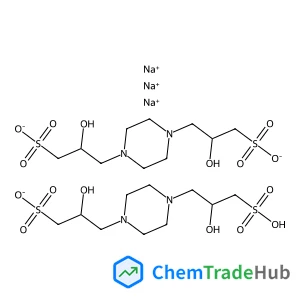
3,3'-(Piperazine-1,4-diyl)bis(2-hydroxypropane-1-sulfonic acid) Sodium Salt
CAS Number:
108321-08-0
Molecular Formula:
C20H41N4Na3O16S4

Recommended Suppliers





Disclaimer
This page provides academic journal information for reference and research purposes only. We are not affiliated with any journal publishers and do not handle publication submissions. For publication-related inquiries, please contact the respective journal publishers directly.
If you notice any inaccuracies in the information displayed, please contact us at support@chemtradehub.com. We will promptly review and address your concerns.