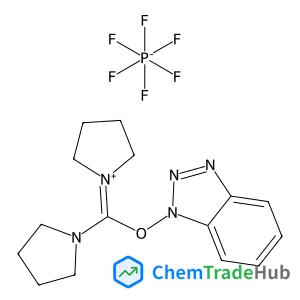
(1H-Benzotriazol-1-yloxy)(di-1-pyrrolidinyl)methylium hexafluorophosphate
CAS Number:
105379-24-6
Molecular Formula:
C15H21F6N5OP
The recombination of the HO radical with SO2 was studied in the bath gas helium at temperatures between 220 and 400 K and in the pressure range between 1 and 96 bar. HO radicals were generated by laser flash photolysis of CH4–O3 mixtures at 248 nm and their decay was detected using saturated laser induced fluorescence (SLIF) following excitation at 281 nm. Thermal second order rate constants were extracted from the SLIF–time profiles under pseudo-first order conditions. Due to our high pressure experiments we accessed a wide part of the falloff range which allowed for a reliable extrapolation towards the high pressure limiting rate constant. We constructed complete falloff curves at 220, 300 and 400 K incorporating the low-pressure experiments from the literature. From the temperature dependence of the high pressure limiting rate constant k1,∞=(1.2±0.3)×10-11 exp(-(360±100) K/T) cm3 molecule-1 s-1 we conclude on a small barrier for the recombination process. Taking into account this barrier, we express the temperature dependence of the low pressure limiting rate constants as k1,0=[He] (2.5±0.7)×10-32 (T/300 K)-(3.8±0.5) exp(-(360±100)K/T) cm6 molecule-2 s-1. With this new falloff analysis we reanalyzed the recombination rate constants in the literature for various third bodies (Ar, N2, O2, CO2, SO2, H2O and SF6), reliably extrapolated towards the corresponding low pressure limiting rate constants, and determined their collision efficiencies and the average energies 〈ΔE〉all transferred per collision. Implications for atmospheric chemistry are discussed.
Mariya Edeleva, Yoshi W. Marien, Paul H. M. Van Steenberge
DOI: 10.1039/D1PY00151E
Gokhan Sagdic, Ozgun Daglar, Ufuk Saim Gunay, Emrah Cakmakci, Gurkan Hizal, Umit Tunca, Hakan Durmaz
DOI: 10.1039/D1PY00726B
Jacob J. Lessard, Georg M. Scheutz, Angie B. Korpusik, Rebecca A. Olson, C. Adrian Figg, Brent S. Sumerlin
DOI: 10.1039/D1PY00208B
Katharina Breul, Sebastian Seiffert
DOI: 10.1039/D1PY00121C
Ioannis Moutsios, Konstantina Tsitoni, Gkreti-Maria Manesi, Nikos Hadjichristidis
DOI: 10.1039/D1PY00258A
Bingfeng Shi, Jianhua Lü, Ying Liu, Yang Xiao, Changli Lü
DOI: 10.1039/D1PY00308A
Zijuan Hai, Zhou Lu, Shuaikang Li, Zhong-Yan Cao, Shengyu Dai
DOI: 10.1039/D1PY00812A
Xiaojun Wang, Xueyan Zhang, Yong Wang, Shengtao Ding
DOI: 10.1039/D1PY00718A
When handling 4-(2-Furylmethyl)thiomorpholine 1,1-dioxide (CAS: 79206-94-3), it ...
When handling 4-Chloro-N-[2-(4-morpholinyl)ethyl]benzamide (CAS: 71320-77-9), it...
Waste containing this compound (CAS: 62921-74-8) should be handled according to ...
Waste containing (S)-Methyl 2-amino-3-cyclohexylpropanoate should be collected i...
This compound can be synthesized using a multi-step process involving the conjug...
There are several alternatives to (2E)-3-(3,4-Dichlorophenyl)acrylic acid in syn...
Ethyl 6-(2-nitrophenyl)imidazo[2,1-b][1,3]thiazole-3-carboxylate (CAS: 925437-84...
Waste containing 2-(1,3-Thiazol-2-yl)ethanamine (CAS: 18453-07-1) should be coll...
Methyl 5-iodo-2-methylbenzoate can be synthesized through the iodination of meth...
5-Chloro[1,2,4]triazolo[1,5-a]pyridine is commonly synthesized via the condensat...

Physical Chemistry Chemical Physics (PCCP) is an international journal co-owned by 19 physical chemistry and physics societies from around the world. This journal publishes original, cutting-edge research in physical chemistry, chemical physics and biophysical chemistry. To be suitable for publication in PCCP, articles must include significant innovation and/or insight into physical chemistry; this is the most important criterion that reviewers and Editors will judge against when evaluating submissions. The journal has a broad scope and welcomes contributions spanning experiment, theory, computation and data science. Topical coverage includes spectroscopy, dynamics, kinetics, statistical mechanics, thermodynamics, electrochemistry, catalysis, surface science, quantum mechanics, quantum computing and machine learning. Interdisciplinary research areas such as polymers and soft matter, materials, nanoscience, energy, surfaces/interfaces, and biophysical chemistry are welcomed if they demonstrate significant innovation and/or insight into physical chemistry. Joined experimental/theoretical studies are particularly appreciated when complementary and based on up-to-date approaches.