













Progress in Crystal Growth and Characterization of Materials
Basic Information
Brief Name:
PROG CRYST GROWTH CH
Impact Factor:
4.5
ISSN:
0960-8974
Research Field:
CHEMICAL
h-index:
41
Self-citation Rate:
4.4%
Articles per Year:
7
SCI Index Status:
Science Citation Index Expanded
Journal Website:
https://www.sciencedirect.com/journal/progress-in-crystal-growth-and-characterization-of-materials
Journal Introduction:
Materials especially crystalline materials provide the foundation of our modern technologically driven world. The domination of materials is achieved through detailed scientific research. Advances in the techniques of growing and assessing ever more perfect crystals of a wide range of materials lie at the roots of much of today's advanced technology. The evolution and development of crystalline materials involves research by dedicated scientists in academia as well as industry involving a broad field of disciplines including biology, chemistry, physics, material sciences and engineering. Crucially important applications in information technology, photonics, energy storage and harvesting, environmental protection, medicine and food production require a deep understanding of and control of crystal growth. This can involve suitable growth methods and material characterization from the bulk down to the nano-scale. The knowledge gained requires authentication by publication and peer review. Since the literature is expanding faster than almost any other comparable field of science, it has become increasingly important for the scientific community to fill the need for communication and rapid publication of review articles and conference reports in order to keep abreast of developments in this field. Besides allowing a fast extraction of the available literature and giving state-of the art overviews, the reviews are to inspire scientists across the disciplines and to stimulate "blue-sky thinking". Progress in Crystal Growth and Characterization of Materials is the only review journal on crystal growth and material assessment including novel applications as well as growth and characterization methods, and acts as a rapid publication medium for review articles and conference reports in the field. Emphasis on practical developments and problems ensures its importance also for scientists in industry. Notes to authors Note regarding self-submission Progress in Crystal Growth and Characterization of Materials is a review journal. The content is directly commissioned by the Editorial Board. If you wish to publish a review in the journal, please email to the journal box at jpcgcm@elsevier.com with the subject line "Proposition of a review - NAME". Your email must contain the following: Proposed title List of all authors and their affiliation(s) Corresponding author' name Corresponding author' email Cover letter Abstract Proposed date of submission Your proposal will be evaluated by the Editorial Board, and it will convey their decision directly to you. Progress in Crystal Growth and Characterization of Materials is a review journal. It doesn't publish research articles. If you wish to submit a research article, the Journal of Crystal Growth would be honored to consider the submission. Note regarding permissions Progress in Crystal Growth and Characterization of Materials now offers help with obtaining permissions for re-using figures and tables at the various publishers to authors of invited review papers. In order to make use of this service, please contact your publishing contact and provide a list of all material (including your own material) that is being re-used in your review article. This information will be forwarded to our Permissions helpdesk, who will obtain the necessary permissions on your behalf.
CiteScore
CiteScore
8.8
SJR
0.812
SNIP
1.53
| Subject | Rank | Percentile |
|---|---|---|
Physics and AstronomyCondensed Matter Physics |
48 / 434 | 89% |
Journal Statistics
Quarterly
Issues/Year
Time to first decision: 1days
Review time: 1days
Review Cycle
Article Processing Fee
Submission Information
Submission Website:
https://www.editorialmanager.com/jpcgcm/default2.aspxAccepted Types:
Invited review papers only
Related Articles
Modulation of physical properties of supramolecular hydrogels based on a hydrophobic core
Masashi Ohno, Shun Fujita, Kowichiro Saruhashi, Nobuhide Miyachi, Katsuaki Miyaji
2014-11-26
Paper
DOI: 10.1039/C4CP04395B
Magnetic and geometric anisotropy in particle-crosslinked ferrohydrogels
Lisa Roeder, Philipp Bender, Matthias Kundt, Andreas Tschöpe, Annette M. Schmidt
2014-11-17
Paper
DOI: 10.1039/C4CP04493B
Correction: High throughput first-principles calculations of bixbyite oxides for TCO applications
Nasrin Sarmadian, Rolando Saniz, Bart Partoens, Dirk Lamoen, Kalpana Volety, Guido Huyberechts, Johan Paul
2014-12-01
Correction
DOI: 10.1039/C4CP90183E
Complex behaviour of vacancy point-defects in SrRuO3 thin films
Henning Schraknepper, Christoph Bäumer, Regina Dittmann, Roger A. De Souza
2014-11-12
Paper
DOI: 10.1039/C4CP03632H
Morphology – composition correlations in carbon nanotubes synthesised with nitrogen and phosphorus containing precursors
Rebecca J. Nicholls, Zabeada Aslam, Michael C. Sarahan, Ana M. Sanchez, Frank Dillon, Antal A. Koós, Nicole Grobert
2014-11-21
Paper
DOI: 10.1039/C4CP04272G
The role of Schottky barrier in the resistive switching of SrTiO3: direct experimental evidence
Xue-Bing Yin, Zheng-Hua Tan, Xin Guo
2014-11-07
Communication
DOI: 10.1039/C4CP04151H
Intermediates caught in the act: tracing insulin amyloid fibril formation in time by combined optical spectroscopy, light scattering, mass spectrometry and microscopy
A. Gladytz, T. Häupl, K. R. Siefermann
2014-11-12
Paper
DOI: 10.1039/C4CP03072A
Reverse hydrotropy by complex formation
Kamil Wojciechowski, Thomas Gutberlet, Vikram Singh Raghuwanshi, Ann Terry
2014-10-16
Paper
DOI: 10.1039/C4CP03835E
Electronic structure aspects of the complete O2 transfer reaction between Ni(ii) and Mn(ii) complexes with cyclam ligands
Jhon Zapata-Rivera, Rosa Caballol, Carmen J. Calzado
2014-12-05
Paper
DOI: 10.1039/C4CP05127K
You might also like
Compound Q&A
What is Ethyl 3-cyclohexylpropanoate (CAS: 10094-36-7)?
Ethyl 3-cyclohexylpropanoate is a clear, colorless to light yellow liquid with a...
10094-36-7Ethyl 3-cyclohexylpr...
Compound Q&A
How should waste containing 2-(Hydroxymethyl)-5-(methoxycarbonyl)-6-methyl-4-(2-nitrophenyl)nicotinic acid (CAS: 34783-31-8) be handled?
Waste containing 2-(Hydroxymethyl)-5-(methoxycarbonyl)-6-methyl-4-(2-nitrophenyl...
34783-31-82-(Hydroxymethyl)-5-...
Compound Q&A
How should waste containing 2,4,6-Tris(pentafluoroethyl)-1,3,5-triazine (CAS: 858-46-8) be handled?
Waste containing 2,4,6-Tris(pentafluoroethyl)-1,3,5-triazine (CAS: 858-46-8) sho...
858-46-82,4,6-Tris(pentafluo...
Compound Q&A
What precautions should be taken when handling Chloroac-nle-oh (CAS: 56787-36-1)?
When handling Chloroac-nle-oh (CAS: 56787-36-1), it is essential to wear appropr...
56787-36-1Chloroac-nle-oh
Compound Q&A
What industries use Ethyl 6-phenylimidazo[2,1-b][1,3]thiazole-3-carboxylate (CAS: 752244-05-6)?
Ethyl 6-phenylimidazo[2,1-b][1,3]thiazole-3-carboxylate is primarily used in the...
752244-05-6Ethyl 6-phenylimidaz...
Compound Q&A
Are there alternatives to alpha-(2-Bromophenyl)benzylamine (CAS: 55095-15-3) in synthesis?
Alternatives to alpha-(2-Bromophenyl)benzylamine (CAS: 55095-15-3) in synthesis ...
55095-15-3alpha-(2-Bromophenyl...
Compound Q&A
How should waste containing 2-Chloro-5-methoxypyridine (CAS: 139585-48-1) be handled?
Waste containing 2-Chloro-5-methoxypyridine (CAS: 139585-48-1) should be managed...
139585-48-12-Chloro-5-methoxypy...
Compound Q&A
What industries use 1-(4-Methoxyphenyl)-2,5-dimethyl-1H-pyrrole (CAS: 5044-27-9)?
1-(4-Methoxyphenyl)-2,5-dimethyl-1H-pyrrole (CAS: 5044-27-9) is used in various ...
5044-27-91-(4-Methoxyphenyl)-...
Compound Q&A
Are there alternatives to 3-Bromo-5-(N-Boc)aminomethylisoxazole (CAS: 903131-45-3) in synthesis?
There are alternative reagents and compounds that can be used in the synthesis o...
903131-45-33-Bromo-5-(N-Boc)ami...
Compound Q&A
What is Tungsten(IV) oxide (CAS: 12036-22-5)?
Tungsten(IV) oxide, also known as tungsten dioxide, is a chemical compound with ...
12036-22-5Tungsten(IV) oxide
Recommended Compounds



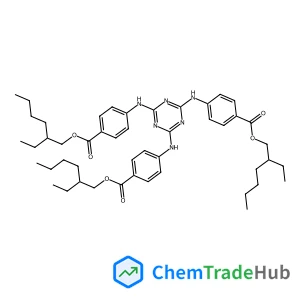
Tris(2-ethylhexyl) 4,4',4''-(1,3,5-triazine-2,4,6-triyltriimino)tribenzoate
CAS Number:
88122-99-0
Molecular Formula:
C48H66N6O6


Recommended Suppliers





Disclaimer
This page provides academic journal information for reference and research purposes only. We are not affiliated with any journal publishers and do not handle publication submissions. For publication-related inquiries, please contact the respective journal publishers directly.
If you notice any inaccuracies in the information displayed, please contact us at support@chemtradehub.com. We will promptly review and address your concerns.