Compound Q&A

What regulatory guidelines apply to Pituitary adenylate cyclase-activating peptide (CAS: 137061-48-4)?

Answer
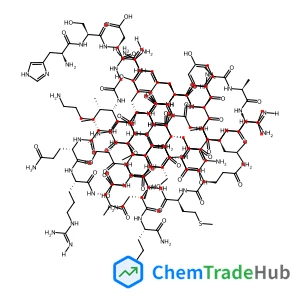
Pituitary adenylate cyclase-activating peptide
Pituitary adenylate cyclase-activating peptide (PACAP, CAS: 137061-48-4) is subject to various regulatory guidelines depending on its intended use. In the EU, it falls under REACH regulations for chemical safety and environmental protection. In the USA, it is regulated by the FDA for pharmaceuticals and EPA for environmental releases. This peptide should be handled according to GHS classification for safe transport and storage.

About

English Name Pituitary adenylate cyclase-activating peptide
Molecular Formula C203H331N63O53S1
Molecular Weight 4534.26 g/mol
SMILES [H]/N=C(/NCCC[C@@H](C(N[C@H](C(N[C@H](C(N[C@H](C(N[C@H](C(N[C@H](C(N[C@H](C(N[C@H](C(N[C@H](C(=O)N)CCCCN)=O)CC(=O)N)=O)CCCCN)=O)C(C)C)=O)CCCN/C(=N/[H])/N)=O)CCC(=O)N)=O)CCCCN)=O)CC1=CC=C(O)C=C1)=O)NC([C@@H](NC(CNC([C@@H](NC([C@H](C(C)C)NC([C@@H](NC([C@@H](NC([C@@H](NC([C@@H](NC([C@@H](NC([C@@H](NC([C@H](C(C)C)NC([C@@H](NC([C@@H](NC([C@@H](NC([C@@H](NC([C@@H](NC([C@@H](NC([C@@H](NC([C@@H](NC([C@@H](NC([C@@H](NC([C@@H](NC([C@H]([C@H](O)C)NC([C@@H](NC([C@H]([C@H](CC)C)NC(CNC([C@@H](NC([C@@H](NC([C@H](CC1N=CNC=1)N)=O)CO)=O)CC(=O)O)=O)=O)=O)CC1=CC=CC=C1)=O)=O)CC(=O)O)=O)CO)=O)CC1=CC=C(O)C=C1)=O)CO)=O)CCCN/C(=N/[H])/N)=O)CC1=CC=C(O)C=C1)=O)CCCN/C(=N/[H])/N)=O)CCCCN)=O)CCC(=O)N)=O)CCSC)=O)C)=O)=O)CCCCN)=O)CCCCN)=O)CC1=CC=C(O)C=C1)=O)CC(C)C)=O)C)=O)C)=O)=O)CC(C)C)=O)=O)CCCCN)=O)\N
InChIKey UFTCZKMBJOPXDM-XXFCQBPRSA-N
Last Updated: 2025-10-23 12:19

Related Q&A

Compound Q&A

Are there alternatives to Pituitary adenylate cyclase-activating peptide (CAS: 137061-48-4) in synthesis?

For synthesis, alternatives to Pituitary adenylate cyclase-activating peptide (PACAP, CAS: 137061-48...

Compound Q&A

What is the market or research trend for Pituitary adenylate cyclase-activating peptide (CAS: 137061-48-4)?

The market for Pituitary adenylate cyclase-activating peptide (PACAP, CAS: 137061-48-4) is growing d...

Compound Q&A

How should waste containing Pituitary adenylate cyclase-activating peptide (CAS: 137061-48-4) be handled?

Waste containing Pituitary adenylate cyclase-activating peptide (PACAP, CAS: 137061-48-4) should be ...

Compound Q&A

How should waste containing N-Methoxy-N-methyl-1,3-thiazole-5-carboxamide (CAS: 898825-89-3) be handled?

Waste containing N-Methoxy-N-methyl-1,3-thiazole-5-carboxamide (CAS: 898825-89-3...

898825-89-3N-Methoxy-N-methyl-1...
Compound Q&A

How should N-(4-Biphenylyl)dibenzo[b,d]furan-4-amine (CAS: 1318338-47-4) be stored?

N-(4-Biphenylyl)dibenzo[b,d]furan-4-amine should be stored in a tightly sealed c...

1318338-47-4N-(4-Biphenylyl)dibe...
Compound Q&A

What is the market or research trend for 3-Acetamido-5-amino-2,4,6-triiodobenzoic acid (CAS: 1713-07-1)?

The market for 3-Acetamido-5-amino-2,4,6-triiodobenzoic acid (CAS: 1713-07-1) is...

1713-07-13-Acetamido-5-amino-...
Compound Q&A

How should Benzyl 2-O-acetyl-3,4,6-tri-O-benzyl-beta-D-galactopyranoside (CAS: 61820-03-9) be stored?

Benzyl 2-O-acetyl-3,4,6-tri-O-benzyl-beta-D-galactopyranoside (CAS: 61820-03-9) ...

61820-03-9Benzyl 2-O-acetyl-3,...