Compound Q&A
What are the physical and chemical properties of trans-4-Phenyl-L-proline hydrochloride (CAS: 90657-53-7)?
Answer
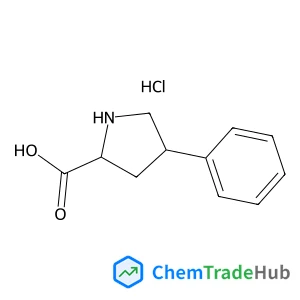
Trans-4-Phenyl-L-proline hydrochloride is a white crystalline solid with a molecular weight of approximately 237.24 g/mol. It is slightly soluble in water and ethanol. Chemically, it is stable under normal conditions but can react with strong bases to form the corresponding amine. Its reactivity is moderate, making it useful in various synthetic applications.
About
CAS No
90657-53-7
English Name
trans-4-Phenyl-L-proline hydrochloride
Molecular Formula
C11H14ClNO2
Molecular Weight
227.69 g/mol
SMILES
C1C(CNC1C(=O)O)C2=CC=CC=C2.Cl
InChIKey
LWFBRHSTNWMMGN-UXQCFNEQSA-N
Last Updated: 2025-10-23 07:31