Compound Q&A
What are the physical and chemical properties of 3-Bromo-2-thiophenecarboxylic acid (CAS: 7311-64-0)?
Answer
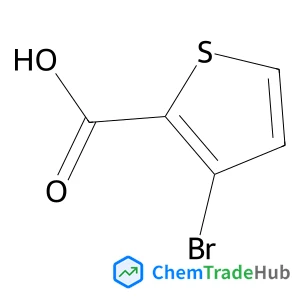
3-Bromo-2-thiophenecarboxylic acid is a white crystalline solid with a molecular weight of approximately 214.03 g/mol. It has a melting point of 135-136°C and is slightly soluble in water. It is reactive towards nucleophiles and can undergo substitution reactions. The compound is stable under normal conditions but should be stored in a dry, cool place away from direct sunlight.
About
CAS No
7311-64-0
English Name
3-Bromo-2-thiophenecarboxylic acid
Molecular Formula
C5H3BrO2S
Molecular Weight
207.05 g/mol
SMILES
C1=CSC(=C1Br)C(=O)O
InChIKey
VQQLWBUTTMNMFT-UHFFFAOYSA-N
Last Updated: 2025-10-01 21:42