

Compound Q&A

How should Tartaric acid (CAS: 868-14-4) be stored?

Answer
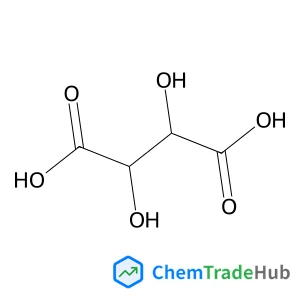
Tartaric acid
Tartaric acid (CAS: 868-14-4) should be stored in a cool, dry, and well-ventilated place, away from direct sunlight. It is best kept in a sealed container to prevent moisture absorption and maintain stability. The ideal storage temperature is below 25°C, and humidity levels should be low. It is important to store it in a location that is inaccessible to children and not in proximity to incompatible substances to ensure long-term safety and effectiveness.

About

CAS No 868-14-4
English Name Tartaric acid
Molecular Formula C4H6O6
Molecular Weight 150.08599999999998 g/mol
SMILES C(C(C(=O)O)O)(C(=O)O)O
InChIKey FEWJPZIEWOKRBE-UHFFFAOYSA-N
Last Updated: 2025-08-25 01:07

Related Q&A

Compound Q&A

What is Tartaric acid (CAS: 868-14-4)?

Tartaric acid (CAS: 868-14-4) is a dicarboxylic acid with the chemical formula C4H6O6. It is natural...

Compound Q&A

What are the main uses of Tartaric acid (CAS: 868-14-4)?

Tartaric acid (CAS: 868-14-4) is widely used in the food industry as a souring agent and antioxidant...

Compound Q&A

Is Tartaric acid (CAS: 868-14-4) safe?

Tartaric acid (CAS: 868-14-4) is generally considered safe when used in appropriate amounts. It is a...

Compound Q&A

Are there alternatives to 1-(4-Chlorophenyl)-N-hydroxymethanimine (CAS: 3848-36-0) in synthesis?

When considering alternatives to 1-(4-Chlorophenyl)-N-hydroxymethanimine (CAS: 3...

3848-36-01-(4-Chlorophenyl)-N...
Compound Q&A

How is 3-(4-Bromophenyl)-5-(2-fluorophenyl)-1,2,4-oxadiazole (CAS: 419553-16-5) typically synthesized?

3-(4-Bromophenyl)-5-(2-fluorophenyl)-1,2,4-oxadiazole is synthesized through a m...

419553-16-53-(4-Bromophenyl)-5-...
Compound Q&A

How is 5-Chloro-2-(4-chlorophenyl)-4-methyl-6-[3-(1-piperidinyl)propoxy]pyrimidine (CAS: 1639220-19-1) typically synthesized?

5-Chloro-2-(4-chlorophenyl)-4-methyl-6-[3-(1-piperidinyl)propoxy]pyrimidine (CAS...

1639220-19-15-Chloro-2-(4-chloro...